
Explore the Exoplanet Detection Lab: Transit & Radial
Tune a planet's size, mass and orbit and see whether the transit dip or the radial-velocity wobble is strong enough to detect above real instrument noise.
- Free to use
- No signup
- Nothing to install
- Runs in your browser
Illustration. Open the tool for the real thing.
See it in action
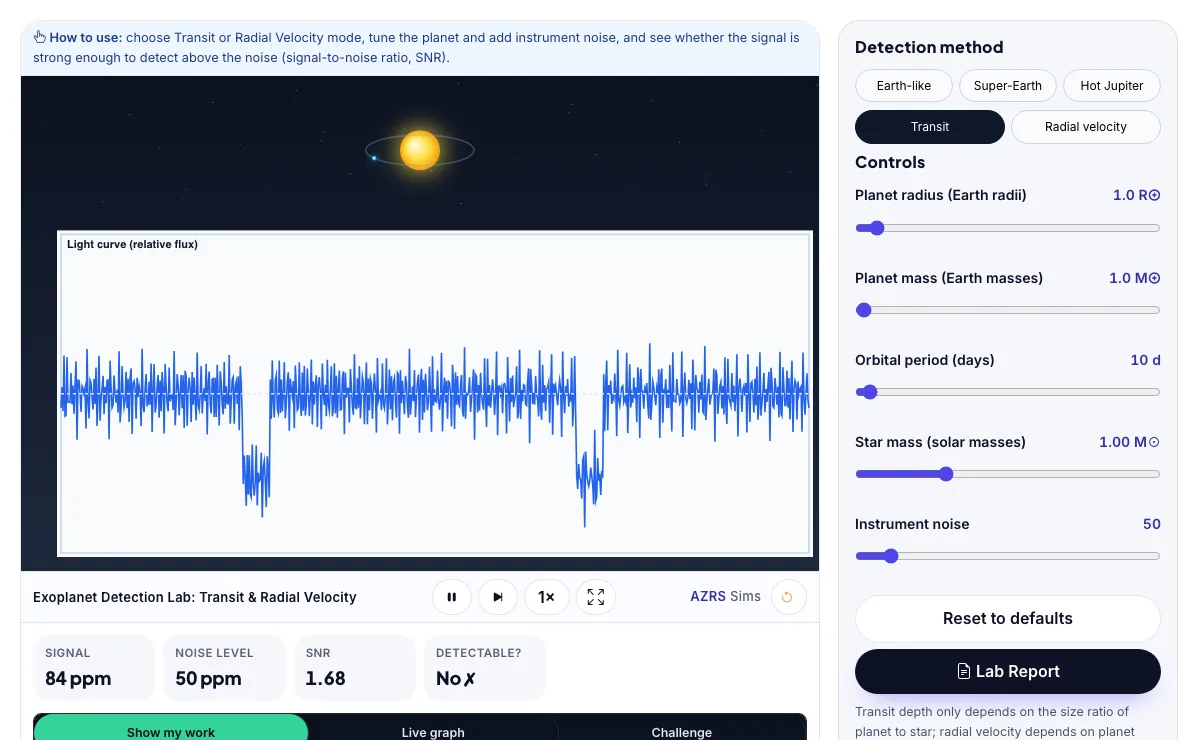
The Exoplanet Detection Lab: Transit & Radial with sample data entered and the result showing.
What is the Exoplanet Detection Lab: Transit & Radial?
Tune a planet's size, mass and orbit and see whether the transit dip or the radial-velocity wobble is strong enough to detect above real instrument noise. It runs in your browser, so a change to a setting or a drag on an object shows up at once.
Missions like Kepler and TESS use the transit method to find thousands of candidate planets, while ground-based spectrographs use the radial-velocity method to confirm planet masses - exactly the two techniques modeled here.
3 steps to your result
Open the tool and follow along. Nothing to install.
What you get
The transit method measures a dip in starlight: depth = (R_planet / R_star)², so a Jupiter-sized planet blocks far more light than an Earth-sized one around the same star.
The radial-velocity method measures the star's own tiny wobble caused by the planet's gravity, with amplitude K depending on planet mass, orbital period and star mass.
A signal only counts as a real detection when it clears the noise by enough - astronomers typically require a signal-to-noise ratio (SNR) of at least 3.
In Transit mode, shrink the planet to Earth-size and watch the SNR readout fall.
In Radial Velocity mode, shorten the orbital period and see the RV signal grow.
Raise the noise slider until an easily-detectable planet becomes undetectable.
Used for
Pick one to see how it fits.
Teachers
For teachers: project the Exoplanet Detection Lab: Transit & Radial Velocity on the board, let students predict the result, then run it together and test this: In Radial Velocity mode, shorten the orbital period and see the RV signal grow. For students: change one thing at a time and write down what changes.
Try it freeHow it compares
A plain look at this tool next to the usual alternative.
| This simulation | Textbook diagram | |
|---|---|---|
| Interactive | Drag, tap and change settings | Fixed picture |
| Install | Nothing to install | Not needed |
| Cost | Free to use | Depends on the book |
Questions people ask
Why is Earth-sized planet harder to detect than a Jupiter-sized one by transit?
Transit depth scales with the square of the radius ratio, so a Jupiter-sized planet (about 11 Earth radii) produces a dip over 100 times deeper than an Earth-sized planet around the same star, far easier to spot above instrument noise.
Why do 'hot Jupiters' dominate early radial-velocity discoveries?
RV semi-amplitude grows with planet mass and shrinks with orbital period, so a massive planet in a very short, close orbit around its star produces the largest, easiest-to-detect stellar wobble.
Is the Exoplanet Detection Lab: Transit & Radial Velocity free to use?
Yes. The Exoplanet Detection Lab: Transit & Radial Velocity is free, needs no signup or download and runs in your web browser. It is part of the Astronomy group of AZRS simulations.
Does the Exoplanet Detection Lab: Transit & Radial Velocity work on a phone or tablet?
Yes. The Exoplanet Detection Lab: Transit & Radial Velocity takes touch input as well as mouse input, so you can use its 5 adjustable settings with a finger. A larger screen makes the controls and graphs easier to read.
How do I use the Exoplanet Detection Lab: Transit & Radial?
1. In the Exoplanet Detection Lab: Transit & Radial Velocity, use the controls to change Planet radius (Earth radii), Planet mass (Earth masses), Orbital period (days), Star mass (solar masses), Instrument noise. The simulation reacts instantly. 2. Start with this experiment: In Transit mode, shrink the planet to Earth-size and watch the SNR readout fall. Drag any glowing handle, object or slider with your mouse or finger and the Exoplanet Detection Lab: Transit & Radial Velocity responds in real time. 3. Change one setting at a time and watch which readout moves, then compare it with this idea: The transit method measures a dip in starlight: depth = (R_planet / R_star)², so a Jupiter-sized planet blocks far more light than an Earth-sized one around the same star.
More free tools
Related to the Exoplanet Detection Lab: Transit & Radial.
Try the Exoplanet Detection Lab: Transit & Radial now
Tune a planet's size, mass and orbit and see whether the transit dip or the. Free to use.
Try it free