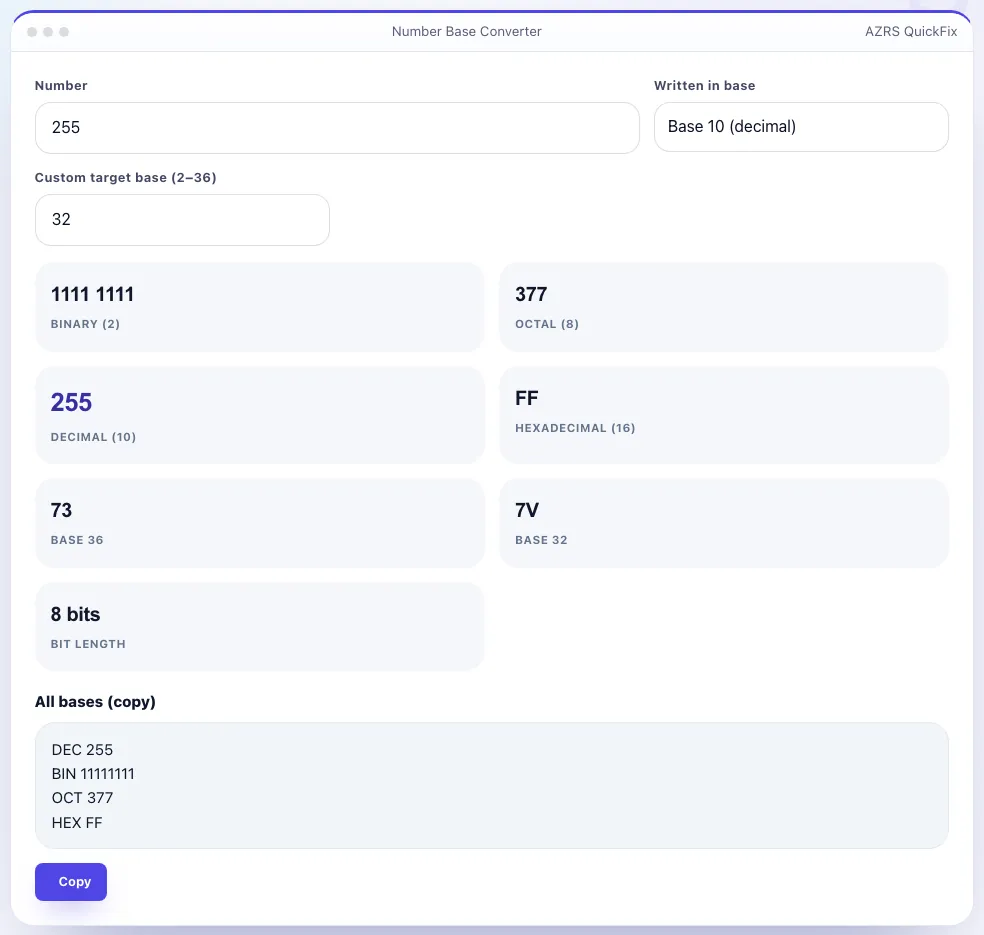
Number Base Converter
Binary, octal, decimal, hex & any base 2–36.
More free tools
How Number Base Converter works, step by step
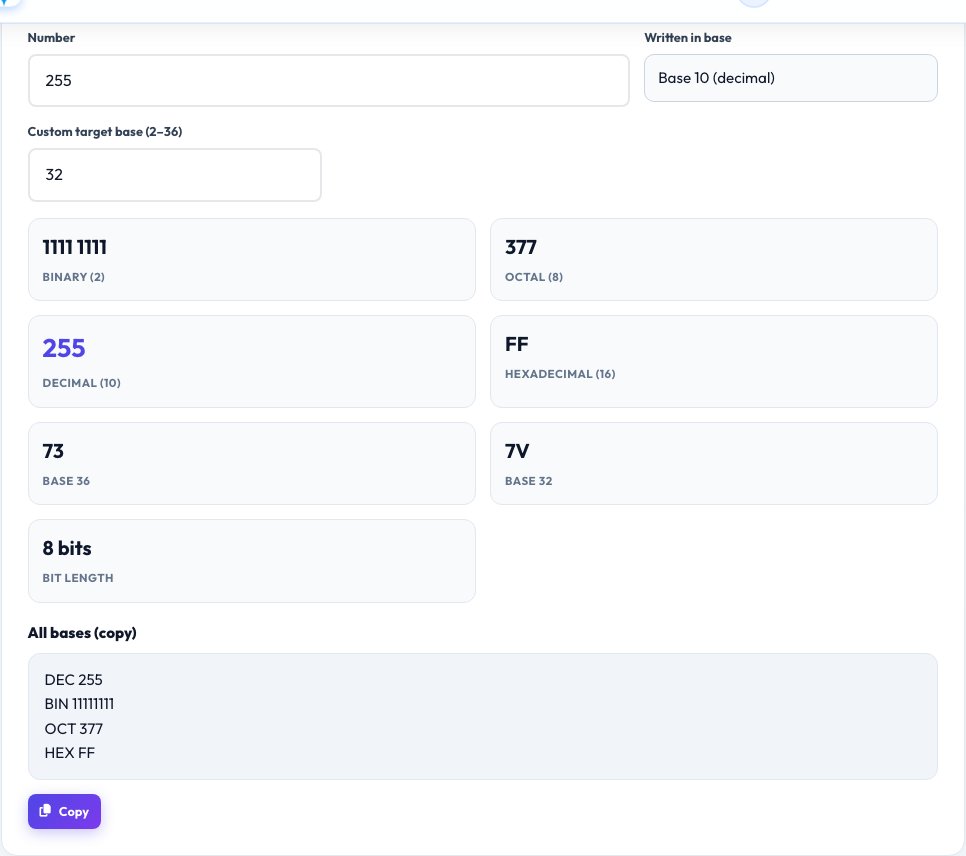
Type the number.
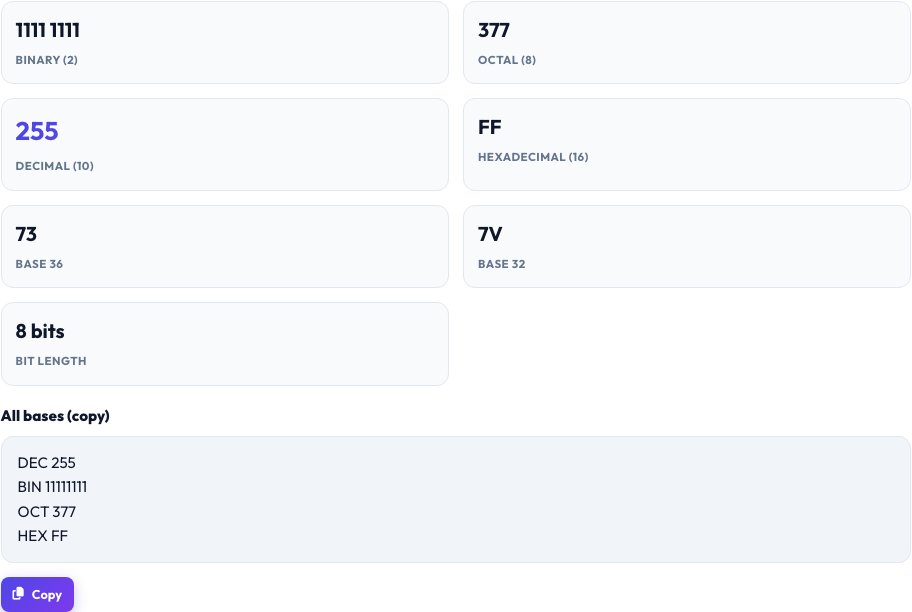 Download it
Select the base it is written in.
Free Number Base Converter — Binary, Octal, Decimal, Hexadecimal and More
Computers work in binary (base 2), programmers read memory in hexadecimal (base 16), Unix permissions use octal (base 8) and people count in decimal (base 10). A number base converter translates a value between these systems — and any other base from 2 up to 36.
Enter a number, choose the base it is written in, and see it in binary, octal, decimal, hexadecimal and base 36 at once, plus a custom base of your choice. It uses exact big-integer arithmetic, so even very long numbers convert without rounding errors, and it also shows the bit length.
Use it in 4 steps
Type the number.
Select the base it is written in.
Read the equivalent in every other base.
Copy the value you need.
Key features
All bases at once
Binary, octal, decimal, hex and base 36 side by side.
Any base 2–36
Pick a custom target base.
Big numbers
Exact arithmetic for very long values.
Bit length
See how many bits the number needs.
A real example, step by step
FF (hex) = 255 (decimal)
1010 (binary) = 10 (decimal)
Who uses this tool
Programmers
Convert addresses, colours, flags and bit masks.
Computer-science students
Check number-system homework.
Electronics hobbyists
Work with binary and hex registers.
Tips for the best results
- Hex digits above 9 are A–F (case insensitive).
- Binary numbers only use 0 and 1.
- Count bits to see whether a value fits in 8, 16, 32 or 64 bits.
- Use base 36 for compact IDs.
Common mistakes to avoid
- Entering digits that do not exist in the chosen base (for example 2 in binary).
- Confusing decimal 10 with binary 10.
- Forgetting that leading zeros do not change the value.
Frequently asked questions
How do I convert binary to decimal?
Multiply each digit by its power of two and add the results.
What is hexadecimal used for?
A compact way to write binary — each hex digit equals four bits.
What bases are supported?
Every base from 2 to 36.
Does it support negative numbers?
Yes, a leading minus sign is kept.
How big can the number be?
Very large; exact arithmetic is used.
Is it free?
Yes.
Free, fast and private by design
No signup, no watermark. New AZRS tools are added every week.