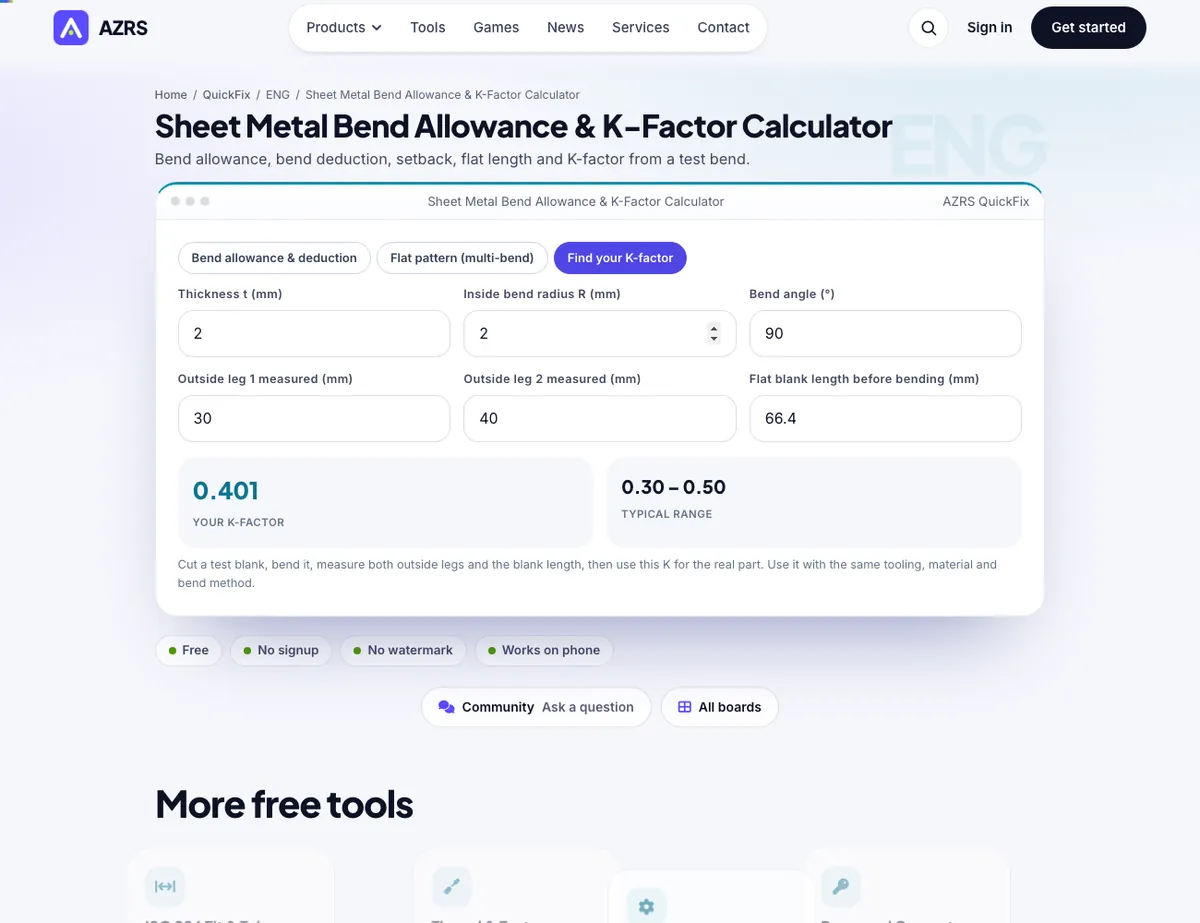
Sheet Metal Bend Allowance & K-Factor Calculator
Bend allowance, bend deduction, setback, flat length and K-factor from a test bend.
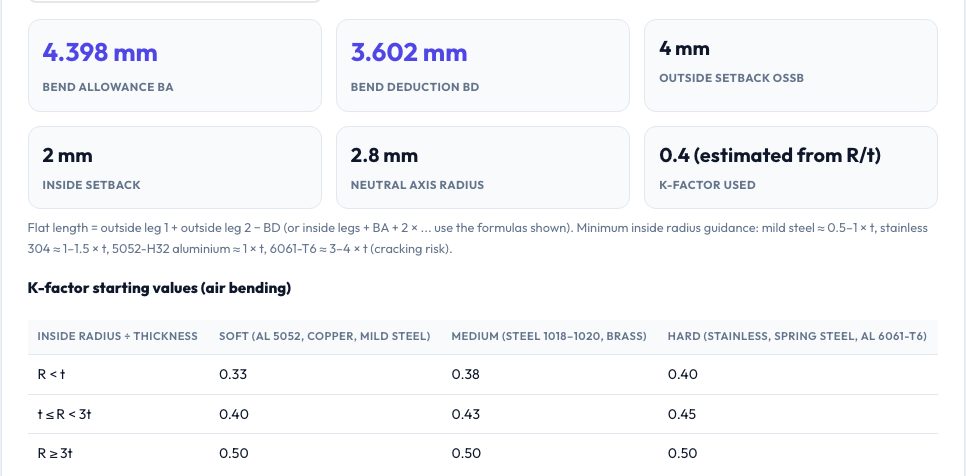
| Inside radius ÷ thickness | Soft (Al 5052, copper, mild steel) | Medium (steel 1018–1020, brass) | Hard (stainless, spring steel, Al 6061-T6) |
|---|---|---|---|
| R < t | 0.33 | 0.38 | 0.40 |
| t ≤ R < 3t | 0.40 | 0.43 | 0.45 |
| R ≥ 3t | 0.50 | 0.50 | 0.50 |
More free tools
See Sheet Metal Bend Allowance & K-Factor Calculator in action
Free Sheet Metal Bend Allowance Calculator
When sheet metal is bent, the inside compresses and the outside stretches, and a neutral line stays the same length. The bend allowance is the length of that neutral line in the bend: BA = θ·(R + K·t), where θ is the bend angle in radians, R the inside radius, t the thickness and K the K-factor (the neutral axis position as a fraction of the thickness). From it follow the bend deduction (BD = 2·OSSB − BA), the outside setback (OSSB = (R + t)·tan(θ/2)) and the flat blank length of a part with several bends.
The first tab computes BA, BD, setbacks and the neutral radius, estimating K from the R/t ratio if you leave it at zero. The second builds a flat pattern from the outside leg lengths and bend angles of up to ten flanges. The third derives your actual K-factor from a test piece — bend a blank, measure its outside legs and the original flat length — which removes the guesswork for your brake, tooling and material.
Use it in 4 steps
Enter thickness, inside radius and angle.
Use the estimated K or enter your own.
Build the flat length in the Flat pattern tab.
Calibrate K with a test bend if tolerances are tight.
Key features
Allowance, deduction, setback
All the standard bend quantities for any angle and radius.
Multi-bend flat pattern
Up to ten flanges with individual angles.
K-factor finder
Calculate K from a measured test bend.
Starting values
K-factor table by R/t and material hardness; minimum radius guidance.
A real example, step by step
2 mm steel, 2 mm inside radius, 90°, K = 0.4: BA = 4.40 mm, outside setback 4.00 mm, BD = 3.60 mm. A part with outside legs 30 + 40 mm needs a flat blank of 66.4 mm.
Who uses this tool
Sheet-metal students and designers
Flat-pattern calculations for CAD and drawings.
Fabricators
Cut blanks accurately before bending.
Makers with a brake
Calibrate K for their own tooling.
Tips for the best results
- Bend a scrap test piece first for critical dimensions.
- Respect the minimum bend radius to avoid cracking.
- Keep flanges longer than about 4 × thickness.
- K-factor depends on tooling and method (air vs bottoming).
Common mistakes to avoid
- Mixing outside and inside dimensions.
- Using 90° when the machine's 'bend angle' means the included angle.
- Assuming one K-factor fits every material and radius.
Frequently asked questions
What is the K-factor?
The ratio of the neutral axis distance from the inside surface to the thickness (0 to 0.5).
Bend allowance vs deduction?
Allowance is the neutral-line length in the bend; deduction is subtracted from the sum of outside legs.
What angle do I enter?
The angle the material is bent through (90° for a right angle).
Is it exact?
It follows the standard formulas; real parts depend on K, which you can calibrate.
Free, fast and private by design
No signup, no watermark. New AZRS tools are added every week.