Pipe Flow & Pressure Drop Calculator (Darcy–Weisbach)
Velocity, Reynolds number, friction factor, head loss, pressure drop and pump power for pipe flow · free, no signup
See Pipe Flow & Pressure Drop Calculator (Darcy–Weisbach) in action
Free Pipe Flow & Pressure Drop Calculator
Sizing a pipe or pump starts with the pressure drop for a given flow. This calculator uses the Darcy–Weisbach equation, the engineering standard: Δp = f·(L/D)·ρv²/2 plus minor losses ΣK·ρv²/2 and any elevation change. Enter the flow rate (L/s, L/min, m³/h, US gpm or m³/s), the inside diameter, the length, the pipe material (a roughness table from drawn tubing and PVC to riveted steel) or a custom roughness, the fluid (water at five temperatures, seawater, air or glycerin, or your own density and viscosity), the sum of fitting loss coefficients, the elevation rise and the pump efficiency.
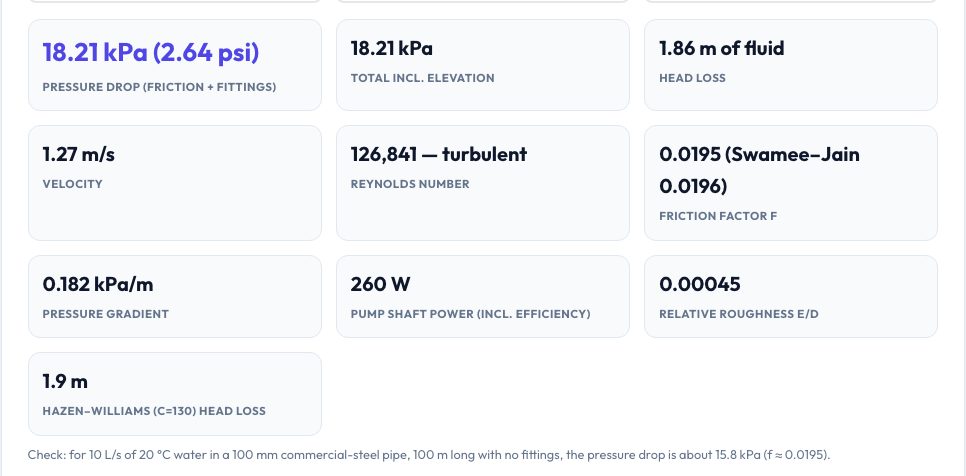
It returns the velocity, the Reynolds number and the flow regime, the friction factor from 64/Re for laminar flow or the Colebrook–White equation for turbulent flow (with the Swamee–Jain explicit formula as a cross-check), the head loss, the pressure drop in kPa and psi and per metre, and the pump power. For water pipes a Hazen–Williams comparison is shown and warnings flag velocities above 3 m/s, transitional flow and very low velocities. For 10 L/s of 20 °C water in 100 m of 100 mm commercial steel pipe the pressure drop is about 15.8 kPa.
Key features
Darcy–Weisbach with Colebrook
Laminar and turbulent friction factors, Swamee–Jain cross-check.
Fluids and materials
Presets for water, seawater, air, glycerin and common pipe roughness.
Minor losses and elevation
Fittings ΣK and height change included.
Pump power
Hydraulic power from pressure and flow, with efficiency.
How to use it
- Enter flow rate, diameter, length and roughness.
- Choose the fluid or enter its properties.
- Add fitting losses and elevation rise.
- Read pressure drop, velocity and pump power.
Worked example
Example
10 L/s of 20 °C water through 100 m of 100 mm commercial-steel pipe has a velocity of 1.27 m/s, Reynolds number 126,800, friction factor 0.0195 and a pressure drop of 15.8 kPa (1.61 m of head).
Who uses this tool
Plumbers and designers
Size water and process piping.
Engineering students
Check fluid mechanics homework.
Pump selectors
Estimate the head a pump must overcome.
Tips for the best results
- Keep water velocity between 0.5 and 3 m/s for most pipework.
- Use inside diameter, not nominal size.
- Add 10–20% roughness margin for ageing pipes.
- Use consistent units — the tool converts flow for you.
Common mistakes to avoid
- Using the nominal diameter instead of the inside diameter.
- Ignoring fittings in short pipe runs.
- Trusting laminar–turbulent transition results.
Why use AZRS QuickFix?
It is 100% free, needs no signup and has no watermark or usage limits. The tool runs in your browser, so what you type stays on your device, and it works on phones, tablets and desktops. New tools are added every week — bookmark this page or browse the full QuickFix toolbox.
Frequently asked questions
What is the Colebrook equation?
The implicit equation for turbulent friction factor, solved iteratively here.
Is Hazen–Williams better?
It is simpler and only valid for water at normal temperatures.
Does it handle gases?
Incompressible flow only; fine for air at low pressure drops.
Is it free?
Yes.