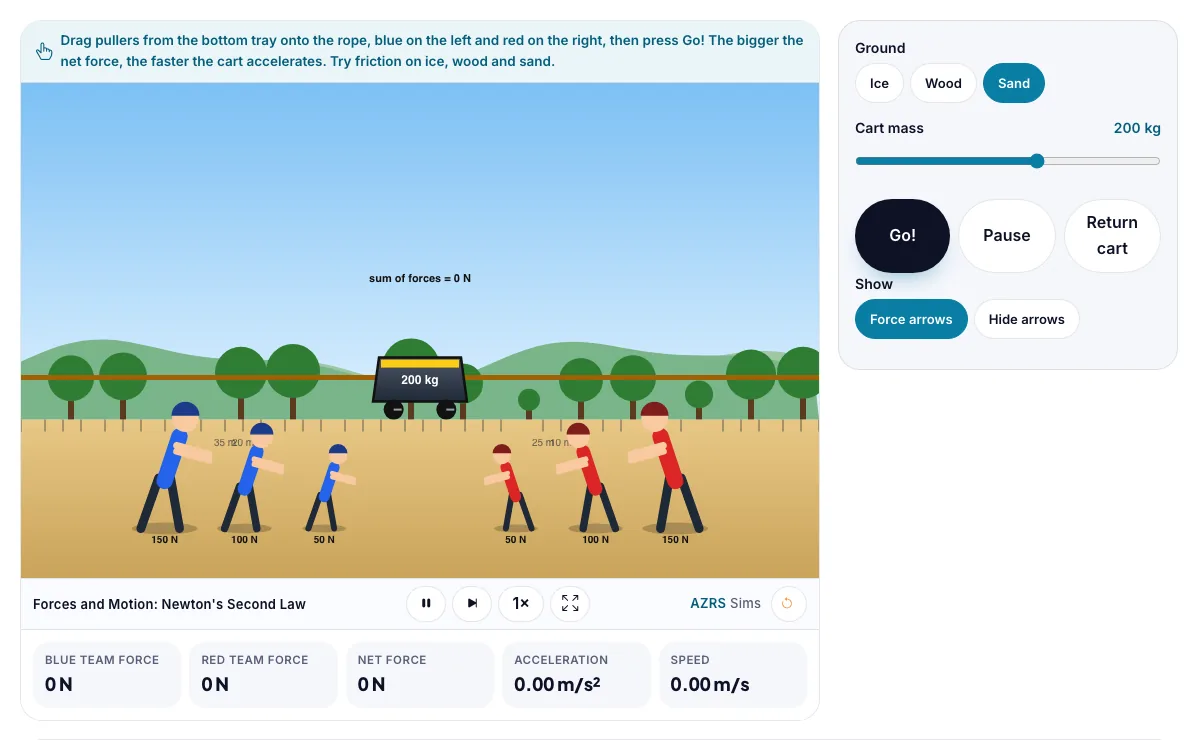
Forces and Motion: Newton's Second Law
Push a cart with different forces and friction and see acceleration, speed and net force.
Drag pullers from the bottom tray onto the rope, blue on the left and red on the right, then press Go! The bigger the net force, the faster the cart accelerates. Try friction on ice, wood and sand.
What the Forces and Motion: Newton's Second Law shows
Push a cart with different forces and friction and see acceleration, speed and net force. Free, no signup, runs in your browser. Built for physics, the forces and motion: newton's second law runs instantly in your browser: change a setting or drag an object and the result updates at once, so you learn by trying things out rather than only reading about them.
A cart is pushed with different forces and friction. Acceleration depends on the net force and the mass.
How to use the Forces and Motion: Newton's Second Law
In the Forces and Motion: Newton's Second Law, use the controls to change Ground, Cart mass. The simulation reacts instantly.
In the Forces and Motion: Newton's Second Law, pick an option such as Ice, Wood, Sand, Force arrows to switch modes or load an example.
In the Forces and Motion: Newton's Second Law, press "Go!", "Pause", "Return cart" to start, reset or change what is happening.
Start with this experiment: Push with 300 N on ice and on sand. Drag any glowing handle, object or slider with your mouse or finger and the Forces and Motion: Newton's Second Law responds in real time.
Change one setting at a time and watch which readout moves, then compare it with this idea: Net force = mass × acceleration.
Things to try
Push with 300 N on ice and on sand.
Double the mass.
Push, then set the force to zero and watch on ice.
The science behind it
Net force = mass × acceleration.
Friction opposes motion.
Without friction, a moving cart keeps moving.
A bigger mass accelerates less for the same force.
A worked example with real numbers
F_net = 100 - 40 = 60 N
a = 60 / 20 = 3 m/s2
After 4 s: v = 12 m/s
Tips and common mistakes
Tips
- Set the force equal to friction and watch the cart move at constant speed.
- Double the mass with the same push and the acceleration halves.
Common mistakes
- Thinking a force is needed to keep moving; only to change the motion.
- Using the applied force rather than the net force.
Where this is used
Vehicle design, safety and sport all depend on F = ma and friction.
Who is this simulation for?
Physics students in middle school, high school and first-year university, teachers who want a quick demonstration for the projector, and anyone revising for exams. A good first experiment in the Forces and Motion: Newton's Second Law: Push with 300 N on ice and on sand. The key relation to keep an eye on: F_net = m a, so a = F_net / m.
For teachers: project the Forces and Motion: Newton's Second Law on the board, let students predict the result, then run it together and test this: Double the mass. For students: change one thing at a time and write down what changes.
Frequently asked questions
What is net force?
The sum of all forces on an object. It decides the acceleration.
Why does the cart stop on sand?
Friction is large, so the net force is opposite the motion and slows it.
Is the Forces and Motion: Newton's Second Law free to use?
Yes. The Forces and Motion: Newton's Second Law is free, needs no signup or download and runs in your web browser. It is part of the Physics group of AZRS simulations.
Does the Forces and Motion: Newton's Second Law work on a phone or tablet?
Yes. The Forces and Motion: Newton's Second Law takes touch input as well as mouse input, so you can use its 2 adjustable settings with a finger. A larger screen makes the controls and graphs easier to read.