Blood Flow & Circulatory System Simulator
Follow blood from the heart through arteries, arterioles, capillaries and veins, and see how strongly flow depends on vessel radius.
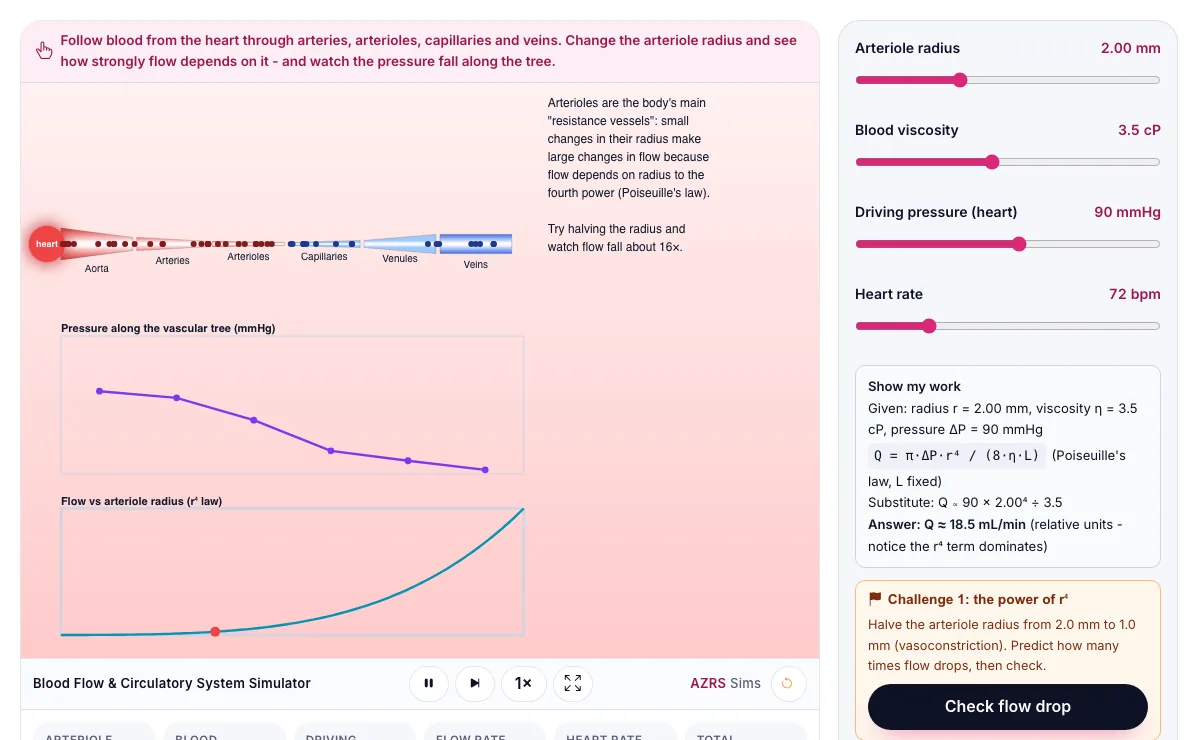
Follow blood from the heart through arteries, arterioles, capillaries and veins. Change the arteriole radius and see how strongly flow depends on it - and watch the pressure fall along the tree.
What the Blood Flow & Circulatory System Simulator shows
Follow blood from the heart through arteries, arterioles, capillaries and veins, and see how strongly flow depends on vessel radius. Built for biology, the blood flow & circulatory system simulator runs instantly in your browser: change a setting or drag an object and the result updates at once, so you learn by trying things out rather than only reading about them.
Blood travels from heart through arteries, capillaries and veins. Flow strongly depends on vessel radius.
How to use the Blood Flow & Circulatory System Simulator
In the Blood Flow & Circulatory System Simulator, use the controls to change Arteriole radius, Blood viscosity, Driving pressure (heart), Heart rate. The simulation reacts instantly.
In the Blood Flow & Circulatory System Simulator, press "Check flow drop", "Check compensation" to start, reset or change what is happening.
Start with this experiment: Halve the arteriole radius and predict the drop in flow before checking. Drag any glowing handle, object or slider with your mouse or finger and the Blood Flow & Circulatory System Simulator responds in real time.
Change one setting at a time and watch which readout moves, then compare it with this idea: Poiseuille's law: flow is proportional to the fourth power of the vessel radius.
Things to try
Halve the arteriole radius and predict the drop in flow before checking.
Raise blood viscosity and compare it with the effect of the same percentage change in radius.
Read the pressure-along-the-tree graph and find where pressure falls fastest.
The science behind it
Poiseuille's law: flow is proportional to the fourth power of the vessel radius.
Arterioles are the body's main resistance vessels because their radius changes the most.
Blood pressure falls steadily along the vascular tree, dropping fastest across the arterioles.
Higher blood viscosity or lower driving pressure both reduce flow.
A worked example with real numbers
Resistance rises by 2^4 = 16 times
Flow at the same pressure falls to 1/16.
Tips and common mistakes
Tips
- Narrow one vessel and watch flow drop.
- Compare arteries and capillaries.
Common mistakes
- Thinking flow changes with radius squared only.
- Forgetting total capillary area is large so speed is low.
Where this is used
This r⁴ relationship is why blood-pressure medications that dilate arterioles work so powerfully, and why cholesterol plaques that narrow arteries are so dangerous.
Who is this simulation for?
Biology students and teachers who want to explore living systems, populations and genetics interactively and safely. A good first experiment in the Blood Flow & Circulatory System Simulator: Halve the arteriole radius and predict the drop in flow before checking. The key relation to keep an eye on: Poiseuille: Q = pi delta P r^4 / (8 eta L); R is proportional to 1 / r^4.
For teachers: project the Blood Flow & Circulatory System Simulator on the board, let students predict the result, then run it together and test this: Raise blood viscosity and compare it with the effect of the same percentage change in radius. For students: change one thing at a time and write down what changes.
Frequently asked questions
Why does a small change in blood vessel radius change flow so much?
Because flow depends on radius to the fourth power, so halving the radius cuts flow to about one sixteenth.
Where does blood pressure fall the most in the circulatory system?
Across the arterioles, which is exactly why the body uses them to control blood pressure and how much blood organs receive.
Is the Blood Flow & Circulatory System Simulator free to use?
Yes. The Blood Flow & Circulatory System Simulator is free, needs no signup or download and runs in your web browser. It is part of the Biology group of AZRS simulations.
Does the Blood Flow & Circulatory System Simulator work on a phone or tablet?
Yes. The Blood Flow & Circulatory System Simulator takes touch input as well as mouse input, so you can use its 4 adjustable settings with a finger. A larger screen makes the controls and graphs easier to read.