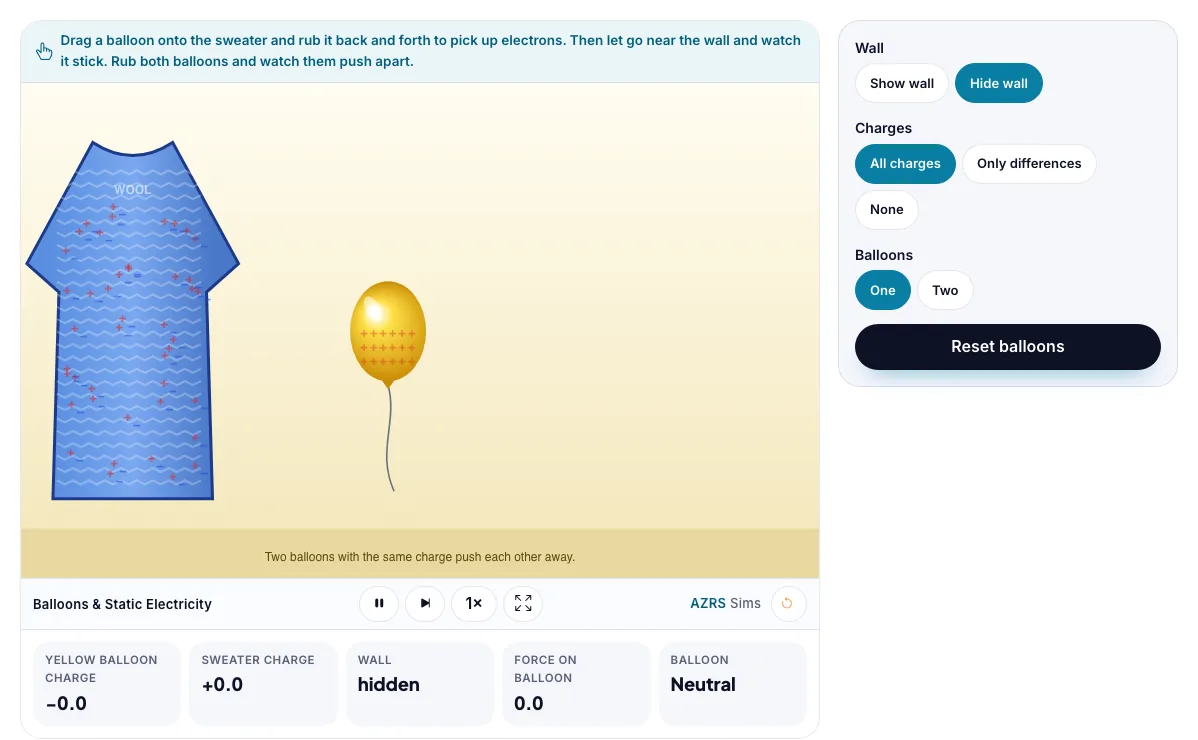
Balloons & Static Electricity
Rub a balloon on a sweater and watch it stick to the wall, showing charge transfer and induced charge.
Drag a balloon onto the sweater and rub it back and forth to pick up electrons. Then let go near the wall and watch it stick. Rub both balloons and watch them push apart.
What the Balloons & Static Electricity shows
Rub a balloon on a sweater and watch it stick to the wall, showing charge transfer and induced charge. Free, no signup, runs in your browser. Built for physics, the balloons & static electricity runs instantly in your browser: change a setting or drag an object and the result updates at once, so you learn by trying things out rather than only reading about them.
A balloon rubbed on a sweater picks up extra electrons. It then sticks to the wall by polarizing it.
How to use the Balloons & Static Electricity
In the Balloons & Static Electricity, use the controls to change Wall, Charges, Balloons. The simulation reacts instantly.
In the Balloons & Static Electricity, pick an option such as Show wall, Hide wall, All charges, Only differences to switch modes or load an example.
In the Balloons & Static Electricity, press "Reset balloons" to start, reset or change what is happening.
Start with this experiment: Rub it more and let it go near the wall. Drag any glowing handle, object or slider with your mouse or finger and the Balloons & Static Electricity responds in real time.
Change one setting at a time and watch which readout moves, then compare it with this idea: Rubbing moves electrons from the sweater to the balloon.
Things to try
Rub it more and let it go near the wall.
Add a second balloon and watch them repel.
Show only the differences in charge.
The science behind it
Rubbing moves electrons from the sweater to the balloon.
The balloon becomes negative and the sweater positive.
A charged balloon polarises the wall, so it sticks.
Two negative balloons repel.
A worked example with real numbers
Excess electrons = 5e-9 / 1.6e-19 = about 3 x 10^10 electrons
The wall's charges shift, giving a small net attraction.
Tips and common mistakes
Tips
- Pull the balloon away and see induced charge return.
- Rub more and see the balloon stick longer.
Common mistakes
- Thinking the wall becomes charged; it is only polarized.
- Believing a balloon sticks equally in humid and dry rooms.
Where this is used
The same effects cause dust to cling to screens and are used in photocopiers and air cleaners.
Who is this simulation for?
Physics students in middle school, high school and first-year university, teachers who want a quick demonstration for the projector, and anyone revising for exams. A good first experiment in the Balloons & Static Electricity: Rub it more and let it go near the wall. The key relation to keep an eye on: Like charges repel, unlike attract; force falls with distance (Coulomb: F = k q1 q2 / r^2).
For teachers: project the Balloons & Static Electricity on the board, let students predict the result, then run it together and test this: Add a second balloon and watch them repel. For students: change one thing at a time and write down what changes.
Frequently asked questions
Why does a charged balloon stick to a wall?
Its negative charge pushes electrons away in the wall, leaving the near surface slightly positive, so they attract.
Does the balloon lose its charge?
Slowly, because charge leaks into the air and wall.
Is the Balloons & Static Electricity free to use?
Yes. The Balloons & Static Electricity is free, needs no signup or download and runs in your web browser. It is part of the Physics group of AZRS simulations.
Does the Balloons & Static Electricity work on a phone or tablet?
Yes. The Balloons & Static Electricity takes touch input as well as mouse input, so you can use its 3 adjustable settings with a finger. A larger screen makes the controls and graphs easier to read.