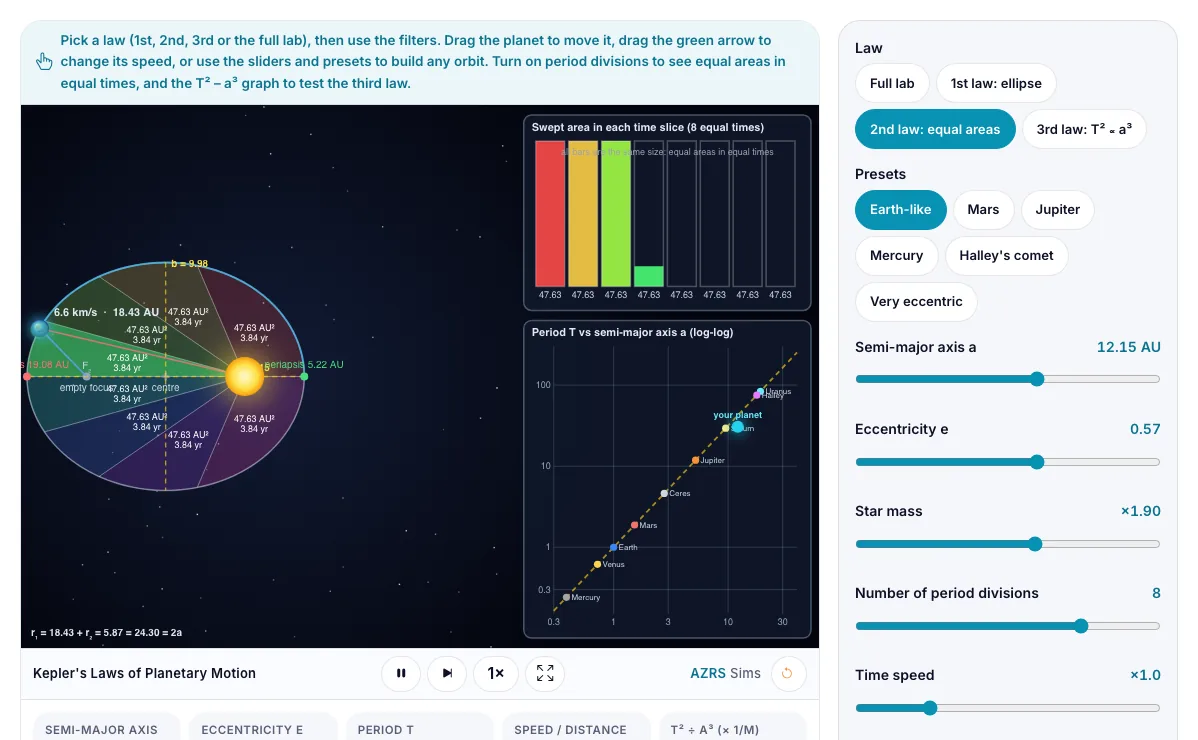
Kepler's Laws of Planetary Motion
Change orbit size and shape, see equal-area sectors and check the period–distance law.
Pick a law (1st, 2nd, 3rd or the full lab), then use the filters. Drag the planet to move it, drag the green arrow to change its speed, or use the sliders and presets to build any orbit. Turn on period divisions to see equal areas in equal times, and the T² – a³ graph to test the third law.
What the Kepler's Laws of Planetary Motion shows
Change orbit size and shape, see equal-area sectors and check the period–distance law. Free, no signup, runs in your browser. Built for earth & space, the kepler's laws of planetary motion runs instantly in your browser: change a setting or drag an object and the result updates at once, so you learn by trying things out rather than only reading about them.
Planets move in ellipses and sweep equal areas in equal times. Period grows with distance.
How to use the Kepler's Laws of Planetary Motion
In the Kepler's Laws of Planetary Motion, use the controls to change Law, Semi-major axis a, Eccentricity e, Star mass, Number of period divisions, and more. The simulation reacts instantly.
In the Kepler's Laws of Planetary Motion, pick an option such as Full lab, 1st law: ellipse, 2nd law: equal areas, 3rd law: T² ∝ a³ to switch modes or load an example.
In the Kepler's Laws of Planetary Motion, press "Restart orbit", "Clear path" to start, reset or change what is happening.
Start with this experiment: Set e = 0.9 and watch the speed. Drag any glowing handle, object or slider with your mouse or finger and the Kepler's Laws of Planetary Motion responds in real time.
Change one setting at a time and watch which readout moves, then compare it with this idea: Orbits are ellipses with the star at one focus.
Things to try
Set e = 0.9 and watch the speed.
Double a and check the period.
Turn on equal areas.
The science behind it
Orbits are ellipses with the star at one focus.
A line to the star sweeps equal areas in equal times.
T² is proportional to a³.
Planets move fastest when closest to the star.
A worked example with real numbers
T = 1.524^1.5 = 1.88 years
Closer to the Sun it moves faster.
Tips and common mistakes
Tips
- Make the orbit more eccentric.
- Compare area sectors.
Common mistakes
- Thinking the Sun is at the centre of the ellipse; it is at a focus.
- Using the period law with mixed units.
Where this is used
Kepler's laws are still used to plan satellite orbits and find exoplanets.
Who is this simulation for?
Astronomy and earth-science students, and teachers who need a visual model to explain what is happening in the sky. A good first experiment in the Kepler's Laws of Planetary Motion: Set e = 0.9 and watch the speed. The key relation to keep an eye on: T^2 = a^3 (T in years, a in AU); equal areas in equal times.
For teachers: project the Kepler's Laws of Planetary Motion on the board, let students predict the result, then run it together and test this: Double a and check the period. For students: change one thing at a time and write down what changes.
Frequently asked questions
What is Kepler's second law?
The line from the star to the planet sweeps out equal areas in equal times, so the planet speeds up near the star.
What is eccentricity?
A number from 0 (circle) to 1 that says how stretched an ellipse is.
Is the Kepler's Laws of Planetary Motion free to use?
Yes. The Kepler's Laws of Planetary Motion is free, needs no signup or download and runs in your web browser. It is part of the Earth & Space group of AZRS simulations.
Does the Kepler's Laws of Planetary Motion work on a phone or tablet?
Yes. The Kepler's Laws of Planetary Motion takes touch input as well as mouse input, so you can use its 8 adjustable settings with a finger. A larger screen makes the controls and graphs easier to read.