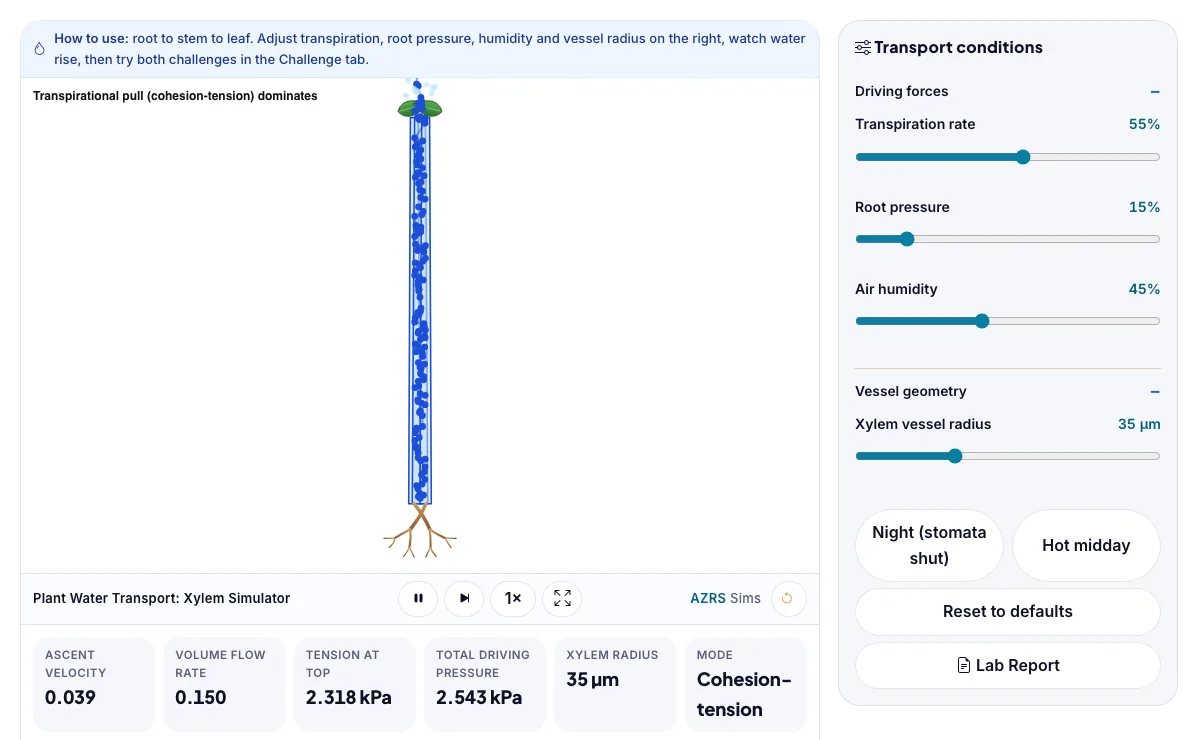
Plant Water Transport: Xylem Simulator
Follow water from root to leaf through the xylem, and see how transpiration, root pressure and vessel width set the water's speed and pressure.
Ascent velocity vs transpiration rate, at your current diameter and root pressure.
Ascent velocity vs xylem radius (r⁴ dependence - notice how sharply it rises).
What the Plant Water Transport: Xylem Simulator shows
Follow water from root to leaf through the xylem, and see how transpiration, root pressure and vessel width set the water's speed and pressure. Built for botany, the plant water transport: xylem simulator runs instantly in your browser: change a setting or drag an object and the result updates at once, so you learn by trying things out rather than only reading about them.
Water rises in xylem vessels pulled by transpiration and pushed by root pressure.
How to use the Plant Water Transport: Xylem Simulator
In the Plant Water Transport: Xylem Simulator, use the controls to change Transpiration rate, Root pressure, Air humidity, Xylem vessel radius. The simulation reacts instantly.
In the Plant Water Transport: Xylem Simulator, press "Night (stomata shut)", "Hot midday" to start, reset or change what is happening.
Start with this experiment: Try the night preset and see root pressure take over as the driving force. Drag any glowing handle, object or slider with your mouse or finger and the Plant Water Transport: Xylem Simulator responds in real time.
Change one setting at a time and watch which readout moves, then compare it with this idea: Cohesion-tension theory: water evaporating from the leaf pulls the whole connected water column up the xylem under tension, held together by cohesion between water molecules.
Things to try
Try the night preset and see root pressure take over as the driving force.
Try the hot midday preset and watch the tension climb.
Narrow the vessel radius and see how sharply the ascent velocity drops.
Try the narrow-vessel challenge: reach the target speed with a 30 micron radius or less.
The science behind it
Cohesion-tension theory: water evaporating from the leaf pulls the whole connected water column up the xylem under tension, held together by cohesion between water molecules.
At night, with stomata shut, root pressure alone can push water upward, sometimes causing droplets called guttation.
The Hagen-Poiseuille law says flow speed rises with the square of the vessel radius and volume flow with the fourth power, so slightly wider vessels move dramatically more water.
Very wide vessels move more water but are more vulnerable to air-bubble embolism breaking the column.
A worked example with real numbers
Flow ratio = (40 / 20)⁴ = 16 times
ΔP = 1000 × 9.81 × 100 ≈ 0.98 MPa (gravity alone)
Trees do it with negative pressure in the xylem, using cohesion and tension.
Tips and common mistakes
Tips
- Narrow the vessel to see flow fall steeply.
- Try Hot midday and Night.
- Raise humidity.
Common mistakes
- Plants do not pump water; evaporation pulls it.
- Wider vessels carry more water but risk air bubbles.
- Root pressure is small compared with transpiration pull.
Where this is used
Foresters and plant physiologists use cohesion-tension theory to explain how trees move water without pumps, and it also explains why droughts can cause fatal embolism in tree xylem.
Who is this simulation for?
Students, teachers and curious learners of all ages. A good first experiment in the Plant Water Transport: Xylem Simulator: Try the night preset and see root pressure take over as the driving force. The key relation to keep an eye on: Hagen–Poiseuille: Q = π r⁴ ΔP / (8 μ L); lifting 100 m needs ΔP ≈ ρ g h.
For teachers: project the Plant Water Transport: Xylem Simulator on the board, let students predict the result, then run it together and test this: Try the hot midday preset and watch the tension climb. For students: change one thing at a time and write down what changes.
Frequently asked questions
What pulls water up a 100-metre-tall tree with no pump?
Transpiration at the leaves creates tension that is transmitted down an unbroken column of water held together by cohesion - the cohesion-tension theory.
Why don't trees just evolve very wide xylem vessels for maximum flow?
Wider vessels are more likely to develop or trap air bubbles (embolism) that can block the whole column, so many trees favour narrower, safer vessels and rely more on strong transpirational tension.
Is the Plant Water Transport: Xylem Simulator free to use?
Yes. The Plant Water Transport: Xylem Simulator is free, needs no signup or download and runs in your web browser. It is part of the Botany group of AZRS simulations.
Does the Plant Water Transport: Xylem Simulator work on a phone or tablet?
Yes. The Plant Water Transport: Xylem Simulator takes touch input as well as mouse input, so you can use its 4 adjustable settings with a finger. A larger screen makes the controls and graphs easier to read.