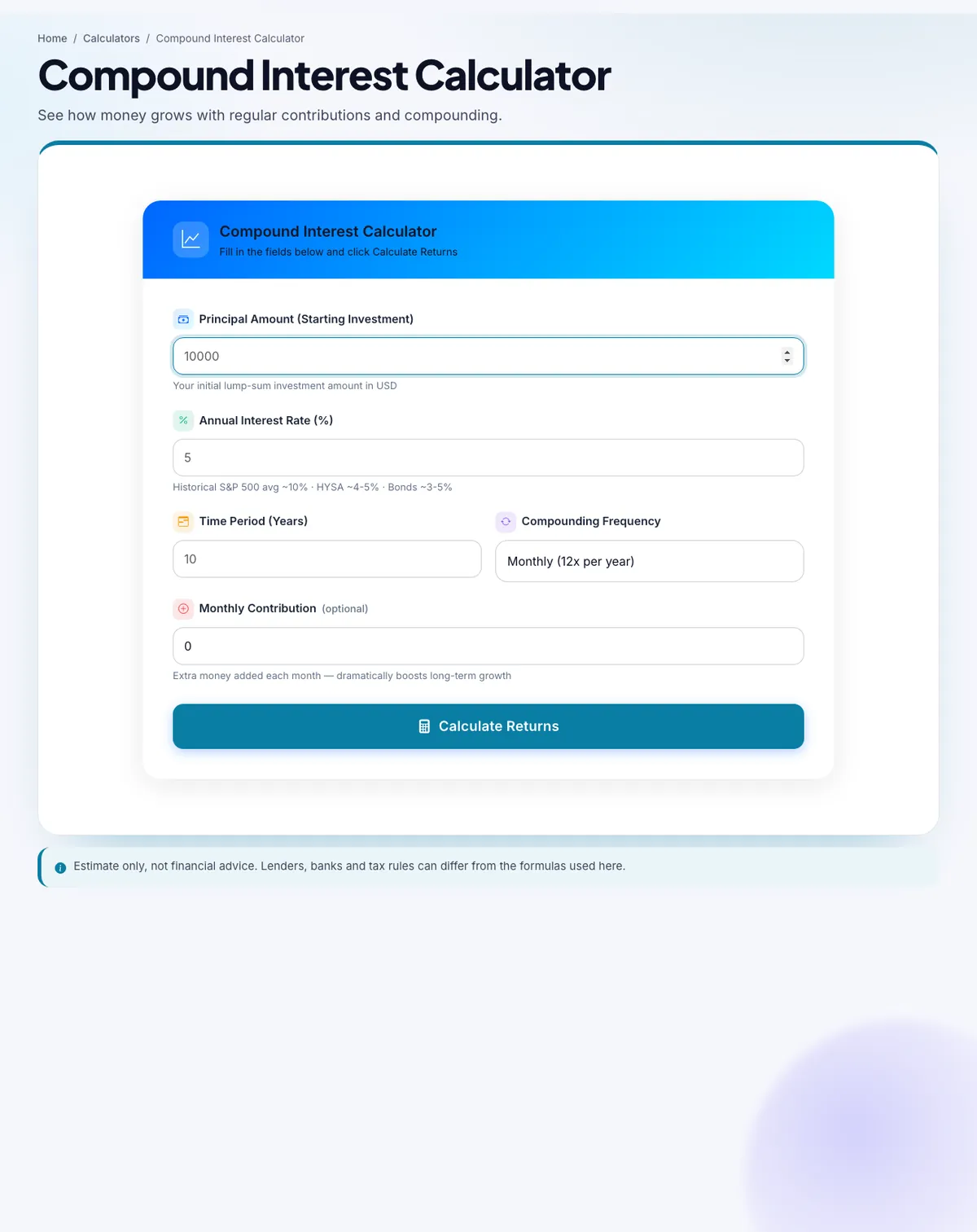
Compound Interest Calculator
See how money grows with regular contributions and compounding.
Estimate only, not financial advice. Lenders, banks and tax rules can differ from the formulas used here.
About the Compound Interest Calculator
Compound interest means you earn interest on your earlier interest as well as on the money you started with. Over many years that effect is large, which is why starting early matters.
Enter a starting amount, a yearly rate, how long you will invest and how often interest compounds. Add a monthly contribution if you plan to save regularly. The page returns the final balance, what you put in and what the interest added.
How to use it
Enter the principal. The amount you start with.
Set rate, years and frequency. The yearly rate, the time in years and how often interest compounds.
Add monthly deposits. Optional. Leave at zero for a one-off amount.
Calculate. Read the future value and the year-by-year breakdown.
Worked example: 10,000 at 5 percent for 10 years
Years: 10, monthly contribution: 0
Future value: $16,470.09
Interest earned: $6,470.09
Tips for good results
- Time does more work than rate. Ten extra years often beats a point of extra return.
- More frequent compounding helps a little. The gap between monthly and daily is small.
- Rates are not guaranteed. Test a lower rate to see a cautious case.
- Fees and inflation reduce what you really keep, so compare results in real terms too.
Common mistakes
- Treating a hoped-for return as a promise.
- Mixing a monthly rate into the yearly rate box.
Common questions
What is the compound interest formula?
A = P x (1 + r/n) raised to n x t, where P is the principal, r the yearly rate, n the compounds per year and t the years.
Does it include taxes?
No. Taxes on interest or gains are not modelled.
Is the rate guaranteed?
No. Savings accounts and investments can change. Use the result as an illustration.
Where do my numbers go?
Nowhere beyond the calculation request for this page. We do not keep them.
More calculators
Estimate only, not financial advice. Lenders, banks and tax rules can differ from the formulas used here.