Gear Train & Mechanical Advantage Designer
Build a real two-stage compound gear train, watch the gears mesh and turn, and read off the true speed and torque the math predicts.
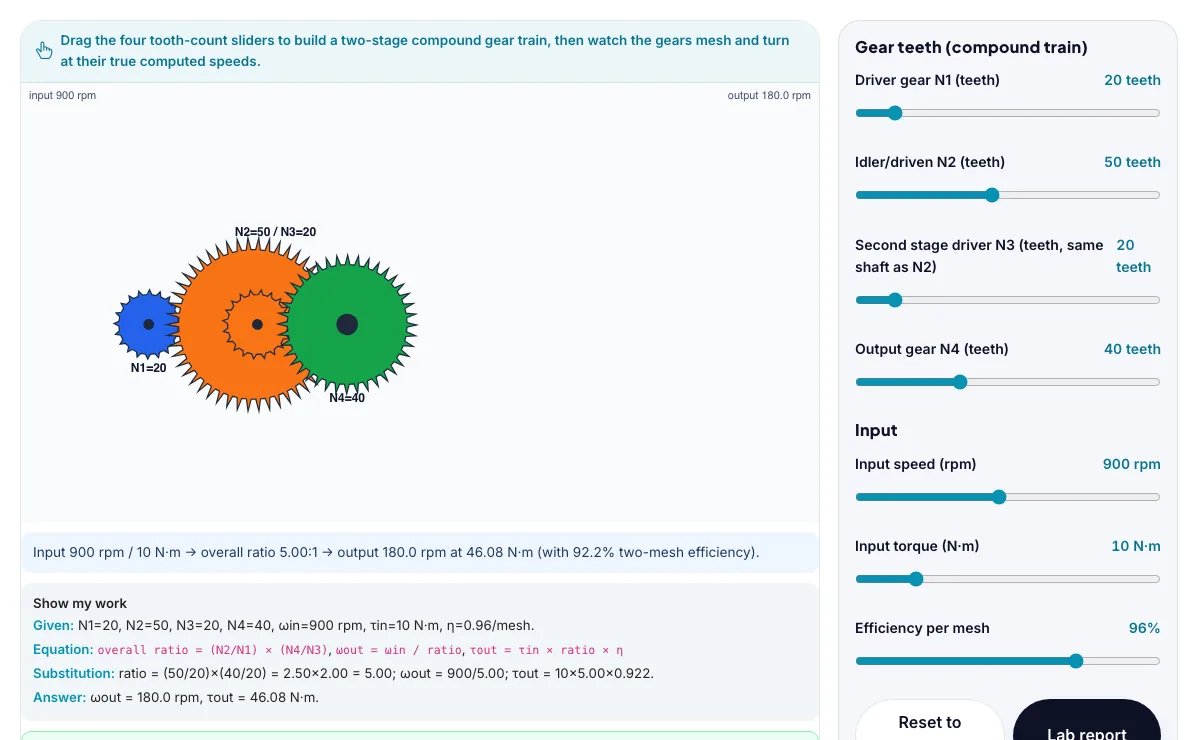
Drag the four tooth-count sliders to build a two-stage compound gear train, then watch the gears mesh and turn at their true computed speeds.
overall ratio = (N2/N1) × (N4/N3), ωout = ωin / ratio, τout = τin × ratio × ηWhat the Gear Train & Mechanical Advantage Designer shows
Build a real two-stage compound gear train, watch the gears mesh and turn, and read off the true speed and torque the math predicts. Built for engineering, the gear train & mechanical advantage designer runs instantly in your browser: change a setting or drag an object and the result updates at once, so you learn by trying things out rather than only reading about them.
A two-stage compound gear train. Set each tooth count and read the true overall ratio, speed and torque.
How to use the Gear Train & Mechanical Advantage Designer
In the Gear Train & Mechanical Advantage Designer, use the controls to change Driver gear N1 (teeth), Idler/driven N2 (teeth), Output gear N4 (teeth), Input speed (rpm), Input torque (N·m), and more. The simulation reacts instantly.
Start with this experiment: Set N1=20, N2=50, N3=20, N4=40 and confirm the overall ratio is exactly 5:1. Drag any glowing handle, object or slider with your mouse or finger and the Gear Train & Mechanical Advantage Designer responds in real time.
Change one setting at a time and watch which readout moves, then compare it with this idea: Gear ratio is inversely proportional to tooth count: a small driver gear turning a large driven gear slows the speed down and multiplies the torque.
Things to try
Set N1=20, N2=50, N3=20, N4=40 and confirm the overall ratio is exactly 5:1.
Keep the input speed fixed and see how far you can drop the output speed by raising N2 and N4.
Try the 5:1 mechanical-advantage challenge.
Try the 60 rpm output-speed challenge at a fixed 900 rpm input.
The science behind it
Gear ratio is inversely proportional to tooth count: a small driver gear turning a large driven gear slows the speed down and multiplies the torque.
A compound gear train stacks two (or more) stages on shared shafts, so the overall ratio is the product of each stage's ratio.
Torque and speed trade off through a gear train: whatever factor speed is divided by, torque is multiplied by (minus friction losses).
Real gear meshes are not perfectly efficient; each mesh typically loses a few percent, so a two-stage train loses roughly twice as much as one stage.
A worked example with real numbers
ratio = 3 x 3 = 9
output speed = 200 rpm
output torque = 18 N m ideal
Tips and common mistakes
Tips
- Keep the idler and compound gears on one shaft in mind.
- Try a ratio near 1 and a big ratio.
Common mistakes
- Multiplying stages by adding instead.
- Ignoring friction losses.
Where this is used
Compound gear trains like this appear in car transmissions, bicycle drivetrains, wind-up clocks, power drills and wind-turbine gearboxes, anywhere a motor's natural speed needs to be traded for more torque or vice versa.
Who is this simulation for?
Engineering and technology students, makers, robotics clubs and teachers of design and technology. A good first experiment in the Gear Train & Mechanical Advantage Designer: Set N1=20, N2=50, N3=20, N4=40 and confirm the overall ratio is exactly 5:1. The key relation to keep an eye on: overall ratio = (N2 / N1) x (N4 / N3); torque out = torque in x ratio x efficiency.
For teachers: project the Gear Train & Mechanical Advantage Designer on the board, let students predict the result, then run it together and test this: Keep the input speed fixed and see how far you can drop the output speed by raising N2 and N4. For students: change one thing at a time and write down what changes.
Frequently asked questions
Why does a compound gear train multiply the ratios of each stage instead of adding them?
Each stage independently divides speed (and multiplies torque) by its own ratio, and since the output of stage one becomes the input of stage two, the two scaling factors apply one after another - which is multiplication, not addition.
Why is the output torque slightly less than N times the input torque even though the gear ratio is exactly N?
Every real gear mesh has friction between the meshing teeth, so a small fraction of the input power is lost as heat at each mesh; the efficiency factors for each mesh multiply together and slightly reduce the torque the ideal ratio alone would predict.
Is the Gear Train & Mechanical Advantage Designer free to use?
Yes. The Gear Train & Mechanical Advantage Designer is free, needs no signup or download and runs in your web browser. It is part of the Engineering group of AZRS simulations.
Does the Gear Train & Mechanical Advantage Designer work on a phone or tablet?
Yes. The Gear Train & Mechanical Advantage Designer takes touch input as well as mouse input, so you can use its 6 adjustable settings with a finger. A larger screen makes the controls and graphs easier to read.