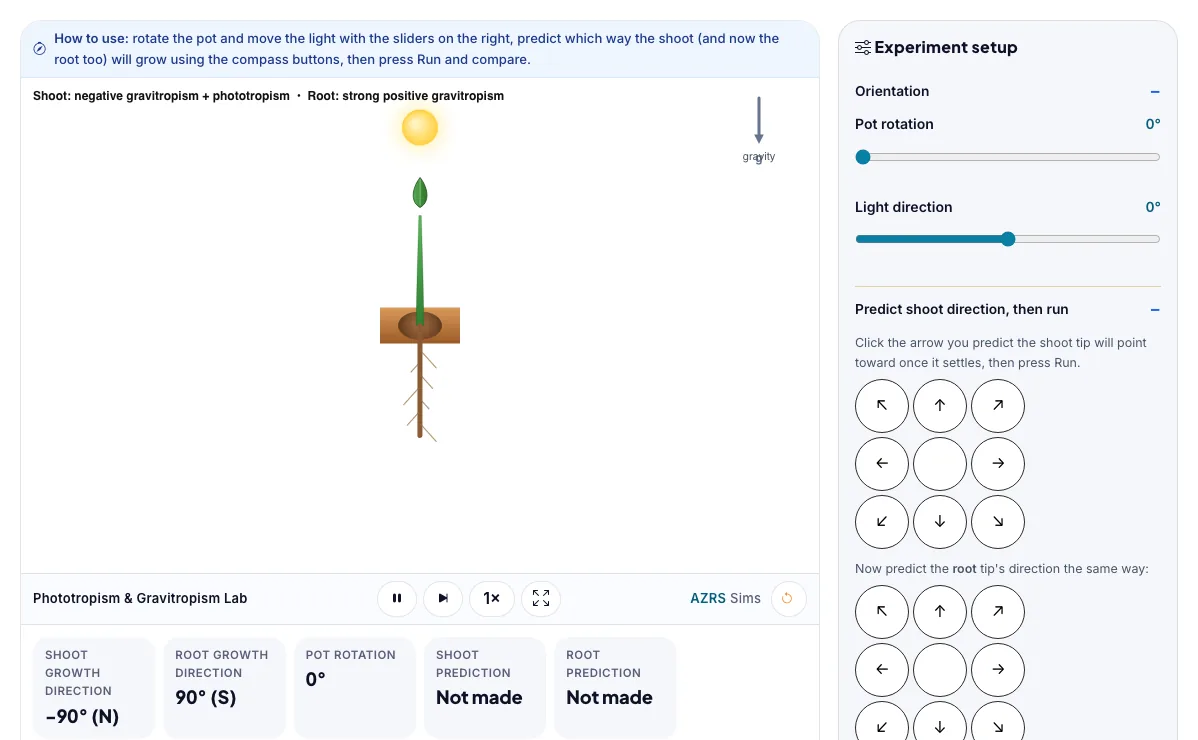
Phototropism & Gravitropism Lab
Rotate the pot and move the light, predict which way the shoot and root will grow, then run the simulation and check your prediction.
What the Phototropism & Gravitropism Lab shows
Rotate the pot and move the light, predict which way the shoot and root will grow, then run the simulation and check your prediction. Built for botany, the phototropism & gravitropism lab runs instantly in your browser: change a setting or drag an object and the result updates at once, so you learn by trying things out rather than only reading about them.
Rotate the pot and change the light direction to see stems bend toward light and roots toward gravity.
How to use the Phototropism & Gravitropism Lab
In the Phototropism & Gravitropism Lab, use the controls to change Pot rotation, Light direction. The simulation reacts instantly.
In the Phototropism & Gravitropism Lab, press "Run simulation" to start, reset or change what is happening.
Start with this experiment: Set the light straight up and predict the shoot direction before running. Drag any glowing handle, object or slider with your mouse or finger and the Phototropism & Gravitropism Lab responds in real time.
Change one setting at a time and watch which readout moves, then compare it with this idea: Shoots show negative gravitropism (grow away from gravity) combined with positive phototropism (grow toward light).
Things to try
Set the light straight up and predict the shoot direction before running.
Rotate the pot 90 degrees and predict again - did your answer change?
Move the light to a hard side angle and see how far off gravity alone the shoot ends up.
Try to predict correctly three times in a row.
The science behind it
Shoots show negative gravitropism (grow away from gravity) combined with positive phototropism (grow toward light).
Roots show strong positive gravitropism and are largely insensitive to light.
Dense statoliths inside root and shoot cells settle toward the lowest side under gravity, triggering the auxin redistribution that curves the organ.
Rotating a plant makes the statoliths resettle, so the plant actively re-aims its growth at the new 'down'.
A worked example with real numbers
Difference = 0.2 mm
θ ≈ 0.2 / 2 = 0.1 rad ≈ 5.7° of bend
Keep it up for hours and the stem points at the light.
Tips and common mistakes
Tips
- Rotate the pot to see gravitropism.
- Change the light direction.
- Run and watch the bend over time.
Common mistakes
- The stem bends because cells on the dark side lengthen, not because the light side shrinks.
- Roots respond to gravity oppositely to shoots.
- Hormone movement is gradual.
Where this is used
Farmers count on gravitropism when planting seeds any-side-up, and space agencies studied plant tropisms on the International Space Station to see how growth changes with weaker or absent gravity.
Who is this simulation for?
Students, teachers and curious learners of all ages. A good first experiment in the Phototropism & Gravitropism Lab: Set the light straight up and predict the shoot direction before running. The key relation to keep an eye on: Cholodny–Went: auxin moves to the shaded side, which elongates faster; curvature angle θ ≈ Δlength / width.
For teachers: project the Phototropism & Gravitropism Lab on the board, let students predict the result, then run it together and test this: Rotate the pot 90 degrees and predict again - did your answer change?. For students: change one thing at a time and write down what changes.
Frequently asked questions
Why do shoots grow up and roots grow down?
Shoots combine negative gravitropism with phototropism to reach for light, while roots use strong positive gravitropism to anchor and find water and nutrients in the soil.
What happens if you rotate a growing seedling on its side?
Statoliths resettle to the new lowest side of the cells, and within hours the shoot curves back upward and the root curves back downward.
Is the Phototropism & Gravitropism Lab free to use?
Yes. The Phototropism & Gravitropism Lab is free, needs no signup or download and runs in your web browser. It is part of the Botany group of AZRS simulations.
Does the Phototropism & Gravitropism Lab work on a phone or tablet?
Yes. The Phototropism & Gravitropism Lab takes touch input as well as mouse input, so you can use its 2 adjustable settings with a finger. A larger screen makes the controls and graphs easier to read.