Plinko Probability: Galton Board
Drop balls through pegs and watch the bell-shaped binomial distribution build, with the theory curve.
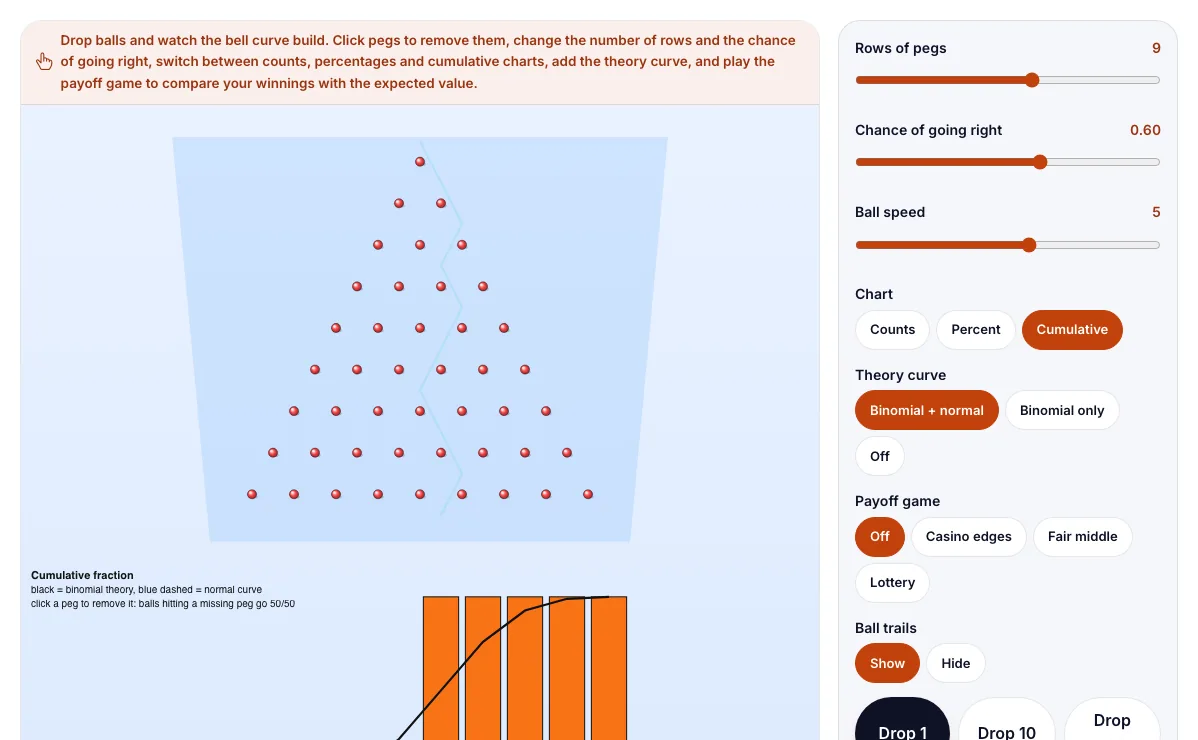
Drop balls and watch the bell curve build. Click pegs to remove them, change the number of rows and the chance of going right, switch between counts, percentages and cumulative charts, add the theory curve, and play the payoff game to compare your winnings with the expected value.
What the Plinko Probability: Galton Board shows
Drop balls through pegs and watch the bell-shaped binomial distribution build, with the theory curve. Free, no signup, runs in your browser. Built for math, the plinko probability: galton board runs instantly in your browser: change a setting or drag an object and the result updates at once, so you learn by trying things out rather than only reading about them.
Balls fall through pegs and pile up in a bell-shaped pattern.
How to use the Plinko Probability: Galton Board
In the Plinko Probability: Galton Board, use the controls to change Rows of pegs, Chance of going right, Ball speed, Chart, Theory curve, and more. The simulation reacts instantly.
In the Plinko Probability: Galton Board, pick an option such as Counts, Percent, Cumulative, Binomial + normal to switch modes or load an example.
In the Plinko Probability: Galton Board, press "Drop 1", "Drop 10", "Drop 100", "Restore pegs" to start, reset or change what is happening.
Start with this experiment: Drop 50 balls at once. Drag any glowing handle, object or slider with your mouse or finger and the Plinko Probability: Galton Board responds in real time.
Change one setting at a time and watch which readout moves, then compare it with this idea: Each peg is a 50/50 (or biased) choice.
Things to try
Drop 50 balls at once.
Bias the chance to 0.8.
Add more rows.
The science behind it
Each peg is a 50/50 (or biased) choice.
Many random choices make a bell curve.
Mean = rows × probability.
More balls match the theory curve better.
A worked example with real numbers
P(centre, k = 5) = 252 / 1024 = 24.6%
Mean = 5, σ = 1.58
Most balls land within ±1.6 slots of the centre.
Tips and common mistakes
Tips
- Drop 100 balls.
- Change the chance of going right.
- Show the theory curve.
Common mistakes
- Each ball is independent.
- The pattern shows only when many balls fall.
- Changing p shifts the whole curve.
Where this is used
The same maths underlies polling, quality control, insurance and the spread of test scores.
Who is this simulation for?
Algebra, geometry, trigonometry and calculus students, teachers preparing demonstrations, and self-learners who want to see the maths move. A good first experiment in the Plinko Probability: Galton Board: Drop 50 balls at once. The key relation to keep an eye on: P(k) = C(n, k) pᵏ (1 − p)ⁿ⁻ᵏ; mean n p; σ = √(n p (1 − p)).
For teachers: project the Plinko Probability: Galton Board on the board, let students predict the result, then run it together and test this: Bias the chance to 0.8. For students: change one thing at a time and write down what changes.
Frequently asked questions
What is a Galton board?
A board with rows of pegs where balls bounce left or right at random, showing the binomial distribution.
Why does a bell curve appear?
There are many more ways to reach the middle bins than the edge bins.
Is the Plinko Probability: Galton Board free to use?
Yes. The Plinko Probability: Galton Board is free, needs no signup or download and runs in your web browser. It is part of the Math group of AZRS simulations.
Does the Plinko Probability: Galton Board work on a phone or tablet?
Yes. The Plinko Probability: Galton Board takes touch input as well as mouse input, so you can use its 7 adjustable settings with a finger. A larger screen makes the controls and graphs easier to read.