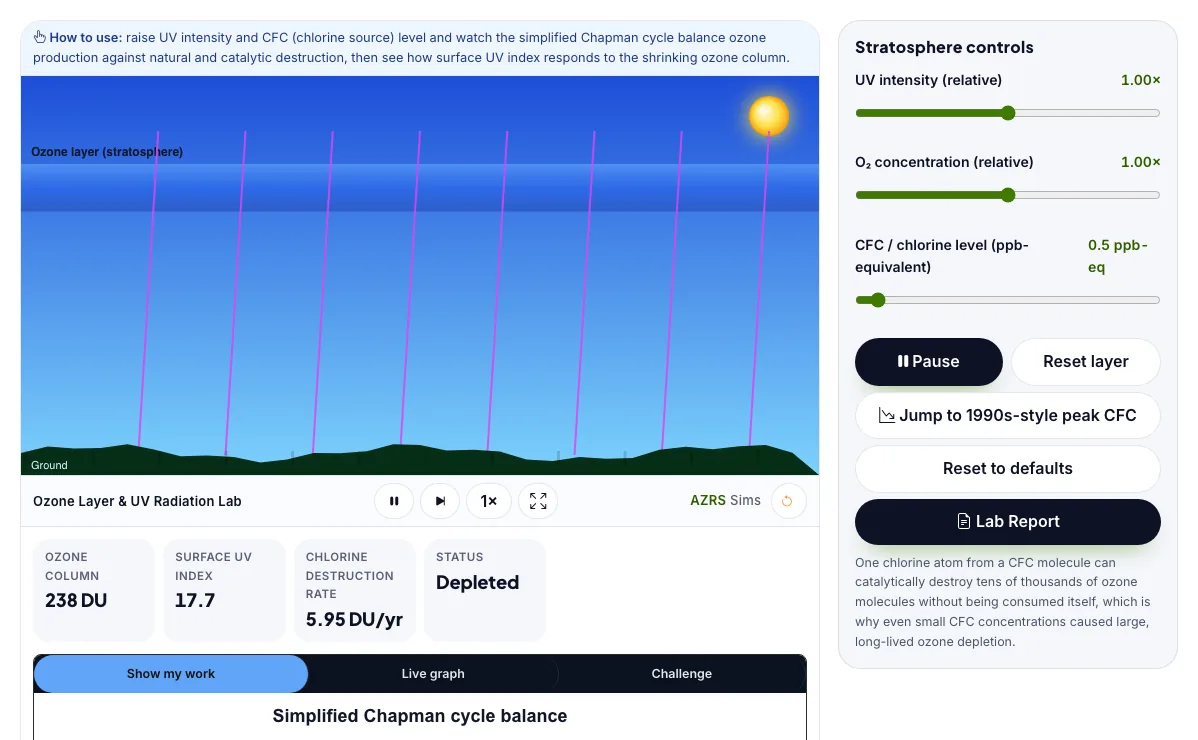
Ozone Layer & UV Radiation Lab
Run a simplified Chapman cycle: balance ozone production against natural and CFC-driven catalytic destruction, and watch surface UV respond.
How to use: raise UV intensity and CFC (chlorine source) level and watch the simplified Chapman cycle balance ozone production against natural and catalytic destruction, then see how surface UV index responds to the shrinking ozone column.
Challenge 1: open an ozone hole
Raise CFC level high enough and run time forward until the ozone column drops below 220 Dobson Units (the real "ozone hole" threshold).
Challenge 2: recover the layer (Montreal Protocol)
Starting from a depleted layer, cut CFC level to near zero and run time forward until the column recovers above 300 Dobson Units.
What the Ozone Layer & UV Radiation Lab shows
Run a simplified Chapman cycle: balance ozone production against natural and CFC-driven catalytic destruction, and watch surface UV respond. Built for environmental science, the ozone layer & uv radiation lab runs instantly in your browser: change a setting or drag an object and the result updates at once, so you learn by trying things out rather than only reading about them.
Ozone is made and destroyed by UV and chlorine, and sets how much UV reaches the ground.
How to use the Ozone Layer & UV Radiation Lab
In the Ozone Layer & UV Radiation Lab, use the controls to change UV intensity (relative), O₂ concentration (relative), CFC / chlorine level (ppb-equivalent). The simulation reacts instantly.
In the Ozone Layer & UV Radiation Lab, press "▶ Run years", "Reset layer", "Jump to 1990s-style peak CFC" to start, reset or change what is happening.
Start with this experiment: Push CFC level high and run time forward until an ozone hole (below 220 DU) opens. Drag any glowing handle, object or slider with your mouse or finger and the Ozone Layer & UV Radiation Lab responds in real time.
Change one setting at a time and watch which readout moves, then compare it with this idea: Ozone is continuously created when UV light splits O₂ into single oxygen atoms that combine with more O₂ to form O₃ - part of the Chapman cycle.
Things to try
Push CFC level high and run time forward until an ozone hole (below 220 DU) opens.
From a depleted state, cut CFC to near zero and run time forward to watch recovery.
Raise UV intensity alone (no CFC) and see production and natural destruction both rise together.
Compare surface UV index at 300 DU versus 150 DU.
The science behind it
Ozone is continuously created when UV light splits O₂ into single oxygen atoms that combine with more O₂ to form O₃ - part of the Chapman cycle.
Ozone is also naturally destroyed when UV light splits it back into O₂ and O, which is itself part of what makes the ozone layer such an effective UV shield.
CFCs release chlorine atoms high in the stratosphere that catalytically destroy ozone - each chlorine atom can break down tens of thousands of ozone molecules without being consumed, so small CFC amounts cause outsized damage.
Less stratospheric ozone lets more UV radiation reach the surface, since the ozone column's UV absorption falls off roughly exponentially with its thickness (measured in Dobson Units, DU).
A worked example with real numbers
Erythemal UV rises by about (300 / 250)^1.1 = 1.22
That is roughly 22% more sunburn-causing UV.
One chlorine atom can destroy tens of thousands of ozone molecules.
Tips and common mistakes
Tips
- Raise CFC and watch ozone fall.
- Jump to the 1990s peak.
- Reduce CFC to see recovery.
Common mistakes
- The ozone hole is not the greenhouse effect.
- CFCs do not make ozone themselves.
- UV-B causes sunburn; ozone blocks most of it.
Where this is used
Atmospheric scientists used exactly this kind of Chapman-cycle and chlorine-catalysis modeling to predict and later confirm the Antarctic ozone hole, leading to the 1987 Montreal Protocol banning CFCs.
Who is this simulation for?
Students, teachers and curious learners of all ages. A good first experiment in the Ozone Layer & UV Radiation Lab: Push CFC level high and run time forward until an ozone hole (below 220 DU) opens. The key relation to keep an eye on: Cl + O₃ → ClO + O₂; ClO + O → Cl + O₂; net O₃ + O → 2 O₂.
For teachers: project the Ozone Layer & UV Radiation Lab on the board, let students predict the result, then run it together and test this: From a depleted state, cut CFC to near zero and run time forward to watch recovery. For students: change one thing at a time and write down what changes.
Frequently asked questions
Why can a small amount of CFCs destroy so much ozone?
Chlorine released from CFCs acts as a catalyst: it destroys an ozone molecule but is regenerated in the process (Cl + O3 → ClO + O2, then ClO reactions release Cl again), letting a single chlorine atom destroy tens of thousands of ozone molecules before it is finally removed from the stratosphere.
Why did the ozone layer only start recovering after the Montreal Protocol banned CFCs, rather than immediately?
CFCs are extremely long-lived and take decades to break down and clear from the stratosphere even after emissions stop, so the chlorine they already released kept destroying ozone for years, and the ozone column only slowly climbed back once new chlorine input was cut off.
Is the Ozone Layer & UV Radiation Lab free to use?
Yes. The Ozone Layer & UV Radiation Lab is free, needs no signup or download and runs in your web browser. It is part of the Environmental Science group of AZRS simulations.
Does the Ozone Layer & UV Radiation Lab work on a phone or tablet?
Yes. The Ozone Layer & UV Radiation Lab takes touch input as well as mouse input, so you can use its 3 adjustable settings with a finger. A larger screen makes the controls and graphs easier to read.