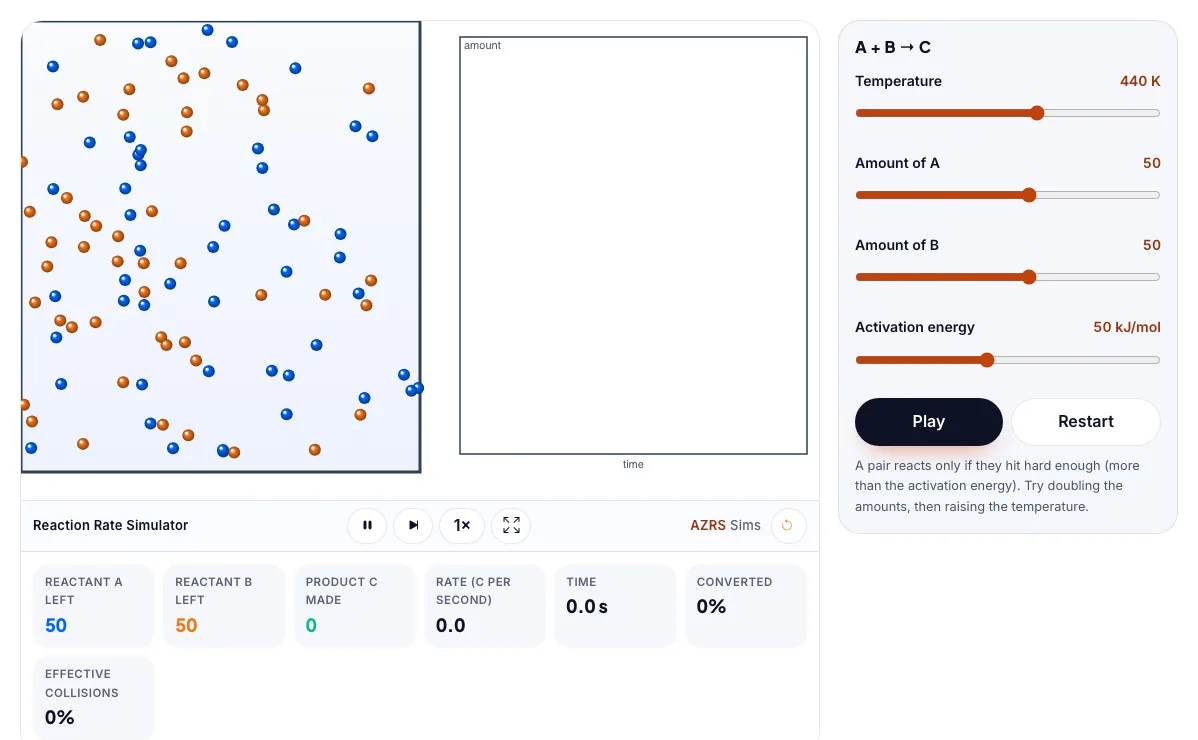
Reaction Rate Simulator
Change temperature and concentration and see how fast a reaction goes.
What the Reaction Rate Simulator shows
Change temperature and concentration and see how fast a reaction goes. Free, no signup, runs in your browser. Works on phones and computers. Built for reactions & kinetics, the reaction rate simulator runs instantly in your browser: change a setting or drag an object and the result updates at once, so you learn by trying things out rather than only reading about them.
Particles collide and react at a rate you change with temperature, amounts and activation energy.
How to use the Reaction Rate Simulator
In the Reaction Rate Simulator, use the controls to change Temperature, Amount of A, Amount of B, Activation energy. The simulation reacts instantly.
In the Reaction Rate Simulator, press "Pause", "Restart" to start, reset or change what is happening.
Start with this experiment: Double the amount of A and B. Drag any glowing handle, object or slider with your mouse or finger and the Reaction Rate Simulator responds in real time.
Change one setting at a time and watch which readout moves, then compare it with this idea: Higher concentration means more collisions per second.
Things to try
Double the amount of A and B.
Raise the temperature.
Raise the activation energy.
Watch the product curve.
The science behind it
Higher concentration means more collisions per second.
Higher temperature makes particles faster, so more collisions have enough energy.
The rate is the slope of the concentration-time graph.
A worked example with real numbers
Ea / R = 50 000 / 8.314 = 6014 K
ln(k₂/k₁) = 6014 × (1/298 − 1/308) = 0.655
k₂ / k₁ = e^0.655 ≈ 1.9
Tips and common mistakes
Tips
- Raise the temperature and see more collisions with enough energy.
- Lower activation energy to speed up.
- Double concentrations and compare.
Common mistakes
- The 'double per 10 °C' rule is only a rough guide.
- Temperature raises the fraction of energetic collisions.
- A catalyst lowers Ea but does not change the equilibrium.
Where this is used
Controlling reaction rate matters in food storage, medicine shelf life, car engines, fertiliser production and industrial chemistry.
Who is this simulation for?
Students learning reaction rates, equilibrium and equations, and teachers who want a visual way to explain what happens to particles. A good first experiment in the Reaction Rate Simulator: Double the amount of A and B. The key relation to keep an eye on: Arrhenius: k = A e^(−Ea / RT).
For teachers: project the Reaction Rate Simulator on the board, let students predict the result, then run it together and test this: Raise the temperature. For students: change one thing at a time and write down what changes.
Frequently asked questions
Why does raising the temperature speed up a reaction?
Particles move faster, so they collide more often and, more importantly, more of the collisions have at least the activation energy.
How do you measure a reaction rate?
By how quickly a reactant is used up or a product forms over time, which is the slope of the concentration-time graph.
Is the Reaction Rate Simulator free to use?
Yes. The Reaction Rate Simulator is free, needs no signup or download and runs in your web browser. It is part of the Reactions & Kinetics group of AZRS simulations.
Does the Reaction Rate Simulator work on a phone or tablet?
Yes. The Reaction Rate Simulator takes touch input as well as mouse input, so you can use its 4 adjustable settings with a finger. A larger screen makes the controls and graphs easier to read.