Molecule Polarity Simulator
Change atom electronegativity and see bond dipoles, the net dipole and molecule polarity.
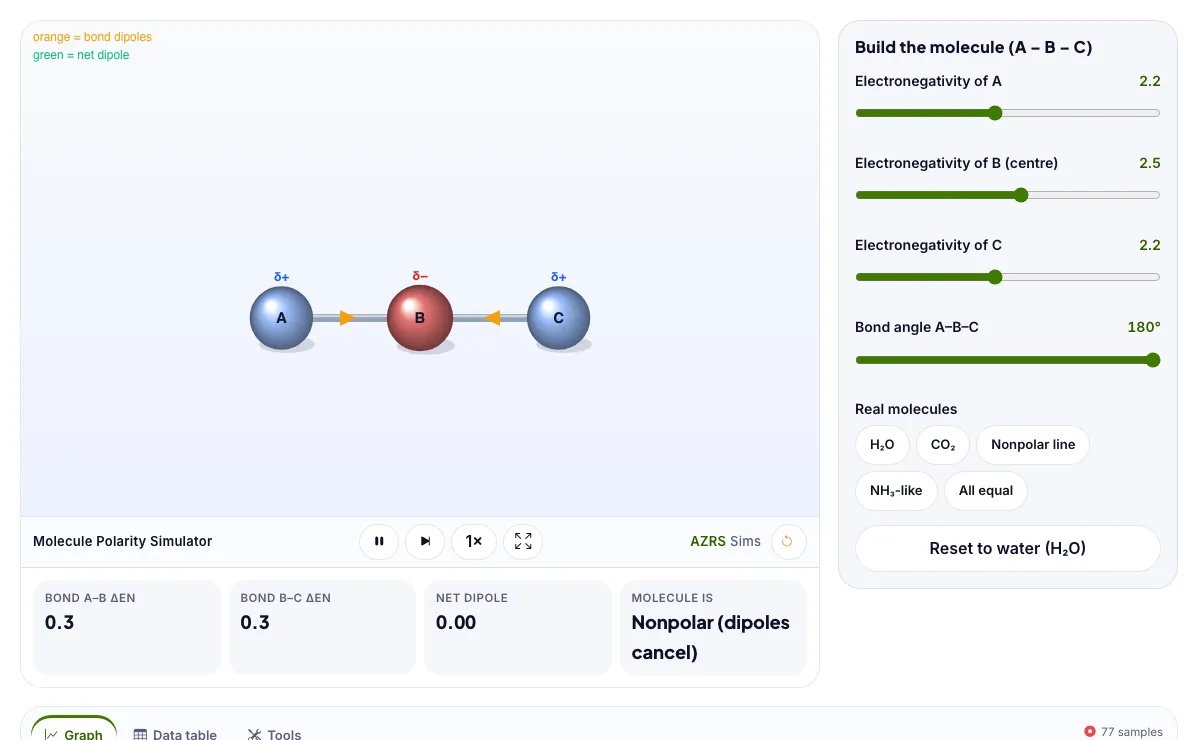
What the Molecule Polarity Simulator shows
Change atom electronegativity and see bond dipoles, the net dipole and molecule polarity. Free, no signup, runs in your browser. Built for chemistry, the molecule polarity simulator runs instantly in your browser: change a setting or drag an object and the result updates at once, so you learn by trying things out rather than only reading about them.
Atoms A, B and C with electronegativity and bond angle you set. The net dipole shows whether the whole molecule is polar.
How to use the Molecule Polarity Simulator
In the Molecule Polarity Simulator, use the controls to change Electronegativity of A, Electronegativity of B (centre), Electronegativity of C, Bond angle A–B–C, Real molecules. The simulation reacts instantly.
In the Molecule Polarity Simulator, pick an option such as H₂O, CO₂, Nonpolar line, NH₃-like to switch modes or load an example.
In the Molecule Polarity Simulator, press "Reset to water (H₂O)" to start, reset or change what is happening.
Start with this experiment: Load H₂O and CO₂ and compare. Drag any glowing handle, object or slider with your mouse or finger and the Molecule Polarity Simulator responds in real time.
Change one setting at a time and watch which readout moves, then compare it with this idea: A bond is polar when the two atoms differ in electronegativity.
Things to try
Load H₂O and CO₂ and compare.
Make all electronegativities equal.
Bend the bond angle.
Find a polar molecule with a net dipole of zero.
The science behind it
A bond is polar when the two atoms differ in electronegativity.
Bond dipoles are vectors: they can cancel out in a symmetric molecule like CO₂.
A bent molecule such as H₂O does not cancel, so it is polar.
A worked example with real numbers
O–H: ΔEN = 3.44 − 2.20 = 1.24 (polar covalent). Bent shape: the dipoles add, net 1.85 D.
C=O: ΔEN = 3.44 − 2.55 = 0.89. Linear shape: equal and opposite, net 0 D.
So water is polar, carbon dioxide is not.
Tips and common mistakes
Tips
- Set the angle to 180° and see the net dipole vanish.
- Make C different from A to break symmetry.
- Load the Real molecules presets.
Common mistakes
- Polar bonds do not always make a polar molecule.
- Shape matters as much as electronegativity.
- Polar does not mean ionic.
Where this is used
Polarity explains why water dissolves salt, why oil and water do not mix, and how soaps and drugs work.
Who is this simulation for?
Chemistry students from middle school to university, teachers who need a virtual demonstration, and anyone without access to a lab. A good first experiment in the Molecule Polarity Simulator: Load H₂O and CO₂ and compare. The key relation to keep an eye on: Bond dipole from ΔEN; molecule polar only if the vector sum is non-zero.
For teachers: project the Molecule Polarity Simulator on the board, let students predict the result, then run it together and test this: Make all electronegativities equal. For students: change one thing at a time and write down what changes.
Frequently asked questions
How can a molecule with polar bonds be nonpolar?
If the shape is symmetric, the bond dipoles point in opposite directions and cancel, as in linear CO₂.
What is electronegativity?
How strongly an atom pulls shared electrons toward itself. The more electronegative atom gets the partial negative charge.
Is the Molecule Polarity Simulator free to use?
Yes. The Molecule Polarity Simulator is free, needs no signup or download and runs in your web browser. It is part of the Chemistry group of AZRS simulations.
Does the Molecule Polarity Simulator work on a phone or tablet?
Yes. The Molecule Polarity Simulator takes touch input as well as mouse input, so you can use its 5 adjustable settings with a finger. A larger screen makes the controls and graphs easier to read.