
Explore the Gravitational Field & Escape Velocity Lab
Pick a world, launch a rocket straight up and see whether it falls back or truly escapes, with the real field strength and escape speed live.
- Free to use
- No signup
- Nothing to install
- Runs in your browser
Illustration. Open the tool for the real thing.
See it in action
The Gravitational Field & Escape Velocity Lab with sample data entered and the result showing.
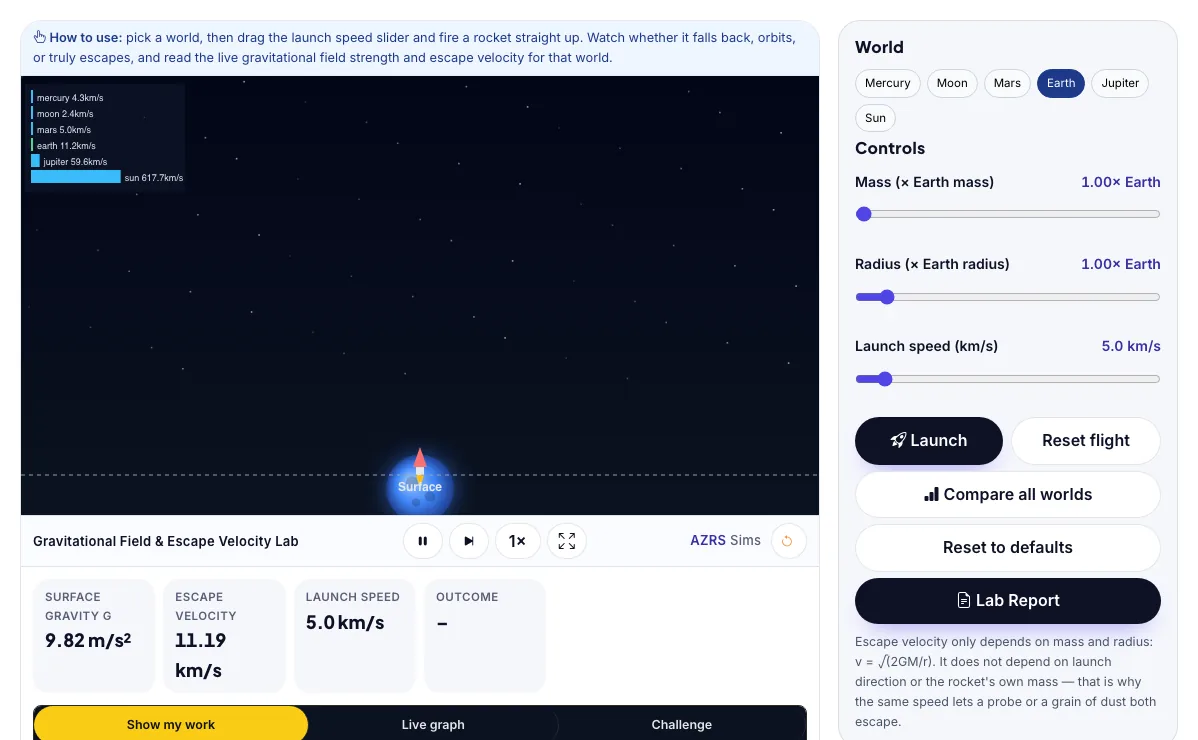
What is the Gravitational Field & Escape Velocity Lab?
Pick a world, launch a rocket straight up and see whether it falls back or truly escapes, with the real field strength and escape speed live. It runs in your browser, so a change to a setting or a drag on an object shows up at once.
Rocket engineers size every launch vehicle's required burnout speed around exactly this escape-velocity calculation, and it is why probes leaving the solar system need a gravity assist to reach solar-system escape speed.
3 steps to your result
Open the tool and follow along. Nothing to install.
What you get
Surface gravity is g = GM/r²: it grows with mass and shrinks fast with radius.
Escape velocity is v = √(2GM/r): it depends only on the mass and radius of the world, not on the rocket's own mass or launch direction.
A launch below escape velocity is gravitationally bound and falls back (or would orbit if launched sideways); at or above escape velocity, the total mechanical energy is zero or positive and the object never returns.
Launch from Earth at 8 km/s and watch it fall back, then try 11.3 km/s.
Switch to the Moon and find how much lower its escape velocity is.
Switch to Jupiter and see how much faster you must launch.
Used for
Pick one to see how it fits.
Teachers
For teachers: project the Gravitational Field & Escape Velocity Lab on the board, let students predict the result, then run it together and test this: Switch to the Moon and find how much lower its escape velocity is. For students: change one thing at a time and write down what changes.
Try it freeHow it compares
A plain look at this tool next to the usual alternative.
| This simulation | Textbook diagram | |
|---|---|---|
| Interactive | Drag, tap and change settings | Fixed picture |
| Install | Nothing to install | Not needed |
| Cost | Free to use | Depends on the book |
Questions people ask
Why doesn't the mass of the rocket matter for escape velocity?
Escape velocity comes from setting the kinetic energy per kilogram equal to the gravitational potential energy per kilogram; the rocket's mass cancels out of both sides, so a feather and a spacecraft need the same speed to escape a given world.
Why is the Moon's escape velocity so much lower than Earth's?
The Moon has both much less mass and a smaller radius than Earth; since v_esc = √(2GM/r), the much smaller M dominates and its escape velocity works out to about 2.4 km/s versus Earth's 11.2 km/s.
Is the Gravitational Field & Escape Velocity Lab free to use?
Yes. The Gravitational Field & Escape Velocity Lab is free, needs no signup or download and runs in your web browser. It is part of the Astronomy group of AZRS simulations.
Does the Gravitational Field & Escape Velocity Lab work on a phone or tablet?
Yes. The Gravitational Field & Escape Velocity Lab takes touch input as well as mouse input, so you can use its 3 adjustable settings with a finger. A larger screen makes the controls and graphs easier to read.
How do I use the Gravitational Field & Escape Velocity Lab?
1. In the Gravitational Field & Escape Velocity Lab, use the controls to change Mass (× Earth mass), Radius (× Earth radius), Launch speed (km/s). The simulation reacts instantly. 2. In the Gravitational Field & Escape Velocity Lab, press "Launch", "Reset flight", "Compare all worlds" to start, reset or change what is happening. 3. Start with this experiment: Launch from Earth at 8 km/s and watch it fall back, then try 11.3 km/s. Drag any glowing handle, object or slider with your mouse or finger and the Gravitational Field & Escape Velocity Lab responds in real time. 4. Change one setting at a time and watch which readout moves, then compare it with this idea: Surface gravity is g = GM/r²: it grows with mass and shrinks fast with radius.
More free tools
Related to the Gravitational Field & Escape Velocity Lab.
Try the Gravitational Field & Escape Velocity Lab now
Pick a world, launch a rocket straight up and see whether it falls back or truly escapes. Free to use.
Try it free