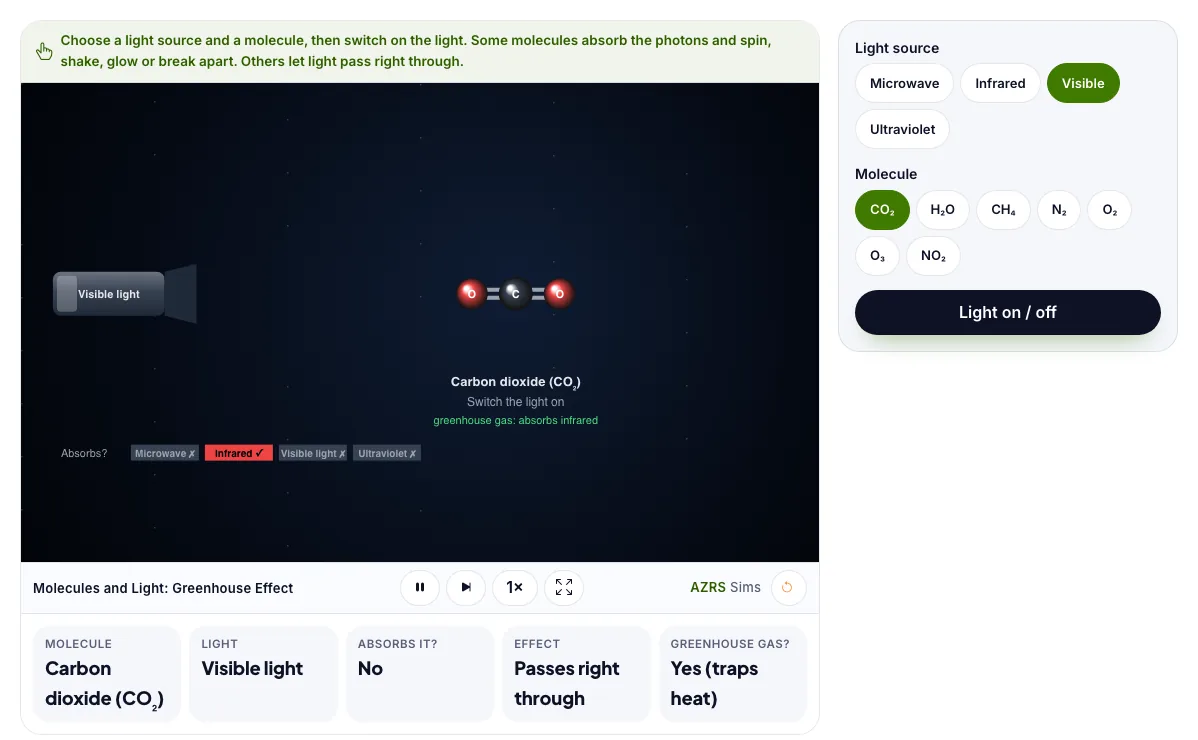
Molecules and Light: Greenhouse Effect
Shine microwave, infrared, visible or ultraviolet light on molecules and see which absorb it and what happens.
Choose a light source and a molecule, then switch on the light. Some molecules absorb the photons and spin, shake, glow or break apart. Others let light pass right through.
What the Molecules and Light: Greenhouse Effect shows
Shine microwave, infrared, visible or ultraviolet light on molecules and see which absorb it and what happens. Free, no signup, runs in your browser. Built for chemistry, the molecules and light: greenhouse effect runs instantly in your browser: change a setting or drag an object and the result updates at once, so you learn by trying things out rather than only reading about them.
Light of different energy meets molecules. Some molecules absorb it and some let it pass, which explains the greenhouse effect.
How to use the Molecules and Light: Greenhouse Effect
In the Molecules and Light: Greenhouse Effect, use the controls to change Light source, Molecule. The simulation reacts instantly.
In the Molecules and Light: Greenhouse Effect, pick an option such as Microwave, Infrared, Visible, Ultraviolet to switch modes or load an example.
In the Molecules and Light: Greenhouse Effect, press "Light on / off" to start, reset or change what is happening.
Start with this experiment: Compare CO₂ and N₂ in infrared. Drag any glowing handle, object or slider with your mouse or finger and the Molecules and Light: Greenhouse Effect responds in real time.
Change one setting at a time and watch which readout moves, then compare it with this idea: Different light energies make molecules move in different ways.
Things to try
Compare CO₂ and N₂ in infrared.
Shine ultraviolet on ozone.
Try microwaves on water.
The science behind it
Different light energies make molecules move in different ways.
Microwaves make polar molecules rotate.
Infrared makes bonds vibrate.
Ultraviolet can break molecules apart.
A worked example with real numbers
IR: 1239.8 / 10 000 = 0.12 eV (vibrations)
Visible: 1239.8 / 500 = 2.48 eV
UV: 1239.8 / 250 = 4.96 eV (can break bonds)
Greenhouse gases absorb IR because it matches their vibrations.
Tips and common mistakes
Tips
- Switch the light source and molecule and note who absorbs what.
- Try CO₂ with infrared and N₂ with infrared.
- Note microwaves rotate water molecules.
Common mistakes
- Greenhouse gases are transparent to visible sunlight but absorb IR.
- Bigger wavelength means lower energy.
- Not every molecule absorbs IR.
Where this is used
This explains global warming, the ozone layer and how a microwave oven heats food.
Who is this simulation for?
Chemistry students from middle school to university, teachers who need a virtual demonstration, and anyone without access to a lab. A good first experiment in the Molecules and Light: Greenhouse Effect: Compare CO₂ and N₂ in infrared. The key relation to keep an eye on: E = h c / λ = 1239.8 eV·nm / λ.
For teachers: project the Molecules and Light: Greenhouse Effect on the board, let students predict the result, then run it together and test this: Shine ultraviolet on ozone. For students: change one thing at a time and write down what changes.
Frequently asked questions
Why are CO₂ and CH₄ greenhouse gases?
They absorb infrared light, which traps heat in the atmosphere.
Why do N₂ and O₂ not trap heat?
They do not absorb infrared, so it passes straight through.
Is the Molecules and Light: Greenhouse Effect free to use?
Yes. The Molecules and Light: Greenhouse Effect is free, needs no signup or download and runs in your web browser. It is part of the Chemistry group of AZRS simulations.
Does the Molecules and Light: Greenhouse Effect work on a phone or tablet?
Yes. The Molecules and Light: Greenhouse Effect takes touch input as well as mouse input, so you can use its 2 adjustable settings with a finger. A larger screen makes the controls and graphs easier to read.