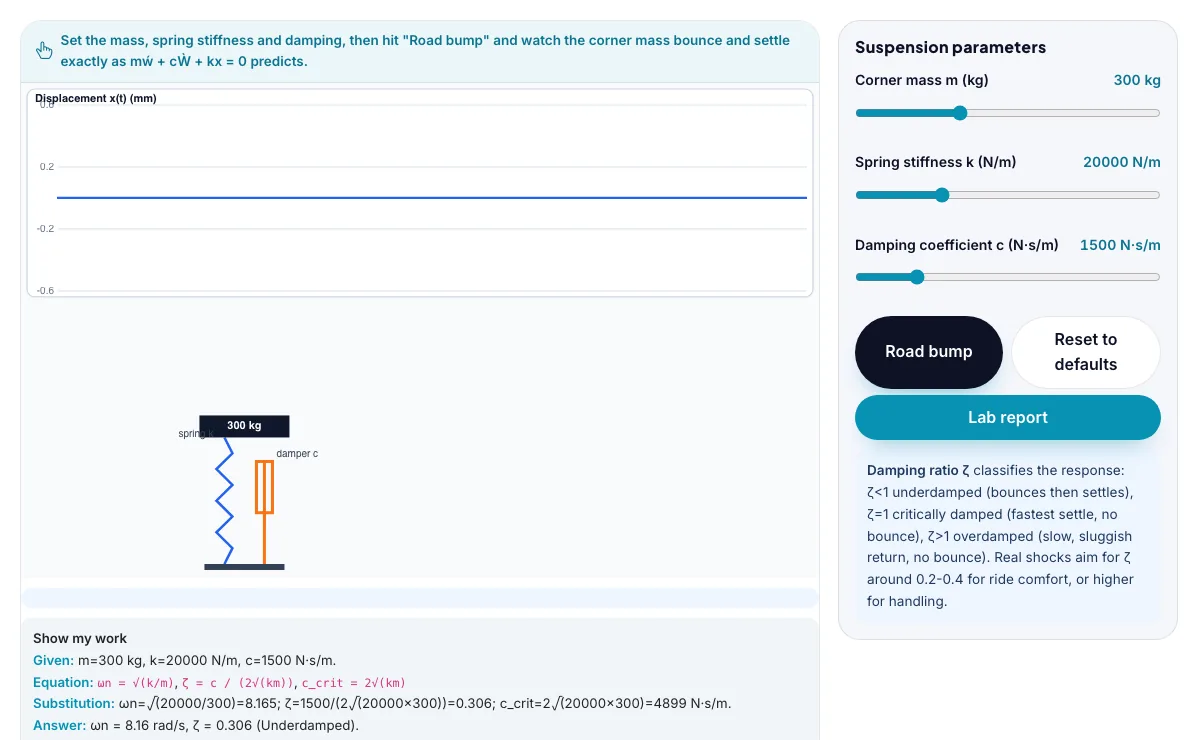
Vehicle Suspension & Shock Absorber Damping Lab
Tune a car corner's mass, spring and damper, trigger a road bump, and watch the real spring-mass-damper equation of motion bounce and settle live.
Set the mass, spring stiffness and damping, then hit "Road bump" and watch the corner mass bounce and settle exactly as mẃ + cẀ + kx = 0 predicts.
ωn = √(k/m), ζ = c / (2√(km)), c_crit = 2√(km)What the Vehicle Suspension & Shock Absorber Damping Lab shows
Tune a car corner's mass, spring and damper, trigger a road bump, and watch the real spring-mass-damper equation of motion bounce and settle live. Built for engineering, the vehicle suspension & shock absorber damping lab runs instantly in your browser: change a setting or drag an object and the result updates at once, so you learn by trying things out rather than only reading about them.
A quarter-car model hitting a bump. You choose mass, spring stiffness and damping to balance comfort and handling.
How to use the Vehicle Suspension & Shock Absorber Damping Lab
In the Vehicle Suspension & Shock Absorber Damping Lab, use the controls to change Corner mass m (kg), Spring stiffness k (N/m), Damping coefficient c (N·s/m). The simulation reacts instantly.
In the Vehicle Suspension & Shock Absorber Damping Lab, press "Road bump" to start, reset or change what is happening.
Start with this experiment: Hit 'road bump' with low damping and count the bounces before it settles. Drag any glowing handle, object or slider with your mouse or finger and the Vehicle Suspension & Shock Absorber Damping Lab responds in real time.
Change one setting at a time and watch which readout moves, then compare it with this idea: A vehicle suspension corner behaves like a spring-mass-damper system obeying m*x'' + c*x' + k*x = 0 after a bump displaces it.
Things to try
Hit 'road bump' with low damping and count the bounces before it settles.
Raise damping until the bounce disappears completely.
Try the comfortable-ride ζ 0.6–0.8 challenge.
Try the critical-damping ζ = 1.0 challenge.
The science behind it
A vehicle suspension corner behaves like a spring-mass-damper system obeying m*x'' + c*x' + k*x = 0 after a bump displaces it.
The damping ratio zeta = c/(2*sqrt(km)) determines the response shape: underdamped (zeta<1) bounces before settling, critically damped (zeta=1) returns fastest with no bounce, overdamped (zeta>1) returns slowly with no bounce.
Natural frequency omega_n = sqrt(k/m) sets how fast the system would oscillate with no damping at all; a stiffer spring or lighter corner mass raises it.
Real ride-comfort shocks are tuned underdamped (zeta roughly 0.2-0.4) to soak up bumps smoothly, while some sport or off-road setups use higher damping ratios that trade comfort for less body motion.
A worked example with real numbers
ωₙ = √(20 000 / 400) = 7.07 rad/s (1.13 Hz)
c_crit = 2√(20 000 × 400) = 5657 N·s/m
ζ = 1500 / 5657 = 0.27
A car body typically uses ζ around 0.2–0.4 for comfort.
Tips and common mistakes
Tips
- Hit the bump with low damping to see it bounce for a long time.
- Raise damping to settle quicker, but notice the harsher first impact.
- Lower the spring stiffness for a softer ride at the cost of more travel.
Common mistakes
- Too much damping feels harsh, not safe.
- Damping removes energy; it does not make the car lighter or the spring softer.
- ζ = 1 is critical damping; cars use less than that.
Where this is used
Automotive engineers tune spring stiffness and shock absorber damping exactly this way to balance ride comfort against handling, and the same spring-mass-damper math sizes vibration isolators for machinery and buildings.
Who is this simulation for?
Engineering and technology students, makers, robotics clubs and teachers of design and technology. A good first experiment in the Vehicle Suspension & Shock Absorber Damping Lab: Hit 'road bump' with low damping and count the bounces before it settles. The key relation to keep an eye on: ωₙ = √(k/m); ζ = c / (2√(k m)).
For teachers: project the Vehicle Suspension & Shock Absorber Damping Lab on the board, let students predict the result, then run it together and test this: Raise damping until the bounce disappears completely. For students: change one thing at a time and write down what changes.
Frequently asked questions
Why does a critically damped suspension return to equilibrium fastest without any bounce?
Critical damping (zeta = 1) is the exact borderline where the system has just enough damping to prevent oscillation; any less damping and it overshoots and bounces (which actually returns near zero faster on the first swing but keeps oscillating), any more damping and the extra resistance slows the return down, so zeta = 1 minimizes settling time among all responses that do not overshoot.
Why does doubling the spring stiffness change the required damping coefficient for critical damping?
Critical damping is c_crit = 2*sqrt(k*m), so it depends on the square root of the stiffness; doubling k multiplies c_crit by sqrt(2), meaning a stiffer spring needs proportionally more damping to stay at the same damping ratio.
Is the Vehicle Suspension & Shock Absorber Damping Lab free to use?
Yes. The Vehicle Suspension & Shock Absorber Damping Lab is free, needs no signup or download and runs in your web browser. It is part of the Engineering group of AZRS simulations.
Does the Vehicle Suspension & Shock Absorber Damping Lab work on a phone or tablet?
Yes. The Vehicle Suspension & Shock Absorber Damping Lab takes touch input as well as mouse input, so you can use its 3 adjustable settings with a finger. A larger screen makes the controls and graphs easier to read.