Bolt Torque, Preload & Strength Calculator (ISO Metric)
Tightening torque, clamp force, proof load and design resistances for M3–M36 bolts by property class · free, no signup
See Bolt Torque, Preload & Strength Calculator (ISO Metric) in action
Free Bolt Torque & Preload Calculator
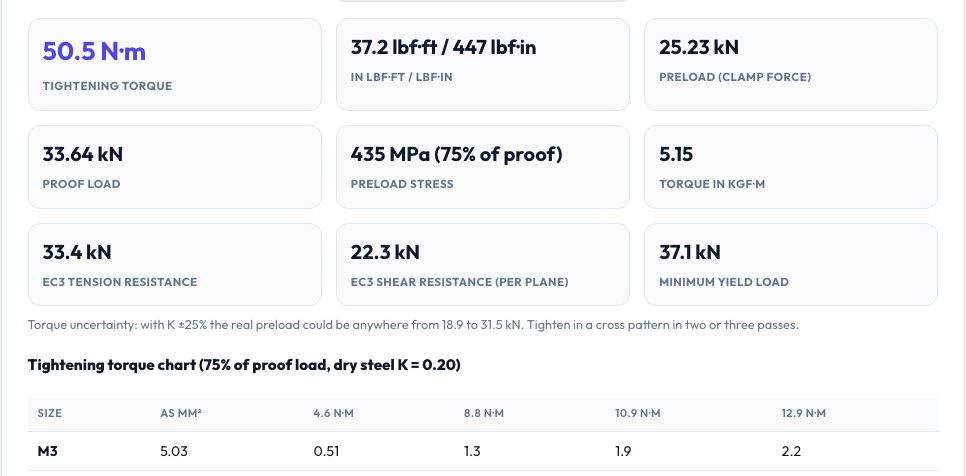
The standard bolt-tightening relationship is T = K·d·F: the torque you apply equals the nut factor times the nominal diameter times the preload (clamp force) you get. This calculator turns it around for you: pick a metric size from M3 to M36 and a property class (4.6, 4.8, 5.6, 5.8, 6.8, 8.8, 9.8, 10.9 or 12.9), choose the percentage of proof load you want as preload (75% for reusable joints, up to 90% for permanent ones) and the friction condition (K = 0.20 dry, 0.17 zinc plated or lightly oiled, down to 0.10 lubricated), and it returns the torque in N·m, lbf·ft, lbf·in and kgf·m, the preload and the proof load.
It also lists the minimum yield load and the Eurocode 3 design tension and shear resistances, and a full torque chart for every size and the four most common classes. The stress areas and proof strengths follow ISO 898-1 for coarse threads. Because the nut factor is empirical, the tool shows the realistic ±25% uncertainty in preload from torque control alone — for critical joints use a standard such as VDI 2230 and tension-indicating methods.
Key features
Torque and preload
T = K·d·F with N·m, lbf·ft, lbf·in and kgf·m outputs.
ISO 898-1 data
Stress area and proof strength for M3–M36 and nine property classes.
Design resistances
Eurocode 3 tension and shear resistance and yield load.
Torque chart
All sizes and classes at 75% proof, dry steel.
How to use it
- Choose bolt size and property class.
- Set the preload percentage and the friction condition.
- Read the tightening torque and preload.
- Check the resistances and the torque chart.
Worked example
Example
An M10 class 8.8 bolt at 75% of its 33.64 kN proof load has a preload of 25.23 kN; with K = 0.20 the tightening torque is 50.5 N·m (37.2 lbf·ft), and the Eurocode shear resistance per plane is 22.3 kN.
Who uses this tool
Mechanics and fitters
Look up torques quickly for any metric bolt.
Engineers
Estimate preload and joint capacity.
Students
Learn the torque–tension relationship.
Tips for the best results
- Lubricated bolts need much less torque for the same preload — reduce K.
- Tighten in a cross pattern and in two or three passes.
- Do not reuse bolts that have been tightened into yield.
- For critical joints measure preload directly.
Common mistakes to avoid
- Applying dry-thread torque to a lubricated bolt and overstressing it.
- Treating torque as exact — it is ±25–30%.
- Using coarse-thread values for fine-pitch bolts.
Why use AZRS QuickFix?
It is 100% free, needs no signup and has no watermark or usage limits. The tool runs in your browser, so what you type stays on your device, and it works on phones, tablets and desktops. New tools are added every week — bookmark this page or browse the full QuickFix toolbox.
Frequently asked questions
What is the nut factor?
An empirical number that lumps thread and head friction; 0.20 is typical for plain dry steel.
What does 8.8 mean?
Minimum tensile strength 800 MPa and yield 640 MPa (the ratio is 0.8).
Is the chart for fine threads?
No — coarse threads; fine-thread bolts have larger stress areas.
Is it free?
Yes.