Resonance Lab: Driven Oscillators
Shake five springs and masses at different frequencies and see the one whose natural frequency matches swing wildly.
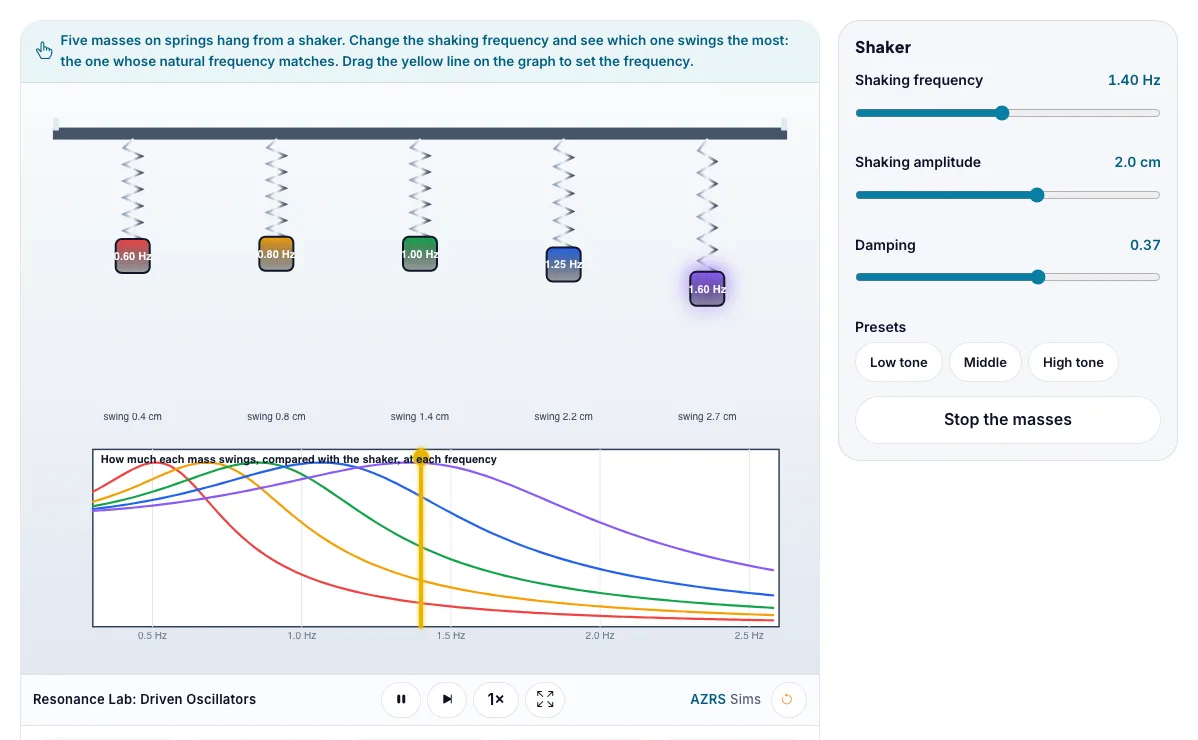
Five masses on springs hang from a shaker. Change the shaking frequency and see which one swings the most: the one whose natural frequency matches. Drag the yellow line on the graph to set the frequency.
What the Resonance Lab: Driven Oscillators shows
Shake five springs and masses at different frequencies and see the one whose natural frequency matches swing wildly. Free, no signup, runs in your browser. Built for physics, the resonance lab: driven oscillators runs instantly in your browser: change a setting or drag an object and the result updates at once, so you learn by trying things out rather than only reading about them.
Masses on springs shaken from below at a frequency you choose. You see the response grow when the shaking matches a natural frequency.
How to use the Resonance Lab: Driven Oscillators
In the Resonance Lab: Driven Oscillators, use the controls to change Shaking frequency, Shaking amplitude, Damping. The simulation reacts instantly.
In the Resonance Lab: Driven Oscillators, pick an option such as Low tone, Middle, High tone to switch modes or load an example.
In the Resonance Lab: Driven Oscillators, press "Stop the masses" to start, reset or change what is happening.
Start with this experiment: Choose the middle preset and find which mass swings the most. Drag any glowing handle, object or slider with your mouse or finger and the Resonance Lab: Driven Oscillators responds in real time.
Change one setting at a time and watch which readout moves, then compare it with this idea: Every oscillator has a natural frequency at which it likes to swing.
Things to try
Choose the middle preset and find which mass swings the most.
Slowly drag the shaking frequency across the graph and watch the masses take turns.
Raise the damping and see the peaks flatten.
Set the frequency very high and check that the masses barely move.
The science behind it
Every oscillator has a natural frequency at which it likes to swing.
Driving it near that frequency makes the swings grow large. This is resonance.
More damping lowers and widens the resonance peak.
Off resonance the mass barely moves even if the shaking is strong.
A worked example with real numbers
f₀ = (1 / 2π) × √(100 / 1.0) = 10 / 6.283 = 1.59 Hz
Shaking at 1.6 Hz gives a large response; at 0.5 Hz or 4 Hz the mass barely moves relative to the driver.
Tips and common mistakes
Tips
- Sweep the shaking frequency slowly through each mass and note which one reacts.
- Turn damping up to see the peak get lower and wider.
- Use the Low/Middle/High presets to link each mass with its own resonance.
Common mistakes
- Resonance needs the driving frequency to match, not a large driving force.
- Heavier masses resonate at lower, not higher, frequencies.
- Damping lowers the peak but also changes it slightly in frequency.
Where this is used
Bridges, buildings, musical instruments, radio tuners, MRI machines and swings all depend on resonance, sometimes to be used and sometimes to be avoided.
Who is this simulation for?
Physics students in middle school, high school and first-year university, teachers who want a quick demonstration for the projector, and anyone revising for exams. A good first experiment in the Resonance Lab: Driven Oscillators: Choose the middle preset and find which mass swings the most. The key relation to keep an eye on: Natural frequency f₀ = (1/2π) √(k/m); the response peaks near f₀ and is limited by damping.
For teachers: project the Resonance Lab: Driven Oscillators on the board, let students predict the result, then run it together and test this: Slowly drag the shaking frequency across the graph and watch the masses take turns. For students: change one thing at a time and write down what changes.
Frequently asked questions
What is resonance?
Resonance happens when something is pushed at its natural frequency, so each push adds to the motion and the amplitude grows.
Why does damping matter?
Damping removes energy every swing. With heavy damping the resonance peak is smaller and flatter, which is why cars have shock absorbers.
Is the Resonance Lab: Driven Oscillators free to use?
Yes. The Resonance Lab: Driven Oscillators is free, needs no signup or download and runs in your web browser. It is part of the Physics group of AZRS simulations.
Does the Resonance Lab: Driven Oscillators work on a phone or tablet?
Yes. The Resonance Lab: Driven Oscillators takes touch input as well as mouse input, so you can use its 3 adjustable settings with a finger. A larger screen makes the controls and graphs easier to read.