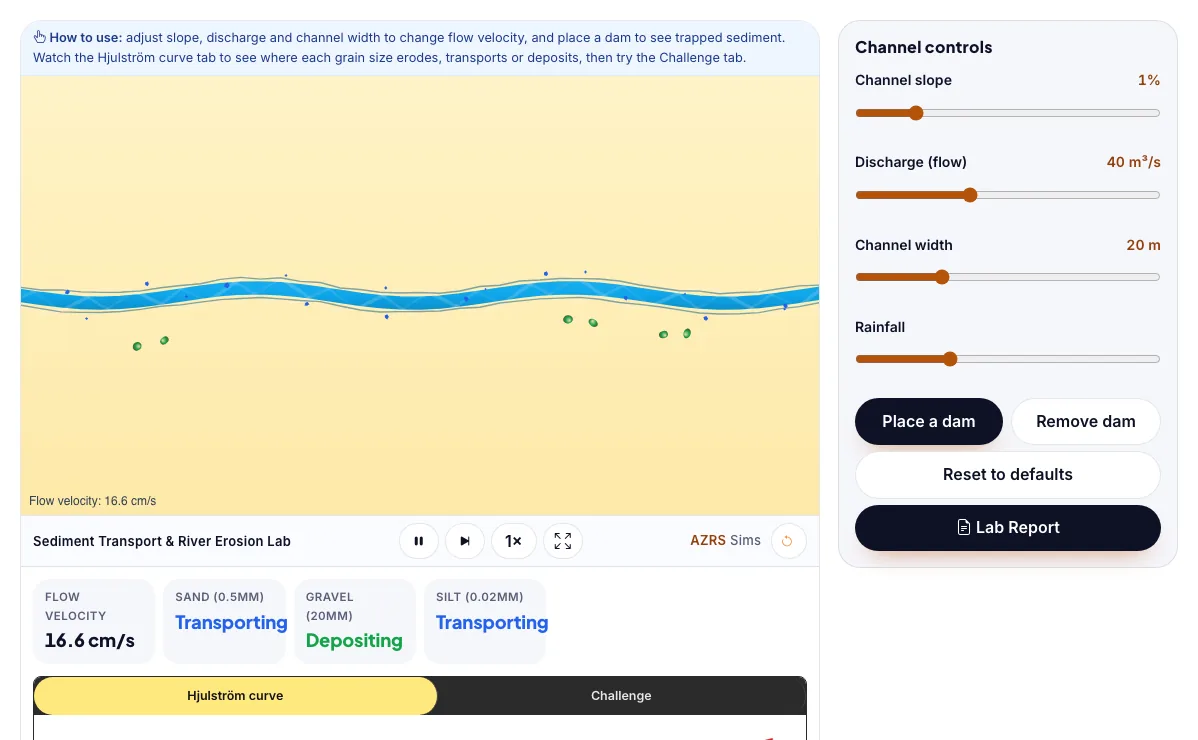
Sediment Transport & River Erosion Lab
Adjust slope, discharge, channel width and grain size and use the real Hjulström curve to predict whether a river erodes, transports or deposits sediment — then add a dam and watch downstream effects.
How to use: adjust slope, discharge and channel width to change flow velocity, and place a dam to see trapped sediment. Watch the Hjulström curve tab to see where each grain size erodes, transports or deposits, then try the Challenge tab.
Challenge: transport sand but deposit gravel
The Hjulström curve shows that fine sand erodes and transports at fairly low velocities, but gravel needs high velocity to erode and drops out (deposits) once velocity falls only a little. Find a flow velocity where sand keeps moving (transport or erosion) while gravel is deposited.
Challenge 2: hit the transport window exactly
Sand transports (moves along without eroding or fully settling) only in a narrow window, between its deposition and erosion thresholds. Tune the sliders so sand's state is exactly Transporting.
What the Sediment Transport & River Erosion Lab shows
Adjust slope, discharge, channel width and grain size and use the real Hjulström curve to predict whether a river erodes. Works on phones and computers. Built for geology, the sediment transport & river erosion lab runs instantly in your browser: change a setting or drag an object and the result updates at once, so you learn by trying things out rather than only reading about them.
A river channel carrying sediment with adjustable slope, flow and width.
How to use the Sediment Transport & River Erosion Lab
In the Sediment Transport & River Erosion Lab, use the controls to change Channel slope, Discharge (flow), Channel width, Rainfall. The simulation reacts instantly.
In the Sediment Transport & River Erosion Lab, press "Place a dam", "Remove dam" to start, reset or change what is happening.
Start with this experiment: Find a flow velocity where sand transports but gravel deposits (the challenge). Drag any glowing handle, object or slider with your mouse or finger and the Sediment Transport & River Erosion Lab responds in real time.
Change one setting at a time and watch which readout moves, then compare it with this idea: The Hjulström curve shows the flow velocity needed to erode, transport or deposit a given grain size.
Things to try
Find a flow velocity where sand transports but gravel deposits (the challenge).
Place a dam and watch the channel change upstream and downstream.
Raise the slope and discharge together and see the meander pattern strengthen.
Compare a wide, slow channel to a narrow, fast one at the same discharge.
The science behind it
The Hjulström curve shows the flow velocity needed to erode, transport or deposit a given grain size.
Fine sand is actually easier to erode than clay, because clay particles are cohesive and stick together.
Gravel needs high velocity to erode but drops out (deposits) quickly once velocity falls.
A dam traps sediment upstream and releases sediment-starved, erosive clear water downstream.
A worked example with real numbers
τ = 1000 × 9.81 × 0.5 × 0.001 = 4.9 Pa
θ = 4.9 / (1650 × 9.81 × 0.001) = 0.30
Critical θ ≈ 0.047, so the sand moves.
Tips and common mistakes
Tips
- Raise the slope and watch more bed move.
- Place a dam to see deposition upstream.
- Increase rain.
Common mistakes
- Bigger grains need more flow to move.
- Rivers drop sediment when they slow.
- Dams trap the sediment downstream needs.
Where this is used
River engineers use the Hjulström curve and dam-effect reasoning to design channels, protect bridges and predict where a dam will cause downstream riverbed erosion.
Who is this simulation for?
Students, teachers and curious learners of all ages. A good first experiment in the Sediment Transport & River Erosion Lab: Find a flow velocity where sand transports but gravel deposits (the challenge). The key relation to keep an eye on: Bed shear τ = ρ g R S; Shields number θ = τ / ((ρs − ρ) g D).
For teachers: project the Sediment Transport & River Erosion Lab on the board, let students predict the result, then run it together and test this: Place a dam and watch the channel change upstream and downstream. For students: change one thing at a time and write down what changes.
Frequently asked questions
Why is fine sand the easiest sediment to erode?
Coarser grains like gravel need high velocity because they are heavy; very fine grains like clay resist erosion because their particles are cohesive and stick together, so sand sits at the easiest-to-erode minimum.
Why do dams cause downstream erosion?
The reservoir traps sediment, so the river downstream still has erosive energy but nothing left to deposit, and it starts cutting into its own banks and bed.
Is the Sediment Transport & River Erosion Lab free to use?
Yes. The Sediment Transport & River Erosion Lab is free, needs no signup or download and runs in your web browser. It is part of the Geology group of AZRS simulations.
Does the Sediment Transport & River Erosion Lab work on a phone or tablet?
Yes. The Sediment Transport & River Erosion Lab takes touch input as well as mouse input, so you can use its 4 adjustable settings with a finger. A larger screen makes the controls and graphs easier to read.