Special Relativity: Time Dilation & Length Contraction Lab
Push a spaceship toward the speed of light and watch its onboard clock run slow and its length shrink, exactly as γ predicts.
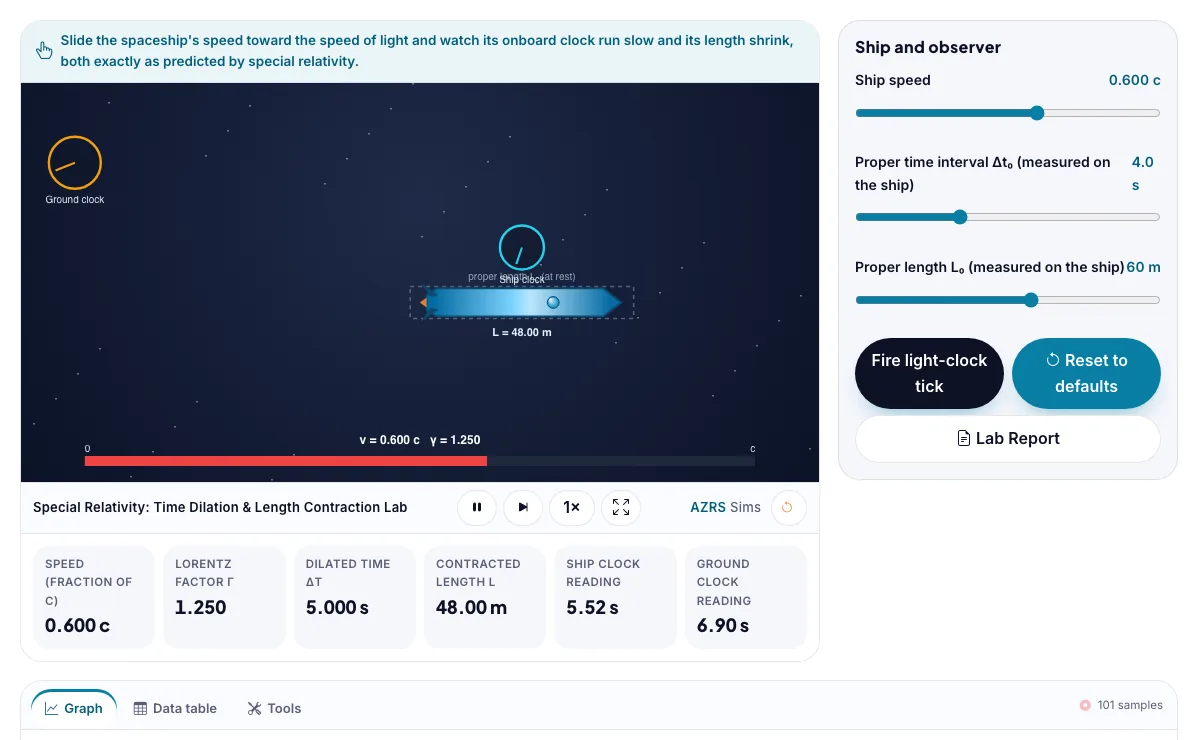
Slide the spaceship's speed toward the speed of light and watch its onboard clock run slow and its length shrink, both exactly as predicted by special relativity.
What the Special Relativity: Time Dilation & Length Contraction Lab shows
Push a spaceship toward the speed of light and watch its onboard clock run slow and its length shrink, exactly as γ predicts. Built for physics, the special relativity: time dilation & length contraction lab runs instantly in your browser: change a setting or drag an object and the result updates at once, so you learn by trying things out rather than only reading about them.
A spaceship at a speed you set, with a light clock and a ship length. See time dilation and length contraction between ship and lab frames.
How to use the Special Relativity: Time Dilation & Length Contraction Lab
In the Special Relativity: Time Dilation & Length Contraction Lab, use the controls to change Ship speed, Proper time interval Δt₀ (measured on the ship), Proper length L₀ (measured on the ship). The simulation reacts instantly.
In the Special Relativity: Time Dilation & Length Contraction Lab, press "Fire light-clock tick" to start, reset or change what is happening.
Start with this experiment: Push the speed slider past 0.9c and watch the ship clock nearly freeze compared to the ground clock. Drag any glowing handle, object or slider with your mouse or finger and the Special Relativity: Time Dilation & Length Contraction Lab responds in real time.
Change one setting at a time and watch which readout moves, then compare it with this idea: Time dilation: a clock moving relative to an observer ticks slower by the Lorentz factor γ = 1/√(1-v²/c²).
Things to try
Push the speed slider past 0.9c and watch the ship clock nearly freeze compared to the ground clock.
Set the speed to 0.6c and check γ against the formula by hand.
Try the muon-decay-distance challenge.
Find the exact speed that contracts a meter stick to 60 cm.
The science behind it
Time dilation: a clock moving relative to an observer ticks slower by the Lorentz factor γ = 1/√(1-v²/c²).
Length contraction: an object moving relative to an observer is measured shorter along its direction of motion by the same factor γ.
These effects are symmetric - each observer sees the other's clock run slow and rod shrink - and only become noticeable at a sizeable fraction of the speed of light.
Real-world proof: fast-moving muons created high in the atmosphere reach the ground far more often than their short rest-frame lifetime would allow, because time dilation stretches their lifetime in our frame.
Show my work
Challenges
Challenge 1 - muon decay distance
A muon is created with a proper (rest-frame) lifetime of 2.2 µs and travels at the speed set by the slider above. In the lab frame, how far (in meters) does it travel, on average, before decaying? Use d = v × γ × Δt₀ with Δt₀ = 2.2 × 10⁻⁶ s and c = 3.00 × 10⁸ m/s.
Challenge 2 - contract a meter stick to 60 cm
Set the speed slider so that a 1.000 m proper-length rod appears contracted to exactly 0.60 m to the ground observer. Use L = L₀/γ, so v/c = √(1 − (L/L₀)²). Enter the speed (as a fraction of c) you found.
A worked example with real numbers
γ = 1 / √(1 − 0.64) = 1 / 0.6 = 1.667
Δt = 1.667 × 3.0 = 5.0 s
L = 10 / 1.667 = 6.0 m
At 0.99c the factor γ is about 7.1.
Tips and common mistakes
Tips
- Slide towards 0.99c and watch γ grow quickly only near the speed of light.
- At everyday speeds the effect is tiny, which is why we never notice it.
- Run the Lab Report to record numbers for several speeds.
Common mistakes
- Proper time is measured in the frame where both events happen at the same place.
- Contraction is only along the direction of motion.
- Nothing here says one clock is 'really' slower; each frame sees the other's clock slow.
Where this is used
GPS satellites must correct for real time dilation from their orbital speed, and particle accelerators routinely see unstable particles 'live longer' exactly as relativity predicts.
Who is this simulation for?
Physics students in middle school, high school and first-year university, teachers who want a quick demonstration for the projector, and anyone revising for exams. A good first experiment in the Special Relativity: Time Dilation & Length Contraction Lab: Push the speed slider past 0.9c and watch the ship clock nearly freeze compared to the ground clock. The key relation to keep an eye on: γ = 1 / √(1 − v²/c²); Δt = γ Δt₀; L = L₀ / γ.
For teachers: project the Special Relativity: Time Dilation & Length Contraction Lab on the board, let students predict the result, then run it together and test this: Set the speed to 0.6c and check γ against the formula by hand. For students: change one thing at a time and write down what changes.
Frequently asked questions
Why don't we notice time dilation in everyday life?
Because γ is extremely close to 1 unless v is a large fraction of the speed of light - at highway speeds the effect is many orders of magnitude too small to detect.
Is length contraction just an optical illusion?
No - it is a real effect of how space and time mix between reference frames, confirmed by particle-accelerator experiments, even though nothing physically 'squeezes' the object in its own rest frame.
Is the Special Relativity: Time Dilation & Length Contraction Lab free to use?
Yes. The Special Relativity: Time Dilation & Length Contraction Lab is free, needs no signup or download and runs in your web browser. It is part of the Physics group of AZRS simulations.
Does the Special Relativity: Time Dilation & Length Contraction Lab work on a phone or tablet?
Yes. The Special Relativity: Time Dilation & Length Contraction Lab takes touch input as well as mouse input, so you can use its 3 adjustable settings with a finger. A larger screen makes the controls and graphs easier to read.