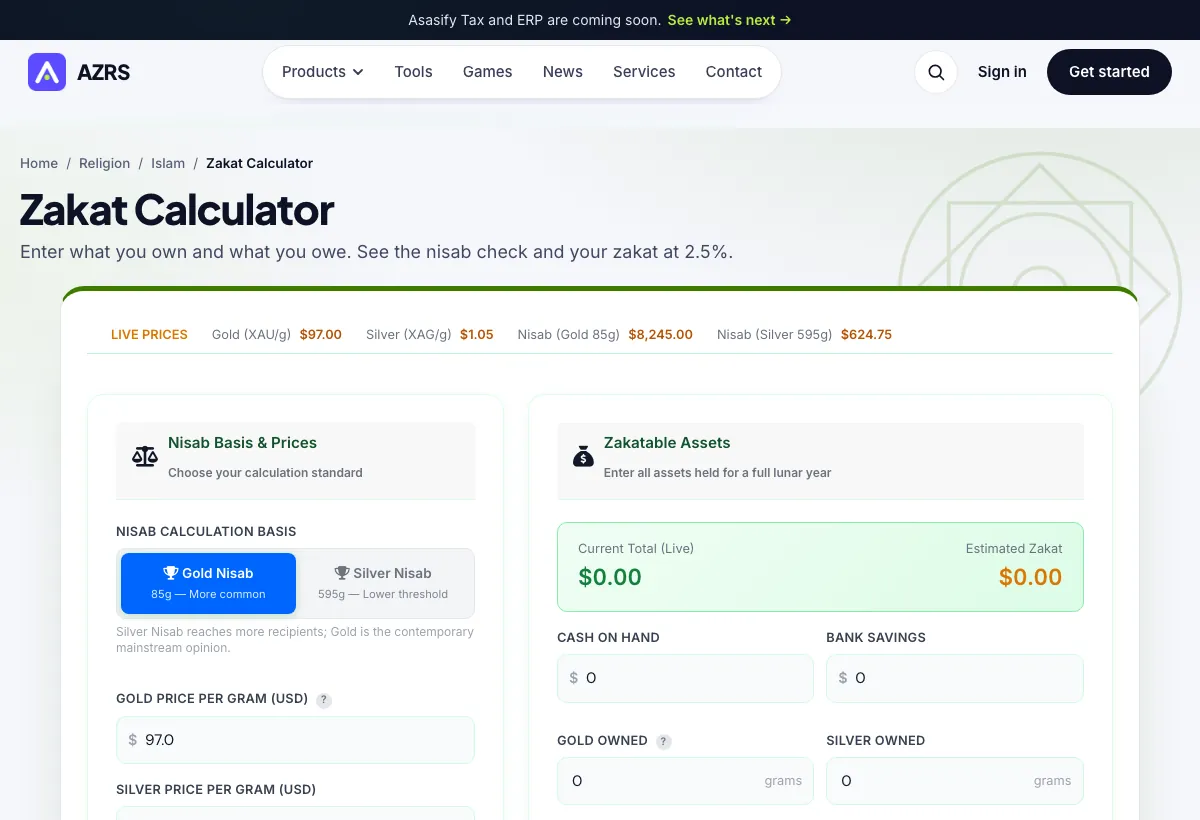
Zakat Calculator
Enter what you own and what you owe. See the nisab check and your zakat at 2.5%.
Guidance only. Confirm any religious ruling with a qualified scholar or your local mosque.
About the Zakat Calculator tool
Zakat is a yearly charity due on wealth that stays above the nisab for one full lunar year. The usual rate on cash, savings, trade goods and investments is 2.5%. The nisab is a minimum amount, worked out from either 85 grams of gold or 595 grams of silver.
This calculator adds up the assets you list, takes away debts that are due now, compares the total with the nisab you choose, and shows the zakat amount. It also keeps the prices you used so you can change them and see the result move.
It gives a clear estimate for common cases. Business stock, money owed to you, jewellery worn every day, and shared property are handled differently by different scholars, so use the result as a starting point and ask a qualified scholar about anything unusual.
How to use it
Pick a nisab basis. Choose gold or silver, and check that the price per gram is today's price in your currency.
Enter your assets. Add cash, bank savings, gold and silver, investments and trade goods. Leave a field empty if it does not apply.
Enter debts due now. Add loans and bills you must pay soon. Debts far in the future are usually left out of this step.
Read the result. The page shows your net wealth, whether it is above the nisab, and the zakat due at 2.5%.
A simple example
Net wealth: 7,500
Above the nisab, so zakat is due
Zakat at 2.5%: 187.50
Tips for good results
- Use one currency for every field, including the gold and silver prices.
- Count your wealth on the same day each year, such as the first day of Ramadan, so it is easy to repeat.
- Keep a note of the date your wealth first passed the nisab. That starts your lunar year.
- If your net wealth is close to the nisab, ask a scholar before deciding.
Common mistakes
- Mixing currencies, for example entering savings in dollars and a gold price in euros.
- Counting debts that are not due yet, or forgetting debts that are.
- Using an old gold or silver price, which moves the nisab.
- Treating the result as a final ruling for a business or shared property.
Common questions
What is the nisab?
The nisab is the smallest amount of wealth on which zakat becomes due. It is measured as 85 grams of gold or 595 grams of silver, at the price on the day you calculate.
Which nisab should I choose, gold or silver?
Scholars differ. Many people use the silver nisab because it is lower, which brings more people into giving. Choose the one your scholar or local mosque follows.
Is zakat due on the home I live in?
Generally no. Zakat applies to wealth that can grow or be spent, such as savings, gold, trade goods and investments, not to a home or car you use every day.
Can I give zakat in advance?
Many scholars allow paying early, as long as the person is already above the nisab. Ask your scholar how to settle any difference at year end.
Does this tool store my figures?
The calculation runs from the numbers you type on this page. Do not enter anything you would not want on your own screen, and keep your own record.
More Islam tools
See Free Zakat Calculator 2026 in action
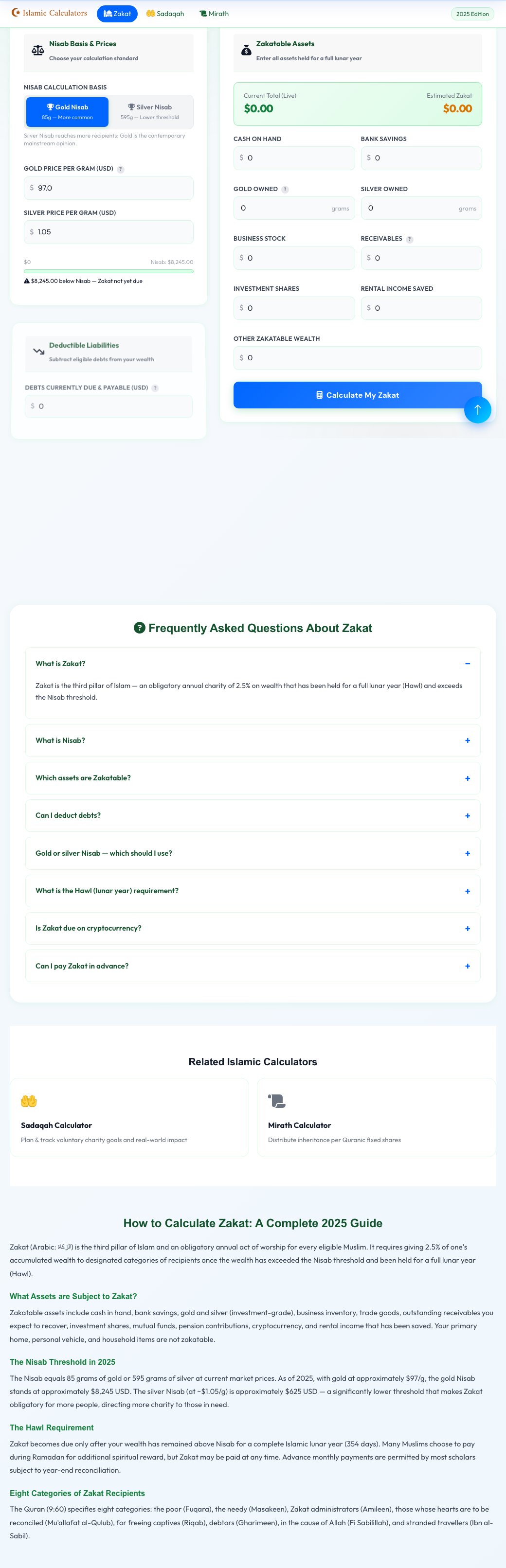
Free Zakat Calculator 2026
Calculate your annual Zakat obligation accurately across gold, silver, cash, investments and business stock. Enter your assets and the calculator checks them against the live Nisab threshold (the minimum wealth level that makes Zakat obligatory), then applies the standard 2.5% rate to the portion that qualifies.
The calculator supports both the gold Nisab (85 grams) and silver Nisab (612.36 grams) standards, lets you choose which one applies based on your school of thought, and gives a full breakdown by asset category — cash, gold, silver, investments and business inventory — so you can see exactly how the final Zakat figure was reached.
Use it in 4 steps
Choose whether to calculate Nisab using the gold or silver standard.
Enter your cash, gold, silver, investment and business asset values.
Subtract any outstanding debts and basic living needs.
Review whether your net wealth exceeds Nisab and see your total Zakat due at 2.5%.
Key features
Live Nisab threshold check
Compares your total zakatable wealth against the current gold or silver Nisab value.
Multiple asset types
Covers cash, gold, silver, investments and business stock in one calculation.
Hawl tracker
Accounts for the requirement that wealth be held for one full lunar year before Zakat is due.
Full asset breakdown
See exactly how much Zakat is owed per asset category, not just a single total.
A real example, step by step
Someone with $12,000 in cash, gold worth $3,000 and no debts, using the silver Nisab (roughly $650), has zakatable wealth well above the threshold, so Zakat due is 2.5% of $15,000 = $375.
Who uses this tool
Muslims calculating annual Zakat
Get an accurate, category-by-category Zakat figure instead of estimating by hand.
Business owners
Include business inventory and stock correctly alongside personal assets.
Anyone new to Zakat calculation
Learn which assets are zakatable and which (like a primary home) are exempt.
Tips for the best results
- Zakat is due only on wealth held for one full lunar year (Hawl) above the Nisab threshold — track your Hawl date rather than recalculating from scratch each time.
- Your primary residence and personal vehicle are exempt; only assets held for trade, investment or savings are zakatable.
- Subtract genuine short-term debts and immediate living needs from your gross assets before applying the 2.5% rate.
- Consult a knowledgeable scholar for edge cases like retirement accounts, rental property income or complex business inventory, since rulings vary.
Common mistakes to avoid
- Forgetting to subtract outstanding debts before calculating Zakat on gross assets.
- Using the wrong Nisab standard (gold vs. silver) for your school of thought without checking which applies.
- Including exempt assets like a primary home or personal-use vehicle in the zakatable total.
Frequently asked questions
What is the Zakat Nisab threshold for 2026?
The Nisab is the minimum wealth for Zakat eligibility. Gold Nisab is 85 grams (roughly $8,000-9,500 depending on the gold price); silver Nisab is 612.36 grams (roughly $600-700). Most scholars use the silver Nisab for cash and general wealth.
How is Zakat calculated?
Zakat is 2.5% of total zakatable assets (cash, gold, silver, investments, business inventory) that exceed the Nisab and have been held for one complete lunar year (Hawl), after subtracting basic living needs and outstanding debts.
Do I pay Zakat on my house and car?
No, a primary residence and personal vehicle used for daily transportation are exempt. Only assets held for trade or investment, including rental properties, are zakatable.
Who must pay Zakat?
Every sane adult Muslim who possesses wealth above the Nisab threshold for a complete lunar year, both men and women.
Who are the 8 categories of Zakat recipients?
Quran 9:60 specifies: the poor, the destitute, Zakat administrators, those whose hearts are inclined to Islam, freeing slaves, those in debt, those in the way of Allah, and stranded travelers.
Is this Zakat calculator free?
Yes, free with no signup, and nothing you enter is stored.
Free, fast and private by design
No signup, no watermark. New AZRS tools are added every week.