Bernoulli's Principle & Fluid Flow
Squeeze a pipe and watch the fluid speed up while the pressure gauge drops.
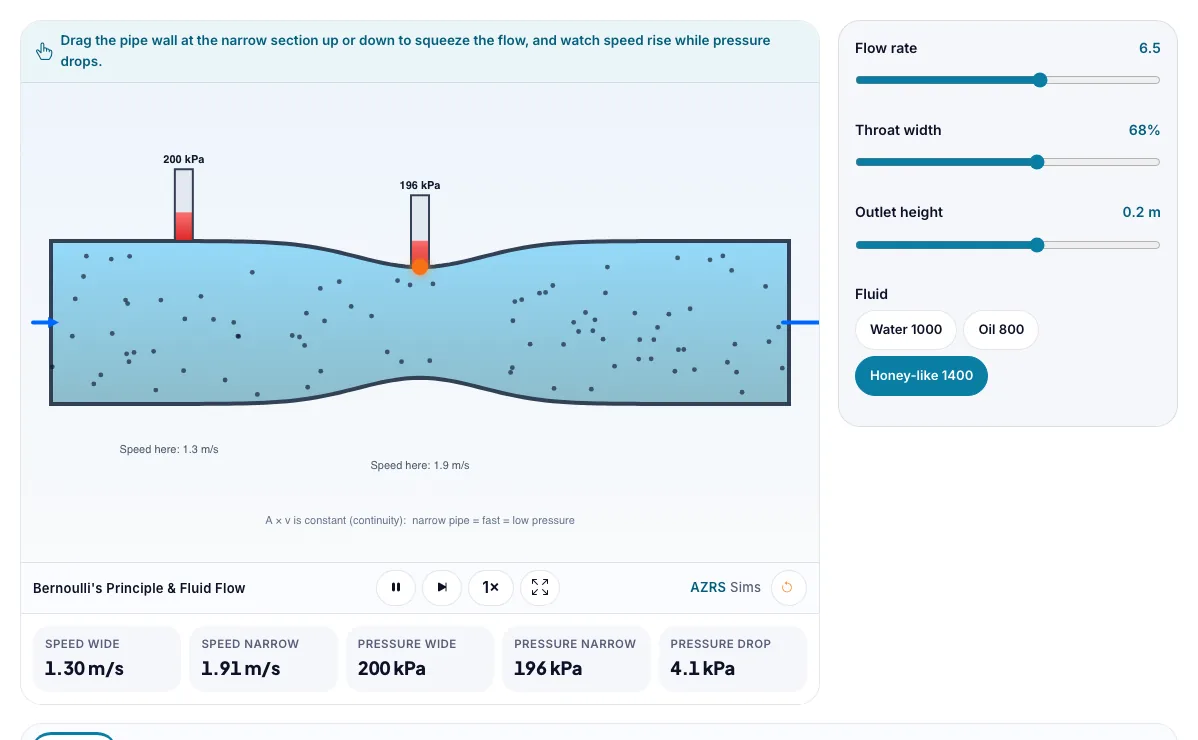
Drag the pipe wall at the narrow section up or down to squeeze the flow, and watch speed rise while pressure drops.
What the Bernoulli's Principle & Fluid Flow shows
Squeeze a pipe and watch the fluid speed up while the pressure gauge drops. Free, no signup, runs in your browser. Works on phones and computers. Built for physics, the bernoulli's principle & fluid flow runs instantly in your browser: change a setting or drag an object and the result updates at once, so you learn by trying things out rather than only reading about them.
Fluid flows through a pipe that narrows. The fluid speeds up in the narrow part and the pressure there drops.
How to use the Bernoulli's Principle & Fluid Flow
In the Bernoulli's Principle & Fluid Flow, use the controls to change Flow rate, Throat width, Outlet height, Fluid. The simulation reacts instantly.
In the Bernoulli's Principle & Fluid Flow, pick an option such as Water 1000, Oil 800, Honey-like 1400 to switch modes or load an example.
Start with this experiment: Squeeze the throat to 20% and read the pressure drop. Drag any glowing handle, object or slider with your mouse or finger and the Bernoulli's Principle & Fluid Flow responds in real time.
Change one setting at a time and watch which readout moves, then compare it with this idea: Continuity: A₁v₁ = A₂v₂, so a narrow pipe means faster flow.
Things to try
Squeeze the throat to 20% and read the pressure drop.
Change to a denser fluid.
Raise the outlet and see the pressure fall.
The science behind it
Continuity: A₁v₁ = A₂v₂, so a narrow pipe means faster flow.
Bernoulli: faster fluid has lower pressure.
Raising the outlet costs pressure (ρgh).
The pressure drop grows with the square of the speed.
A worked example with real numbers
v2 = 2 x 10 / 5 = 4 m/s
P2 = 200000 + 0.5 x 1000 x (4 - 16) = 194,000 Pa = 194 kPa
Tips and common mistakes
Tips
- Narrow the pipe and watch the pressure gauge drop.
- Raise the pipe and see the height term trade with pressure.
Common mistakes
- Believing narrow means higher pressure; for flowing fluid the fast part has lower pressure.
- Using the equation across a pipe with big losses or turbulence.
Where this is used
Carburettors, spray bottles, aeroplane wings, medical flow meters and chimney draughts all use Bernoulli's principle.
Who is this simulation for?
Physics students in middle school, high school and first-year university, teachers who want a quick demonstration for the projector, and anyone revising for exams. A good first experiment in the Bernoulli's Principle & Fluid Flow: Squeeze the throat to 20% and read the pressure drop. The key relation to keep an eye on: A1 v1 = A2 v2 (continuity); P + (1/2) rho v^2 + rho g h = constant.
For teachers: project the Bernoulli's Principle & Fluid Flow on the board, let students predict the result, then run it together and test this: Change to a denser fluid. For students: change one thing at a time and write down what changes.
Frequently asked questions
What is the Venturi effect?
Fluid speeds up in a narrow section and its pressure falls.
Does Bernoulli's principle explain aeroplane lift?
It is part of it; faster air over the wing means lower pressure, together with the wing deflecting air downwards.
Is the Bernoulli's Principle & Fluid Flow free to use?
Yes. The Bernoulli's Principle & Fluid Flow is free, needs no signup or download and runs in your web browser. It is part of the Physics group of AZRS simulations.
Does the Bernoulli's Principle & Fluid Flow work on a phone or tablet?
Yes. The Bernoulli's Principle & Fluid Flow takes touch input as well as mouse input, so you can use its 4 adjustable settings with a finger. A larger screen makes the controls and graphs easier to read.