Heat Exchanger Design Lab (LMTD & Effectiveness-NTU)
Switch between counter-flow and parallel-flow, size a real heat exchanger, and watch the hot and cold temperature profiles run the length of the unit while effectiveness-NTU and LMTD agree on the same heat duty.
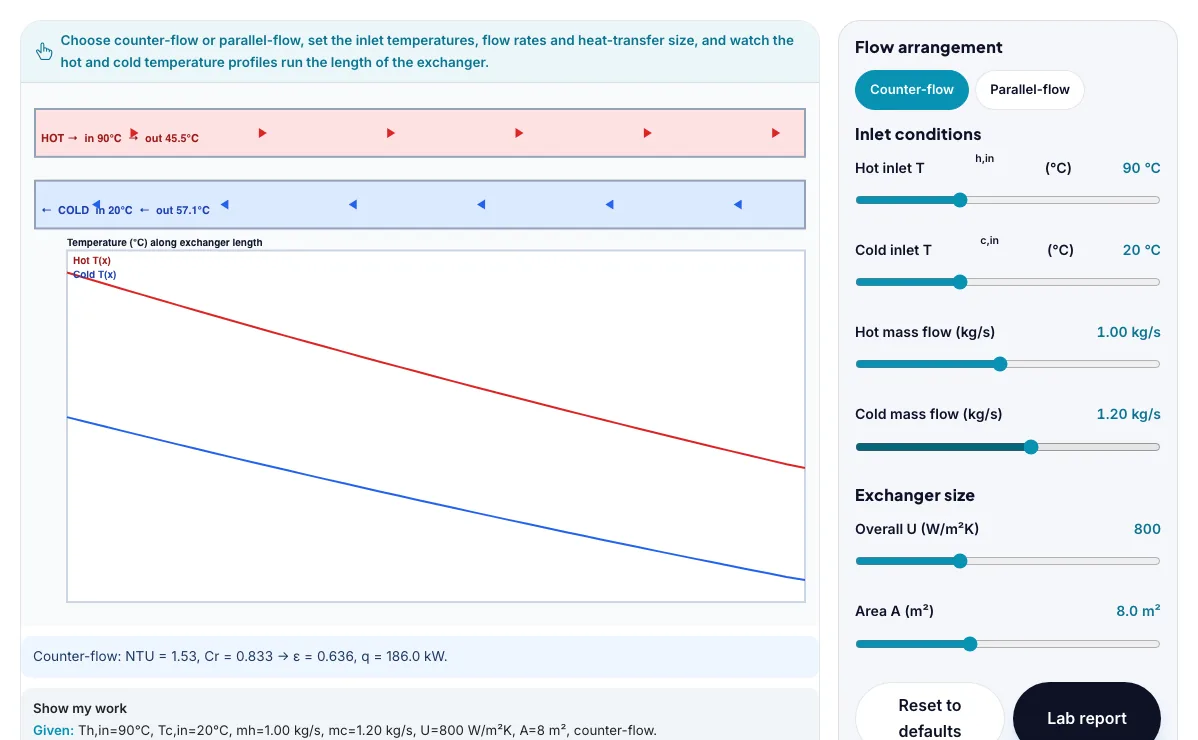
Choose counter-flow or parallel-flow, set the inlet temperatures, flow rates and heat-transfer size, and watch the hot and cold temperature profiles run the length of the exchanger.
NTU = UA/Cmin, Cr = Cmin/Cmax, ε from flow arrangement, q = εCmin(Th,in-Tc,in). Cross-check via LMTD: q = UA·ΔTlmWhat the Heat Exchanger Design Lab (LMTD & Effectiveness-NTU) shows
Switch between counter-flow and parallel-flow, size a real heat exchanger, and watch the hot. Free, no signup, runs in your browser. Built for engineering, the heat exchanger design lab (lmtd & effectiveness-ntu) runs instantly in your browser: change a setting or drag an object and the result updates at once, so you learn by trying things out rather than only reading about them.
Hot and cold streams swap heat through a heat exchanger. The sim compares counter-flow and parallel-flow and gives the effectiveness.
How to use the Heat Exchanger Design Lab (LMTD & Effectiveness-NTU)
In the Heat Exchanger Design Lab (LMTD & Effectiveness-NTU), use the controls to change Hot inlet Th,in (°C), Cold inlet Tc,in (°C), Hot mass flow (kg/s), Cold mass flow (kg/s), Overall U (W/m²K), and more. The simulation reacts instantly.
In the Heat Exchanger Design Lab (LMTD & Effectiveness-NTU), pick an option such as Counter-flow, Parallel-flow to switch modes or load an example.
Start with this experiment: Try the counter-flow effectiveness-above-0.80 challenge. Drag any glowing handle, object or slider with your mouse or finger and the Heat Exchanger Design Lab (LMTD & Effectiveness-NTU) responds in real time.
Change one setting at a time and watch which readout moves, then compare it with this idea: The effectiveness-NTU method rates a heat exchanger by NTU = UA/Cmin and the capacity-rate ratio Cr = Cmin/Cmax, giving an effectiveness that directly yields the actual heat duty without needing to guess outlet temperatures first.
Things to try
Try the counter-flow effectiveness-above-0.80 challenge.
Switch to parallel-flow, push U and A to maximum, and watch effectiveness plateau at the 1/(1+Cr) ceiling.
Compare the same U, A and flow rates between counter-flow and parallel-flow and see the heat duty difference.
Watch the hot and cold temperature curves on the chart - see them stay apart in parallel-flow but nearly cross in counter-flow.
The science behind it
The effectiveness-NTU method rates a heat exchanger by NTU = UA/Cmin and the capacity-rate ratio Cr = Cmin/Cmax, giving an effectiveness that directly yields the actual heat duty without needing to guess outlet temperatures first.
For the same NTU and Cr, a counter-flow exchanger always reaches a higher effectiveness than a parallel-flow exchanger of identical size.
Parallel-flow effectiveness is capped at 1/(1+Cr) no matter how large NTU gets, because the two fluids' temperatures can only approach each other, never cross, as they travel the same direction; counter-flow has no such hard ceiling.
The log-mean temperature difference (LMTD) method gives the same heat duty as effectiveness-NTU when both are done correctly - q = UA times LMTD equals q from epsilon times Cmin times the maximum possible temperature difference.
A worked example with real numbers
dT1 = 40, dT2 = 40, LMTD = 40 K
Q = 5000 x 40 = 200 kW
Tips and common mistakes
Tips
- Switch to parallel flow and see lower heat transfer.
- Increase area to raise NTU.
Common mistakes
- Using the plain average of temperature differences.
- Forgetting the cold outlet cannot exceed the hot outlet in parallel flow.
Where this is used
Process, chemical and HVAC engineers use exactly this effectiveness-NTU and LMTD cross-check when sizing shell-and-tube or plate heat exchangers for power plants, chillers, radiators and industrial process cooling, since choosing counter-flow over parallel-flow can meaningfully shrink the exchanger needed for the same duty.
Who is this simulation for?
Engineering and technology students, makers, robotics clubs and teachers of design and technology. A good first experiment in the Heat Exchanger Design Lab (LMTD & Effectiveness-NTU): Try the counter-flow effectiveness-above-0.80 challenge. The key relation to keep an eye on: Q = U A (delta T)_lm; effectiveness = Q / Q_max; NTU = U A / C_min.
For teachers: project the Heat Exchanger Design Lab (LMTD & Effectiveness-NTU) on the board, let students predict the result, then run it together and test this: Switch to parallel-flow, push U and A to maximum, and watch effectiveness plateau at the 1/(1+Cr) ceiling. For students: change one thing at a time and write down what changes.
Frequently asked questions
Why does counter-flow always transfer more heat than parallel-flow for the same size and flow rates?
In parallel-flow both fluids move the same direction, so their temperature difference is largest at the inlet end and shrinks steadily, capping how close the outlet temperatures can get; in counter-flow the fluids move opposite directions, keeping a more even temperature difference along the whole length, which lets the cold outlet temperature actually exceed the hot outlet temperature in some cases - something parallel-flow can never achieve.
Why does parallel-flow effectiveness plateau instead of climbing toward 1 as NTU increases?
As NTU grows, both fluids approach a common temperature at the outlet since they can never cross paths (same direction of travel), and that common-temperature limit fixes the maximum possible heat duty at a fraction 1/(1+Cr) of the theoretical maximum - adding more area beyond that point does not transfer any additional heat.
Is the Heat Exchanger Design Lab (LMTD & Effectiveness-NTU) free to use?
Yes. The Heat Exchanger Design Lab (LMTD & Effectiveness-NTU) is free, needs no signup or download and runs in your web browser. It is part of the Engineering group of AZRS simulations.
Does the Heat Exchanger Design Lab (LMTD & Effectiveness-NTU) work on a phone or tablet?
Yes. The Heat Exchanger Design Lab (LMTD & Effectiveness-NTU) takes touch input as well as mouse input, so you can use its 6 adjustable settings with a finger. A larger screen makes the controls and graphs easier to read.