
Explore the Sediment Transport & River Erosion Lab
Adjust slope, discharge, channel width and grain size and use the real Hjulström curve to predict whether a river erodes. Works on phones and computers.
- Free to use
- No signup
- Nothing to install
- Runs in your browser
Illustration. Open the tool for the real thing.
See it in action
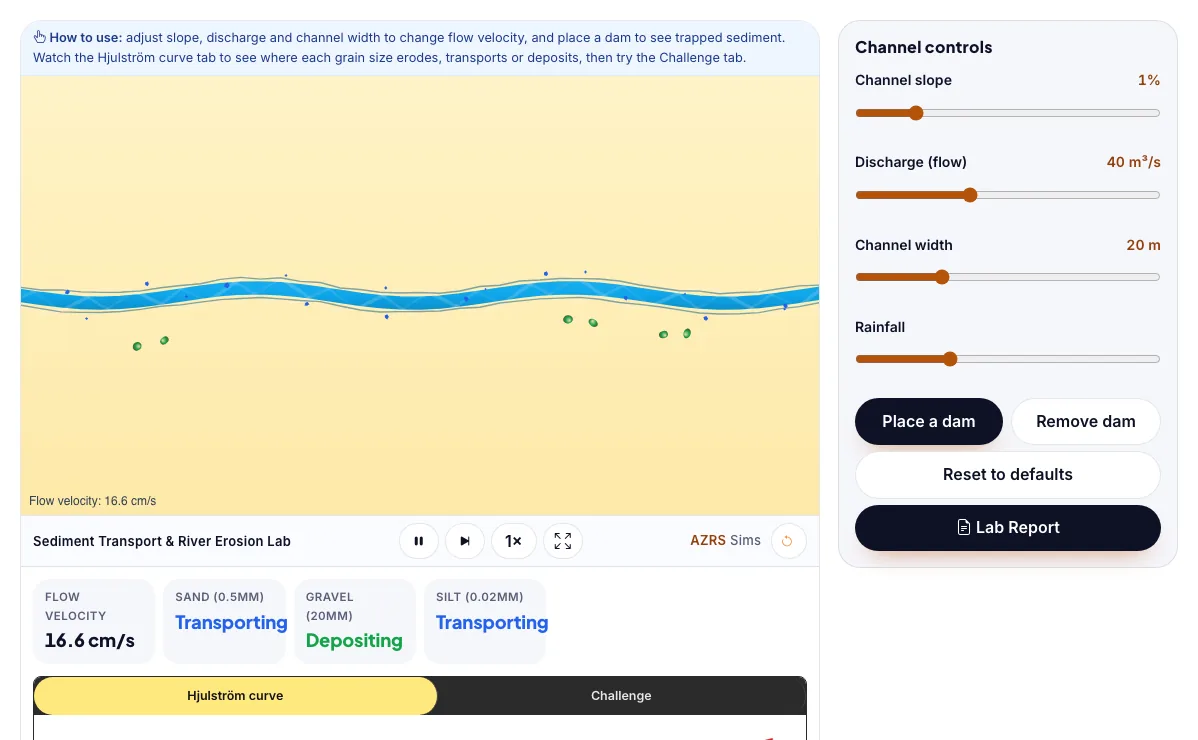
The Sediment Transport & River Erosion Lab with sample data entered and the result showing.
What is the Sediment Transport & River Erosion Lab?
Adjust slope, discharge, channel width and grain size and use the real Hjulström curve to predict whether a river erodes, transports or deposits sediment — then add a dam and watch downstream effects. It runs in your browser, so a change to a setting or a drag on an object shows up at once.
River engineers use the Hjulström curve and dam-effect reasoning to design channels, protect bridges and predict where a dam will cause downstream riverbed erosion.
3 steps to your result
Open the tool and follow along. Nothing to install.
What you get
The Hjulström curve shows the flow velocity needed to erode, transport or deposit a given grain size.
Fine sand is actually easier to erode than clay, because clay particles are cohesive and stick together.
Gravel needs high velocity to erode but drops out (deposits) quickly once velocity falls.
Find a flow velocity where sand transports but gravel deposits (the challenge).
Place a dam and watch the channel change upstream and downstream.
Raise the slope and discharge together and see the meander pattern strengthen.
Used for
Pick one to see how it fits.
Teachers
For teachers: project the Sediment Transport & River Erosion Lab on the board, let students predict the result, then run it together and test this: Place a dam and watch the channel change upstream and downstream. For students: change one thing at a time and write down what changes.
Try it freeHow it compares
A plain look at this tool next to the usual alternative.
| This simulation | Textbook diagram | |
|---|---|---|
| Interactive | Drag, tap and change settings | Fixed picture |
| Install | Nothing to install | Not needed |
| Cost | Free to use | Depends on the book |
Questions people ask
Why is fine sand the easiest sediment to erode?
Coarser grains like gravel need high velocity because they are heavy; very fine grains like clay resist erosion because their particles are cohesive and stick together, so sand sits at the easiest-to-erode minimum.
Why do dams cause downstream erosion?
The reservoir traps sediment, so the river downstream still has erosive energy but nothing left to deposit, and it starts cutting into its own banks and bed.
Is the Sediment Transport & River Erosion Lab free to use?
Yes. The Sediment Transport & River Erosion Lab is free, needs no signup or download and runs in your web browser. It is part of the Geology group of AZRS simulations.
Does the Sediment Transport & River Erosion Lab work on a phone or tablet?
Yes. The Sediment Transport & River Erosion Lab takes touch input as well as mouse input, so you can use its 4 adjustable settings with a finger. A larger screen makes the controls and graphs easier to read.
How do I use the Sediment Transport & River Erosion Lab?
1. In the Sediment Transport & River Erosion Lab, use the controls to change Channel slope, Discharge (flow), Channel width, Rainfall. The simulation reacts instantly. 2. In the Sediment Transport & River Erosion Lab, press "Place a dam", "Remove dam" to start, reset or change what is happening. 3. Start with this experiment: Find a flow velocity where sand transports but gravel deposits (the challenge). Drag any glowing handle, object or slider with your mouse or finger and the Sediment Transport & River Erosion Lab responds in real time. 4. Change one setting at a time and watch which readout moves, then compare it with this idea: The Hjulström curve shows the flow velocity needed to erode, transport or deposit a given grain size.
More free tools
Related to the Sediment Transport & River Erosion Lab.
Try the Sediment Transport & River Erosion Lab now
Adjust slope, discharge, channel width and grain size and use the real Hjulström curve to. Free to use.
Try it free