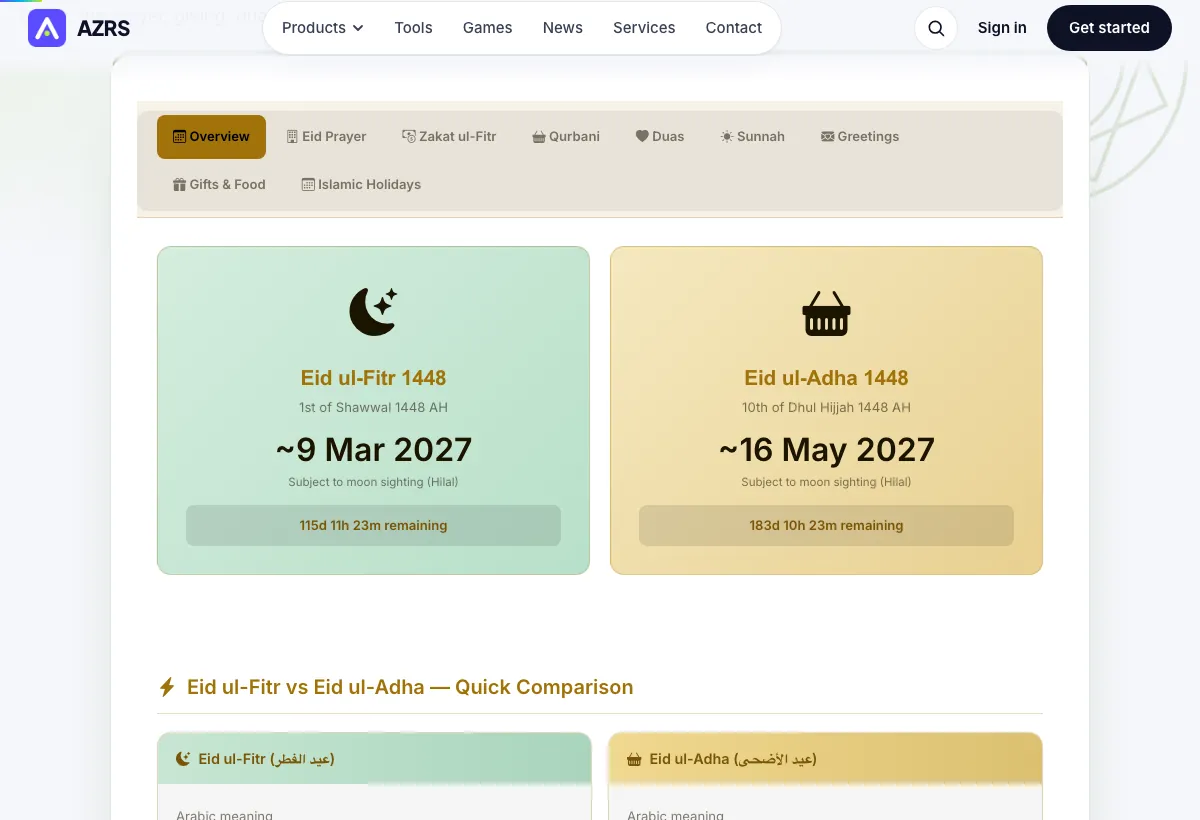
Eid ul-Fitr and Eid ul-Adha Guide
Dates, the prayer, giving, duas and traditions for both Eids in one place.
Eid ul-Fitr 1448
Eid ul-Adha 1448
| Madhab | Ruling | Details |
|---|---|---|
| Hanafi | Wajib (Obligatory) | Obligatory on every free, adult, sane, resident Muslim male. Missing it without excuse is sinful. |
| Shafi'i | Sunnah Mu'akkadah | Strong confirmed Sunnah; highly blameworthy to abandon without excuse. |
| Maliki | Sunnah Mu'akkadah | Confirmed Sunnah; one who abandons it without excuse is sinful according to some Maliki scholars. |
| Hanbali | Fard Kifayah | Communal obligation — if some members of community perform it, the obligation falls from others. Imam Ahmad held it was individually obligatory (Fard Ayn). |
Conclusion: All four madhabs agree that Eid prayer is a major, highly significant act of worship. Men should not miss it without a valid Islamic excuse. Women are encouraged to attend, and the Prophet ﷺ commanded even menstruating women to come and witness the good, though they do not pray.
Absolutely Forbidden
- Fasting on Eid day — Strictly Haram on both Eids. The Prophet ﷺ forbade fasting on both Eid days. (Bukhari & Muslim)
- Fasting on 11th–13th Dhul Hijjah (Ayyam al-Tashreeq) — also Haram without Hajj.
- Cutting nails or hair before Qurbani — for one who intends to sacrifice, forbidden from 1st Dhul Hijjah.
- Mixed free-mingling — men and women freely mixing outside Islamic bounds.
- Music, intoxicants, indecency — Eid does not make Haram things Halal.
Disliked (Makruh)
- Performing voluntary (nafl) prayers at home before the Eid prayer.
- Leaving the Eid prayer without a valid reason.
- Being excessively extravagant in food/gifts beyond one's means.
- Sleeping after Fajr on Eid day (it is a day of worship).
- Returning from the Eid prayer via the same route (against the Sunnah of taking different routes).
Guidance only. Confirm any religious ruling with a qualified scholar or your local mosque.
About the Eid Guide tool
Muslims celebrate two Eids each year. Eid ul-Fitr marks the end of Ramadan on the first of Shawwal, and Eid ul-Adha falls on the tenth of Dhul Hijjah, after the Day of Arafah. Each begins with a congregational prayer, and each has its own acts of giving.
This guide uses tabs for the main topics: an overview with dates, the Eid prayer, zakat ul-fitr, Qurbani, duas, sunnah acts, greetings, gifts and food, and a list of Islamic dates. Pick the tab you need and read the sections in order.
The dates are estimates based on calculation, and moon sighting decides the real day. Rulings differ among the schools of thought, so where a page gives a view, treat it as general guidance and confirm with your local mosque or a qualified scholar.
How to use it
Check the date. Read the overview for the estimated dates and confirm the day with your local mosque.
Plan the prayer. Open the prayer tab for the method and find out the time and place your mosque has announced.
Give what is due. Before Eid ul-Fitr, read the zakat ul-fitr tab. Before Eid ul-Adha, read the Qurbani tab.
Prepare the day. Use the sunnah tab for acts such as bathing, wearing your best clothes and taking a different route home.
Share the joy. Use the greetings and gifts tabs for messages, gift ideas and traditional foods.
A simple example
Overview shows the estimated Eid ul-Fitr date
The zakat tab shows what to give before the prayer
The prayer tab shows how the Eid prayer is offered
Tips for good results
- Confirm the date and the prayer time with your mosque a day ahead.
- Pay zakat ul-fitr before the Eid prayer so it reaches those in need in time.
- Plan your Qurbani early, since it is tied to set days.
- Keep greetings simple and kind, and include relatives you have not spoken to for a while.
Common mistakes
- Treating the estimated date as the official date.
- Paying zakat ul-fitr after the Eid prayer without a reason.
- Fasting on the day of Eid, which is not allowed.
- Using a view from one school as the only view without asking your mosque.
Common questions
When are the Eids?
Eid ul-Fitr is the first of Shawwal and Eid ul-Adha is the tenth of Dhul Hijjah. The Gregorian date depends on moon sighting, so confirm with your mosque.
Is the Eid prayer required?
Schools of thought describe it differently, from required to strongly recommended. Ask your local scholar which view your community follows.
Is fasting allowed on Eid?
Fasting on the two days of Eid is not allowed. Ask a scholar for questions about the days after Eid ul-Adha.
Why are the dates marked as estimates?
They are calculated ahead of time. Many communities wait for the sighting of the new moon.
Do I use this guide for rulings?
It is general guidance. For a ruling on your own case, ask a qualified scholar or your local mosque.