
Try the Which File Format Should I Use?
Answer a few questions about what you need — transparency, animation, editability, compression, compatibility — and get a real.
- Free to use
- No signup
- Nothing to install
- Runs in your browser
Illustration. Open the tool for the real thing.
See it in action
The Which File Format Should I Use? with sample data entered and the result showing.
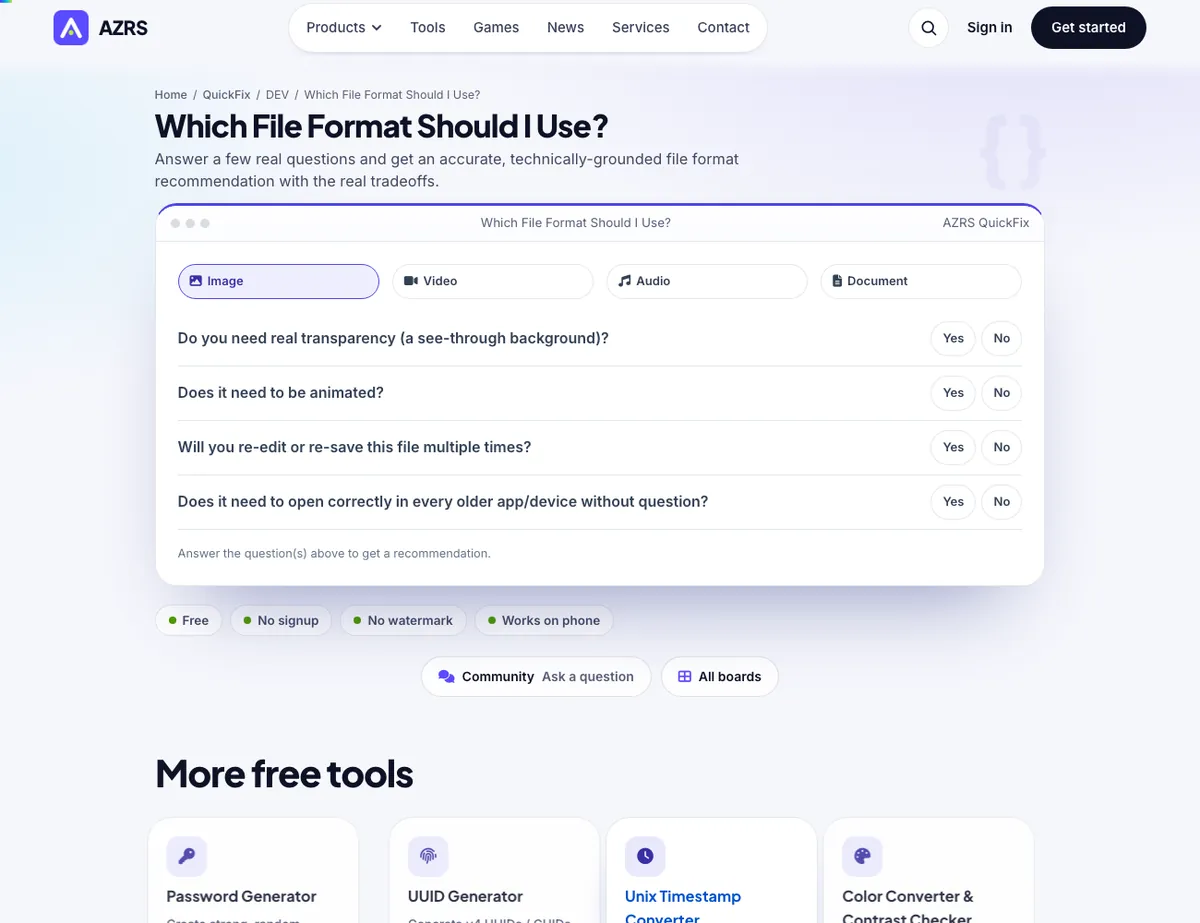
What is the Which File Format Should I Use??
Picking between JPEG, PNG, WebP and AVIF — or MP4, WebM and MOV — or MP3, FLAC, WAV and AAC — or DOCX, PDF and ODT — actually has real, factual right answers depending on what you need, not just personal preference. This tool asks a short set of real technical questions (do you need transparency? animation? lossless editing? maximum compatibility? smallest file size?) and walks a decision tree built from genuine, accurate technical facts about each format's compression method, quality behavior and real-world compatibility.
Every recommendation comes with the real technical reasoning behind it — for example, why PNG is lossless but WebP can be both lossless and smaller, why FLAC preserves the exact original audio while MP3 permanently discards data, or why a PDF freezes layout while a DOCX stays editable — so you understand the actual tradeoff, not just a bare recommendation.
3 steps to your result
Open the tool and follow along. Nothing to install.
What you get
Your specific answers (transparency, animation, editability, compatibility) change which format is actually recommended.
One tool spans the four format families people get stuck on most often.
Every recommendation states the genuine compression/quality/compatibility reasoning, not just a name.
See how your top recommendation stacks up against the runner-up formats on the facts that matter to you.
AZRS tools are free to open and use.
It opens in your browser, so there is nothing to download.
Used for
Pick one to see how it fits.
Anyone exporting an image, video or document and unsure which format to pick
Get a real answer grounded in actual technical facts instead of a guess.
Try it freeWeb developers choosing an image format for a site
Understand the genuine compression and browser-support tradeoffs between JPEG, PNG, WebP and AVIF.
Try it freeAnyone archiving photos, audio or documents long-term
Learn which formats are truly lossless versus which discard data permanently on save.
Try it freeHow it compares
A plain look at this tool next to the usual alternative.
| This utility | Desktop software | |
|---|---|---|
| Install | Nothing to install | Usually an app or program to install |
| Account | No signup | Depends on the product |
| Cost | Free to use | Free or paid, depends on the product |
| Where it runs | In your browser tab | On your computer |
Questions people ask
Is WebP really better than JPEG and PNG?
Technically, WebP usually produces a smaller file than JPEG at equivalent visible quality, and unlike JPEG it also supports a lossless mode and real transparency like PNG — its real downside is that some older software and workflows don't fully support it yet, which this tool weighs in the recommendation.
What's the real difference between lossy and lossless?
Lossless formats (PNG, FLAC, WAV) can be perfectly reconstructed to the original data; lossy formats (JPEG, MP3, most video codecs) permanently discard some information to shrink the file size, and that loss compounds if you re-save the file repeatedly.
Why does the tool ask about animation for images?
Because it's a real technical differentiator — GIF and WebP support animation natively, while JPEG and standard PNG do not, so animation need alone can immediately rule out or rule in specific formats.
Does this apply to video and audio too, not just images?
Yes — the same real-fact decision tree covers MP4/WebM/MOV for video and MP3/FLAC/WAV/AAC for audio, and DOCX/PDF/ODT for documents.
Is this AI-generated advice?
No — the format facts (compression type, transparency/animation support, real compatibility considerations) are fixed, accurate technical information built into the tool's decision logic, not generated per request.
More free tools
Related to the Which File Format Should I Use?.
Try the Which File Format Should I Use? now
Answer a few real questions and get an accurate, technically-grounded file format. Free to use.
Try it free