
Explore the Mountain Building Simulator
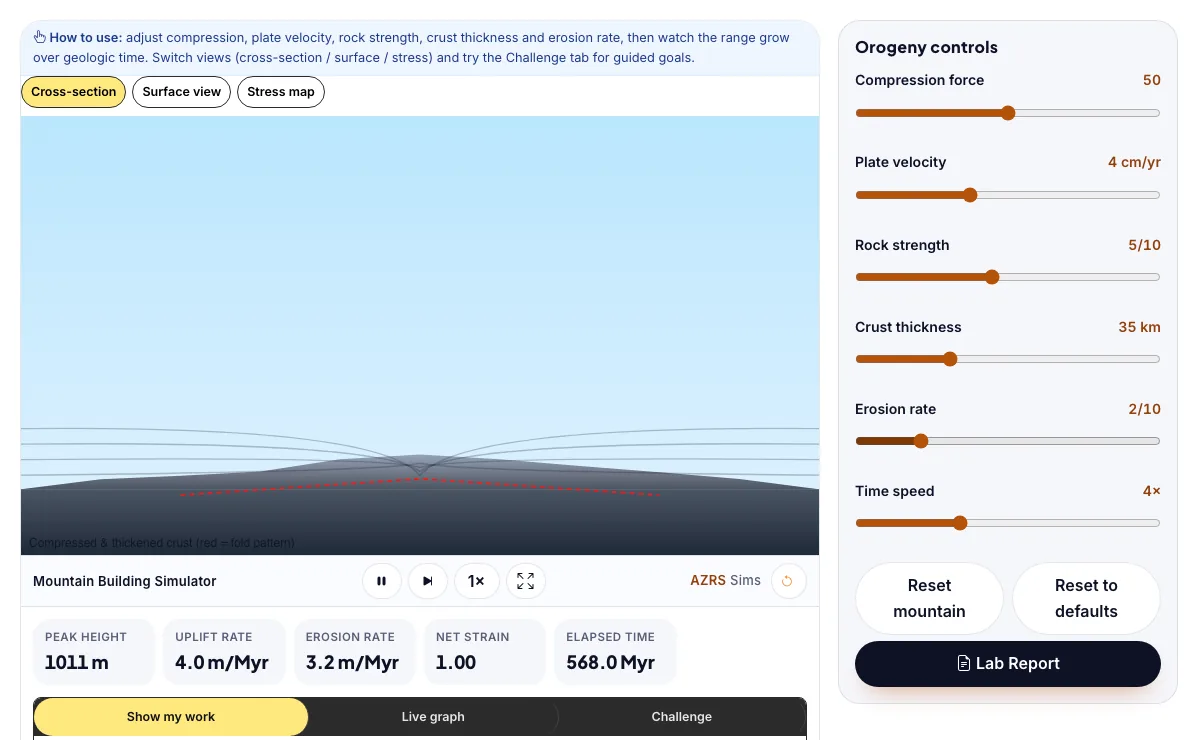
Compress a crustal block with adjustable plate velocity, rock strength and erosion, and watch a mountain range grow in real time cross-section.
- Free to use
- No signup
- Nothing to install
- Runs in your browser
Illustration. Open the tool for the real thing.
See it in action
The Mountain Building Simulator with sample data entered and the result showing.
What is the Mountain Building Simulator?
Compress a crustal block with adjustable plate velocity, rock strength and erosion, and watch a mountain range grow in real time cross-section, surface and stress views. It runs in your browser, so a change to a setting or a drag on an object shows up at once.
This uplift-versus-erosion balance is exactly how geologists explain why the Appalachians (old, eroded) are lower than the Himalaya (young, still rising faster than they erode).
3 steps to your result
Open the tool and follow along. Nothing to install.
What you get
Uplift rate grows with compression force and plate velocity, and falls with greater rock strength.
Erosion accelerates as a mountain gets taller because there is more relief and gravity-driven mass wasting.
Mountains tend toward an equilibrium height where uplift equals erosion.
Push compression to maximum and watch the mountain rise quickly.
Raise erosion rate and see the height plateau lower.
Switch to the stress view and see where compressive stress concentrates.
Used for
Pick one to see how it fits.
Teachers
For teachers: project the Mountain Building Simulator on the board, let students predict the result, then run it together and test this: Raise erosion rate and see the height plateau lower. For students: change one thing at a time and write down what changes.
Try it freeHow it compares
A plain look at this tool next to the usual alternative.
| This simulation | Textbook diagram | |
|---|---|---|
| Interactive | Drag, tap and change settings | Fixed picture |
| Install | Nothing to install | Not needed |
| Cost | Free to use | Depends on the book |
Questions people ask
Why don't mountains grow forever?
As they get taller, erosion accelerates until it matches the uplift rate, creating a rough steady-state height.
What is crustal thickening?
Compression at a plate boundary folds and stacks crustal rock, increasing both its thickness and its elevation.
Is the Mountain Building Simulator free to use?
Yes. The Mountain Building Simulator is free, needs no signup or download and runs in your web browser. It is part of the Geology group of AZRS simulations.
Does the Mountain Building Simulator work on a phone or tablet?
Yes. The Mountain Building Simulator takes touch input as well as mouse input, so you can use its 6 adjustable settings with a finger. A larger screen makes the controls and graphs easier to read.
How do I use the Mountain Building Simulator?
1. In the Mountain Building Simulator, use the controls to change Compression force, Plate velocity, Rock strength, Crust thickness, Erosion rate, and more. The simulation reacts instantly. 2. In the Mountain Building Simulator, press "Reset mountain" to start, reset or change what is happening. 3. Start with this experiment: Push compression to maximum and watch the mountain rise quickly. Drag any glowing handle, object or slider with your mouse or finger and the Mountain Building Simulator responds in real time. 4. Change one setting at a time and watch which readout moves, then compare it with this idea: Uplift rate grows with compression force and plate velocity, and falls with greater rock strength.
More free tools
Related to the Mountain Building Simulator.
Try the Mountain Building Simulator now
Compress a crustal block with adjustable plate velocity, rock strength and erosion, and. Free to use.
Try it free