
Open the Resistor Color Code Calculator
Free resistor colour code calculator. Select the colour bands on a 4-band or 5-band resistor to get its resistance and tolerance.
- Free to use
- No signup
- Nothing to install
- Runs in your browser
Illustration. Open the tool for the real thing.
See it in action
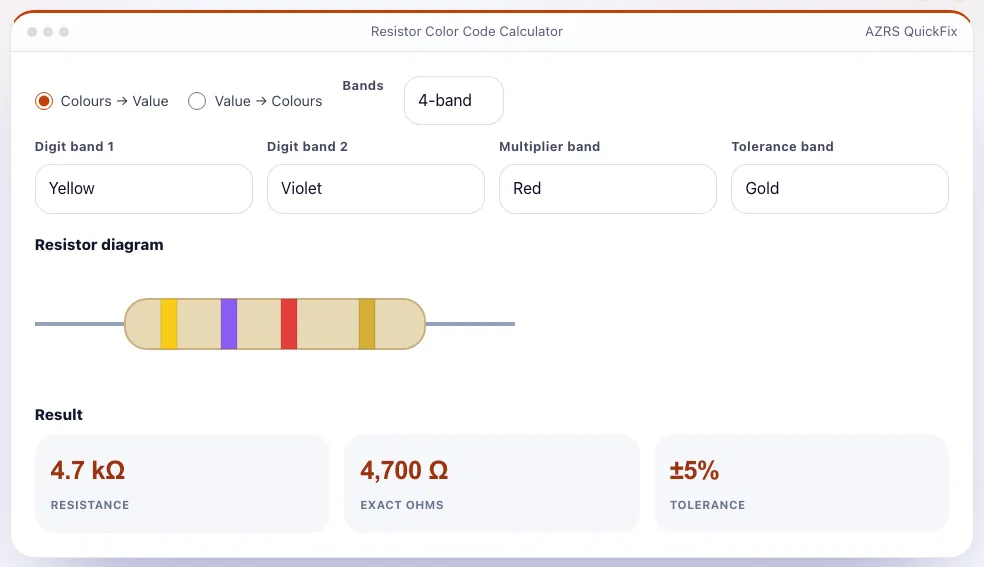
Shown running with its default sample values
What is the Resistor Color Code Calculator?
Reading a resistor's coloured bands correctly requires memorising the colour-to-digit code and knowing which band is the multiplier versus the tolerance, which is easy to get backwards under a magnifying glass or bad lighting. This calculator works in both directions: pick the colour of each band on a standard 4-band or 5-band resistor and it instantly shows the resistance value, tolerance and typical use case, or type in a resistance value and it shows you which colour bands to expect.
It follows the standard IEC 60062 colour code used on virtually all through-hole resistors, and the visual resistor diagram updates live as you pick colours, so you can directly compare it against the physical component in your hand to confirm you're reading it correctly.
3 steps to your result
Open the tool and follow along. Nothing to install.
What you get
Covers the two most common resistor band layouts.
Decode colours to a value, or encode a value to colours.
A resistor graphic updates as you pick each band's colour.
Shows the ± tolerance percentage alongside the resistance.
AZRS tools are free to open and use.
It opens in your browser, so there is nothing to download.
Used for
Pick one to see how it fits.
Makers and repair technicians
Confirm a replacement resistor matches the value needed.
Try it freeHow it compares
A plain look at this tool next to the usual alternative.
| This calculator | Desktop software | |
|---|---|---|
| Install | Nothing to install | Usually an app or program to install |
| Account | No signup | Depends on the product |
| Cost | Free to use | Free or paid, depends on the product |
| Where it runs | In your browser tab | On your computer |
Questions people ask
How do I know if my resistor is 4-band or 5-band?
Count the coloured bands: 4-band resistors have two digit bands, a multiplier and a tolerance band; 5-band resistors have three digit bands, a multiplier and a tolerance band, typically for tighter-tolerance components.
Which end do I start reading from?
Start from the band closest to one edge, furthest from the tolerance band — the tolerance band (often gold or silver) is usually spaced slightly apart from the rest and comes last.
What does the gold or silver band mean?
It indicates the tolerance: gold is typically ±5% and silver ±10%, meaning the actual resistance may vary from the stated value by that percentage.
Can I look up colours for a specific resistance value?
Yes, switch to Value → Colours mode, type the resistance, and it shows the matching band colours.
Does this work for surface-mount (SMD) resistors?
No, SMD resistors typically use printed numeric codes rather than colour bands; this tool covers only colour-banded through-hole resistors.
More free tools
Related to the Resistor Color Code Calculator.
Try the Resistor Color Code Calculator now
Decode a resistor's colour bands into its resistance value, or encode a value into bands. Free to use.
Try it free