
Explore the Pipe Flow & Reynolds Number Simulator
Pick a fluid and a pipe, set the flow rate, and watch whether it flows in smooth layers or chaotic turbulence. Free, no signup, runs in your browser.
- Free to use
- No signup
- Nothing to install
- Runs in your browser
Illustration. Open the tool for the real thing.
See it in action
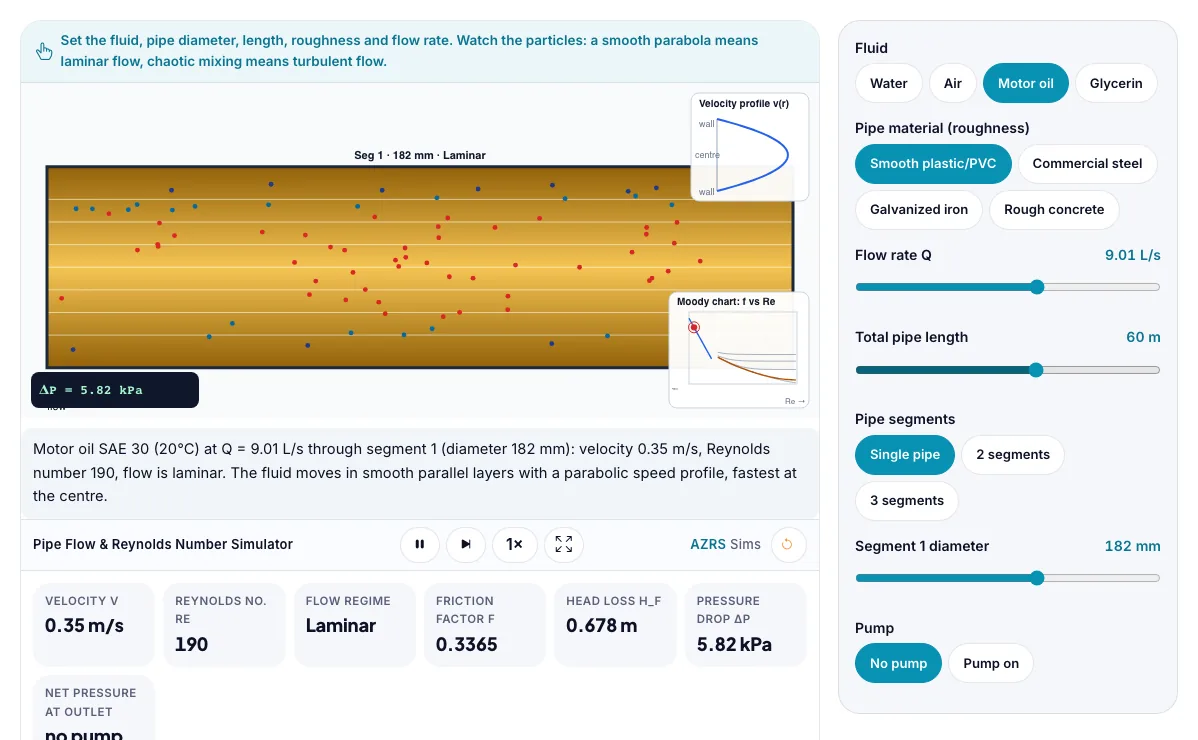
The Pipe Flow & Reynolds Number Simulator with sample data entered and the result showing.
What is the Pipe Flow & Reynolds Number Simulator?
Pick a fluid and a pipe, set the flow rate, and watch whether it flows in smooth layers or chaotic turbulence. It runs in your browser, so a change to a setting or a drag on an object shows up at once.
Plumbers and HVAC engineers size pipes and ducts using these same laminar/turbulent thresholds; oil and gas pipelines are designed around Reynolds number and Darcy-Weisbach head loss to choose pump power; blood flow in large arteries is normally laminar but can turn turbulent past a narrowing or aneurysm, which doctors listen for as a bruit; and aircraft fuel-line and hydraulic-line sizing all rely on exactly this friction-factor and pressure-drop calculation.
3 steps to your result
Open the tool and follow along. Nothing to install.
What you get
The Reynolds number Re = ρVD/μ compares inertial forces to viscous forces inside a moving fluid, and it alone decides whether a flow is laminar or turbulent.
Laminar flow (Re < 2300) moves in smooth parallel layers with a parabolic velocity profile: fastest at the pipe's centre, zero at the wall.
Turbulent flow (Re > 4000) mixes chaotically and has a much flatter velocity profile across most of the pipe, with a thin slow layer right at the wall.
Set the fluid to water and slowly raise the flow rate from near zero: watch the particle pattern break from a smooth parabola into chaotic mixing right around Re = 2300-4000.
Switch the fluid to glycerin without changing anything else, and see the flow drop back to laminar even at a flow rate that made water turbulent.
Turn on 3 segments and make the middle one much narrower than the other two. Check the table: Q stays fixed but V and Re both jump up in the narrow segment.
Used for
Pick one to see how it fits.
Engineering learners
Engineering and technology students, makers, robotics clubs and teachers of design and technology.
Try it freeTeachers
For teachers: project the Pipe Flow & Reynolds Number Simulator on the board, let students predict the result, then run it together and test this: Switch the fluid to glycerin without changing anything else, and see the flow drop back to laminar even at a flow rate that made water turbulent. For students: change one thing at a time and write down what changes.
Try it freeHow it compares
A plain look at this tool next to the usual alternative.
| This simulation | Textbook diagram | |
|---|---|---|
| Interactive | Drag, tap and change settings | Fixed picture |
| Install | Nothing to install | Not needed |
| Cost | Free to use | Depends on the book |
Questions people ask
How is this different from Bernoulli's principle?
Bernoulli's principle (see the separate Bernoulli's Principle simulation) is about frictionless energy trade-offs between velocity and pressure in a narrowing pipe. This simulation is about friction and turbulence: it uses the Reynolds number to decide whether the fluid moves in smooth layers or chaotic eddies, and uses the Darcy-Weisbach equation to work out how much pressure the pipe loses to that friction. Bernoulli's equation on its own has no friction term at all.
Why use the Haaland equation instead of solving Colebrook directly?
The Colebrook equation for turbulent friction factor is implicit: f appears on both sides and it needs iteration to solve. The Haaland equation is an explicit algebraic approximation that is accurate to within about 1-2% of Colebrook across the normal engineering range, so it can be calculated instantly and is a standard textbook shortcut.
Why does the same pipe carry water as turbulent but glycerin as laminar at the same speed?
Reynolds number is inversely proportional to viscosity μ. Glycerin is roughly 1,500 times more viscous than water, so for the same velocity and diameter its Reynolds number is about 1,500 times smaller, which is easily enough to keep it laminar where water is already deep into the turbulent regime.
What happens exactly at Re = 2300 or Re = 4000?
Those numbers are widely used textbook guideposts, not sharp physical walls. Real pipe flow can stay laminar a little past 2300 if it is very undisturbed, or trip into turbulence a little early if there is roughness or vibration. This simulator blends the friction factor smoothly across the 2300-4000 transitional band to reflect that uncertainty.
Is the Pipe Flow & Reynolds Number Simulator free to use?
Yes. The Pipe Flow & Reynolds Number Simulator is free, needs no signup or download and runs in your web browser. It is part of the Engineering group of AZRS simulations.
More free tools
Related to the Pipe Flow & Reynolds Number Simulator.
Try the Pipe Flow & Reynolds Number Simulator now
Pick a fluid and a pipe, set the flow rate, and watch whether it flows in smooth layers. Free to use.
Try it free