
Meet the Password Strength & Crack-Time Checker
Type a password to see its real calculated entropy (bits of randomness), a genuine pattern-aware strength analysis, and an estimated real-world crack time.
- Free to use
- No signup
- Nothing to install
- Runs in your browser
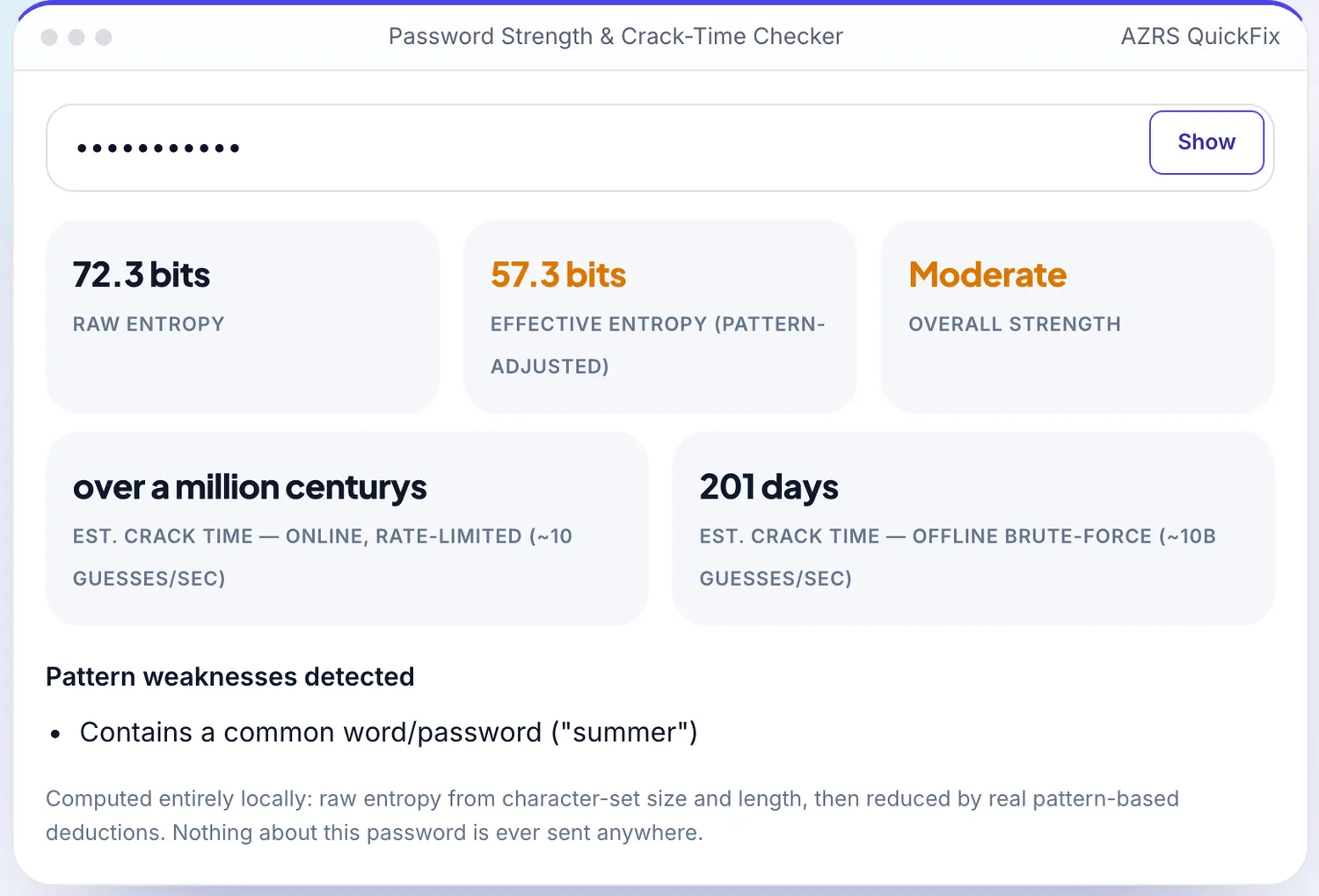
 Your input
 The action
A real example, step by step
Real data entered into the Password Strength & Crack-Time Checker, one screenshot per step. Nothing is mocked up.
Open the tool
The Password Strength & Crack-Time Checker opens ready to use, nothing to install or sign up for.
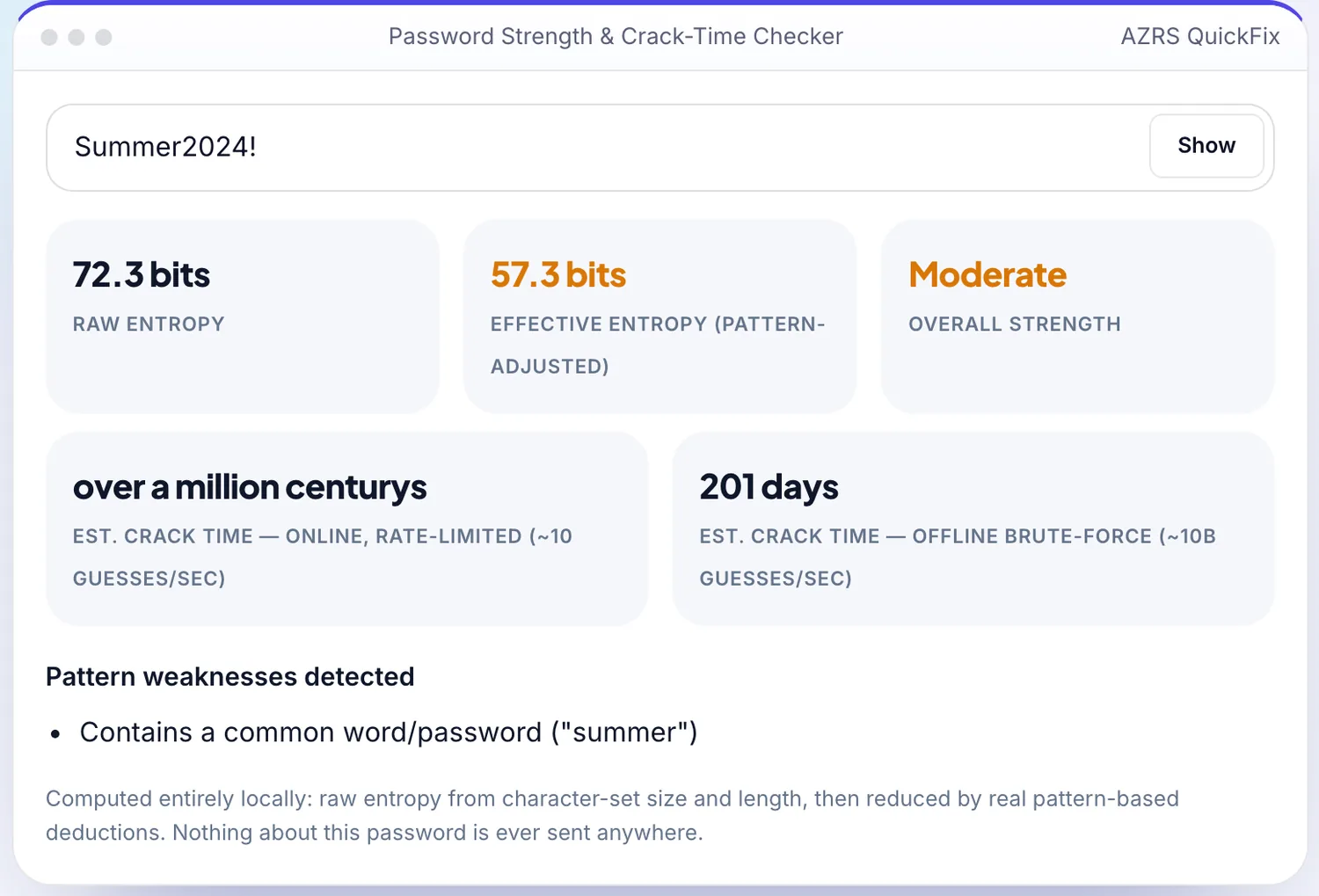
Enter your data
Real input used here: Type a password to analyze — never sent anywhere Summer2024!.
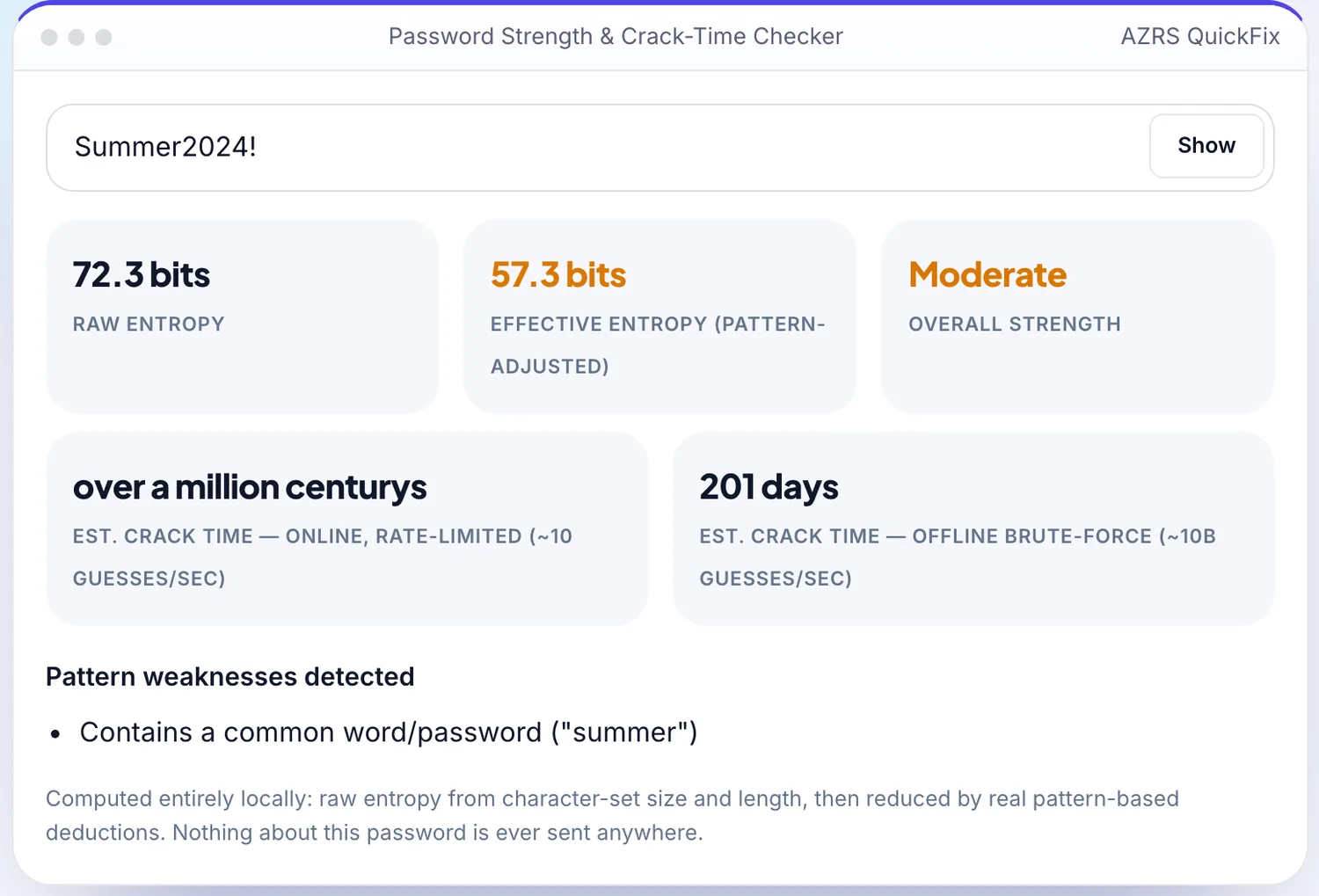
Press Show
The Password Strength & Crack-Time Checker shows the result straight away, below the same form.
What is the Password Strength & Crack-Time Checker?
This is a different tool from this site's Password Breach Checker (which checks a password against known leaked-password databases) and Password Generator (which creates new random passwords) — this one analyzes the actual strength of a password you're considering, computing its real character-set entropy in bits and then applying real, pattern-aware deductions for common weaknesses like dictionary words, keyboard patterns (qwerty, asdf), repeated characters and simple substitutions (like '@' for 'a') that a pure entropy formula alone would miss.
From the resulting effective entropy, it estimates a real, honestly-labeled crack time range under both a slow, rate-limited online guessing scenario and a fast offline brute-force scenario using current typical hardware guessing speeds — giving a concrete, real-world sense of 'how strong is strong enough', not just an abstract strength meter bar.
3 steps to your result
Open the tool and follow along. Nothing to install.
What you get
Computes actual bits of entropy from the password's real character set and length, the mathematically correct base measure.
Detects and penalizes dictionary words, keyboard-walk patterns, repeated characters and common substitutions a raw entropy number would miss.
Shows an estimated crack time under both online rate-limited and offline brute-force attack speeds.
Unlike the breach checker (which safely queries a database), this tool never needs to send the password anywhere at all — pure local calculation.
AZRS tools are free to open and use.
It opens in your browser, so there is nothing to download.
Used for
Pick one to see how it fits.
Anyone choosing a new account password
Get a real, pattern-aware strength read before committing to a password, not just a length check.
Try it freeIT and security-conscious teams setting password policy guidance
Understand concretely how much common patterns weaken a password versus its raw length.
Try it freeAnyone reusing or slightly modifying an old password
See how much a small variation (like adding a year) really helps or doesn't.
Try it freeHow it compares
A plain look at this tool next to the usual alternative.
| This utility | Desktop software | |
|---|---|---|
| Install | Nothing to install | Usually an app or program to install |
| Account | No signup | Depends on the product |
| Cost | Free to use | Free or paid, depends on the product |
| Where it runs | In your browser tab | On your computer |
Questions people ask
Is my password ever sent anywhere to check this?
No — this is one of the few checks on the site that needs zero network transmission at all, since strength analysis and crack-time estimation are pure local calculations; nothing about your password ever leaves your browser.
How is this different from the Password Breach Checker?
The Breach Checker safely checks whether a password has appeared in known real data breaches (using a privacy-preserving method that never sends the full password). This tool instead analyzes the password's own inherent strength and estimates crack time — a genuinely different question that doesn't require checking against any external database at all.
How is 'crack time' actually estimated?
From the password's real effective entropy (raw character-set entropy minus real deductions for detected patterns), divided by a typical guesses-per-second rate for two real scenarios — a slow, rate-limited online login attempt, and a fast offline brute-force attempt — giving two different, honestly-labeled real-world estimates.
What patterns does it detect?
Common dictionary words, keyboard-adjacent sequences (like qwerty or asdf), simple character repetition, and common character substitutions (like '@' for 'a' or '0' for 'o'), all of which measurably reduce a password's real-world guessability below its raw entropy number.
Should I use this instead of the Password Generator?
They serve different steps — use the Password Generator to create a new strong random password, and this tool to evaluate the real strength of a password you already have in mind or are reusing.
More free tools
Related to the Password Strength & Crack-Time Checker.
Try the Password Strength & Crack-Time Checker now
Real entropy-based analysis of a password's actual strength and an estimated real-world. Free to use.
Try it free