
Explore the Ocean Acidification Lab
Raise atmospheric CO₂ and watch ocean pH fall and carbonate ions disappear, using the real carbonic acid chemistry behind ocean acidification.
- Free to use
- No signup
- Nothing to install
- Runs in your browser
Illustration. Open the tool for the real thing.
See it in action
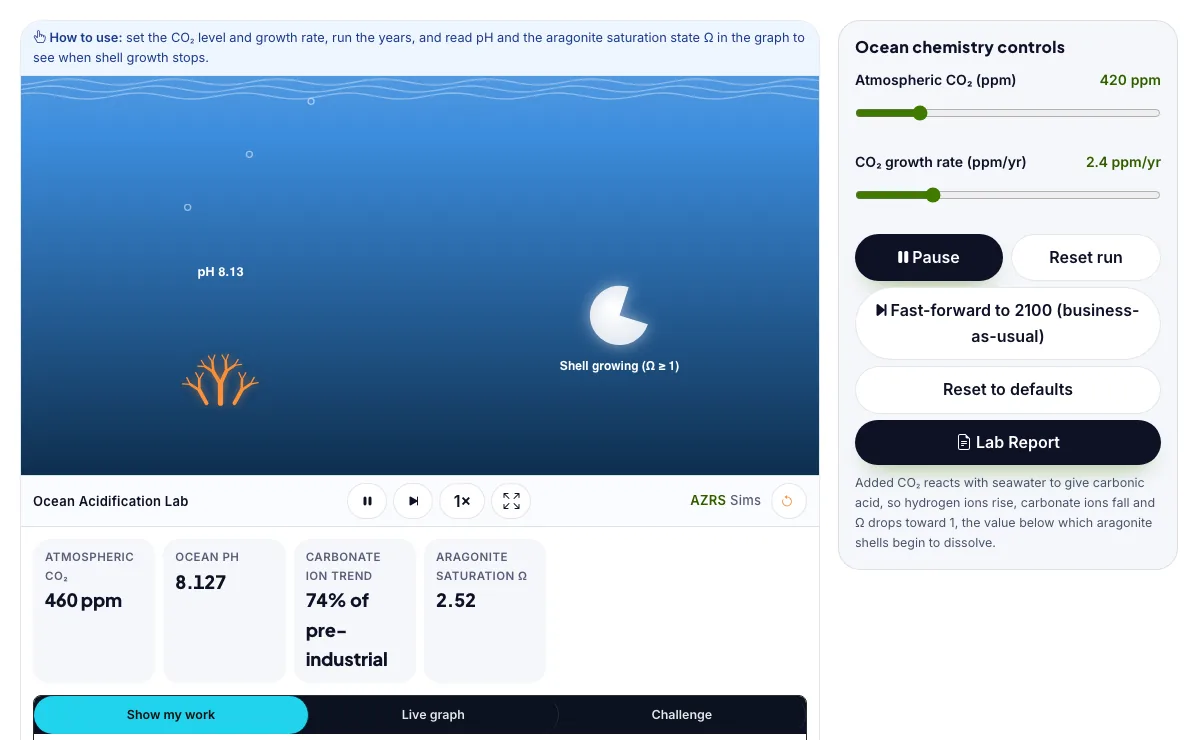
The Ocean Acidification Lab with sample data entered and the result showing.
What is the Ocean Acidification Lab?
Raise atmospheric CO₂ and watch ocean pH fall and carbonate ions disappear, using the real carbonic acid chemistry behind ocean acidification. It runs in your browser, so a change to a setting or a drag on an object shows up at once.
Marine biologists and shellfish farmers track exactly this aragonite saturation state, since oyster and coral reef hatcheries have already reported real production losses tied to falling Ω in coastal waters.
3 steps to your result
Open the tool and follow along. Nothing to install.
What you get
Dissolved CO₂ reacts with seawater to form carbonic acid, which releases hydrogen ions and lowers pH: CO2 + H2O ↔ H2CO3 ↔ H⁺ + HCO3⁻.
Those extra hydrogen ions react with existing carbonate ions to form more bicarbonate, so rising CO₂ directly consumes the carbonate ions that shell- and coral-building organisms need.
Aragonite saturation state Ω measures whether seawater favors shell growth (Ω ≥ 1) or shell dissolution (Ω < 1); it falls as carbonate ion concentration falls.
Run the model at today's real growth rate and watch pH and Ω both fall over decades.
Push CO₂ to 900+ ppm and find where Ω crosses below 1.
Compare the pH drop after 50 years at a low versus a high CO₂ growth rate.
Used for
Pick one to see how it fits.
Environmental Science learners
Students, teachers and curious learners of all ages.
Try it freeTeachers
For teachers: project the Ocean Acidification Lab on the board, let students predict the result, then run it together and test this: Push CO₂ to 900+ ppm and find where Ω crosses below 1. For students: change one thing at a time and write down what changes.
Try it freeHow it compares
A plain look at this tool next to the usual alternative.
| This simulation | Textbook diagram | |
|---|---|---|
| Interactive | Drag, tap and change settings | Fixed picture |
| Install | Nothing to install | Not needed |
| Cost | Free to use | Depends on the book |
Questions people ask
Why does dissolving more CO₂ in the ocean lower the carbonate ion concentration rather than raising it?
The added carbonic acid's hydrogen ions react with existing carbonate ions (CO3²⁻) to form bicarbonate (HCO3⁻), converting one form of dissolved carbon into another and net removing free carbonate ions from the water even though total dissolved carbon goes up.
Why does the ocean's role in acidification often get less attention than its role in the greenhouse effect?
The ocean absorbing CO₂ actually helps slow atmospheric warming by removing a greenhouse gas from the air, but that same absorbed CO₂ directly acidifies the seawater and lowers carbonate availability - so the very process that buys time against climate change is quietly damaging marine chemistry.
Is the Ocean Acidification Lab free to use?
Yes. The Ocean Acidification Lab is free, needs no signup or download and runs in your web browser. It is part of the Environmental Science group of AZRS simulations.
Does the Ocean Acidification Lab work on a phone or tablet?
Yes. The Ocean Acidification Lab takes touch input as well as mouse input, so you can use its 2 adjustable settings with a finger. A larger screen makes the controls and graphs easier to read.
How do I use the Ocean Acidification Lab?
1. Set the atmospheric CO2 level (ppm) and the yearly growth rate, then press Run years to start the clock. 2. Press the fast-forward button to jump to 2100 on the business-as-usual path and compare the end values. 3. Use the two check buttons to test whether Omega is below 1 and whether the pH drop stays under 0.1 units. 4. Start with this experiment: Run the model at today's real growth rate and watch pH and Ω both fall over decades. Drag any glowing handle, object or slider with your mouse or finger and the Ocean Acidification Lab responds in real time. 5. Change one setting at a time and watch which readout moves, then compare it with this idea: Dissolved CO₂ reacts with seawater to form carbonic acid, which releases hydrogen ions and lowers pH: CO2 + H2O ↔ H2CO3 ↔ H⁺ + HCO3⁻.
More free tools
Related to the Ocean Acidification Lab.
Try the Ocean Acidification Lab now
Raise atmospheric CO₂ and watch ocean pH fall and carbonate ions disappear, using the. Free to use.
Try it free