
Explore the Material Fatigue & S-N Curve Lab
Cycle a loaded part through repeated stress, watch the waveform run, and read off the S-N curve exactly how many cycles it should survive before it fails.
- Free to use
- No signup
- Nothing to install
- Runs in your browser
Illustration. Open the tool for the real thing.
See it in action
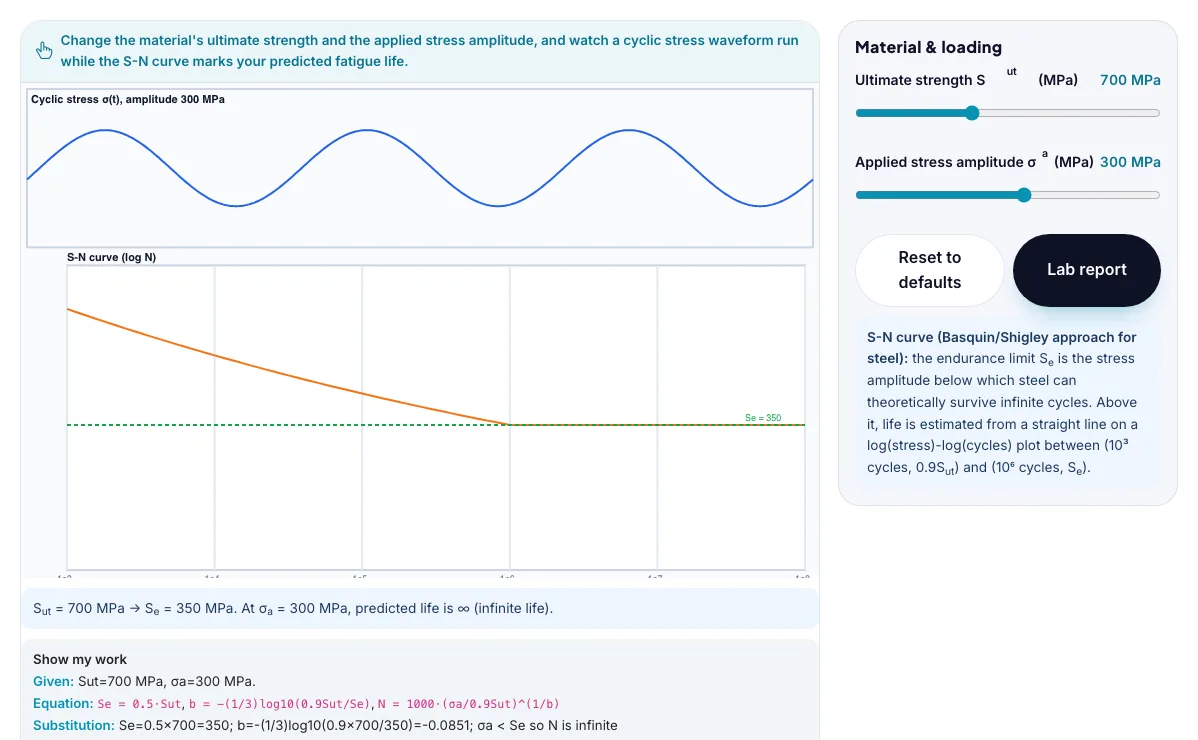
The Material Fatigue & S-N Curve Lab with sample data entered and the result showing.
What is the Material Fatigue & S-N Curve Lab?
Cycle a loaded part through repeated stress, watch the waveform run, and read off the S-N curve exactly how many cycles it should survive before it fails. It runs in your browser, so a change to a setting or a drag on an object shows up at once.
Engineers run this exact S-N/endurance-limit check on rotating shafts, aircraft components, bridge connections and any part under repeated cyclic loading, since fatigue - not one-time overload - is the most common cause of mechanical failure in service.
3 steps to your result
Open the tool and follow along. Nothing to install.
What you get
Repeated cyclic stress can crack and break a part at a stress far below what would fail it in a single static pull - this is fatigue failure.
The endurance limit Se is the stress amplitude below which steel can theoretically survive infinite cycles; for many steels Se is about half the ultimate strength Sut.
Above the endurance limit, the S-N curve (Basquin's equation) draws a straight line on log(stress) vs log(cycles) axes between (10^3 cycles, 0.9Sut) and (10^6 cycles, Se), letting you read off predicted life N for any stress amplitude.
Try the 100,000-cycle life challenge at the default 700 MPa steel.
Drop the stress amplitude below the endurance limit and confirm the infinite-life challenge passes.
Raise Sut to 1000 MPa and see how much longer the same stress amplitude survives.
Used for
Pick one to see how it fits.
Engineering learners
Engineering and technology students, makers, robotics clubs and teachers of design and technology.
Try it freeTeachers
For teachers: project the Material Fatigue & S-N Curve Lab on the board, let students predict the result, then run it together and test this: Drop the stress amplitude below the endurance limit and confirm the infinite-life challenge passes. For students: change one thing at a time and write down what changes.
Try it freeHow it compares
A plain look at this tool next to the usual alternative.
| This simulation | Textbook diagram | |
|---|---|---|
| Interactive | Drag, tap and change settings | Fixed picture |
| Install | Nothing to install | Not needed |
| Cost | Free to use | Depends on the book |
Questions people ask
Why can a part fail from fatigue at a stress far below its ultimate strength?
Fatigue failure is driven by microscopic cracks that form and slowly grow at points of repeated cyclic stress, not by the material yielding all at once; each cycle grows the crack a little further until it is large enough to fracture suddenly, which can happen at stress amplitudes well below the one-time ultimate strength.
Why does lowering the stress amplitude below the endurance limit give theoretically infinite life instead of just a longer one?
For many steels the S-N curve flattens out into a horizontal line at the endurance limit Se; below that stress the microscopic damage per cycle is too small to ever grow into a propagating crack, so the Basquin power-law relationship no longer applies and the part can in theory be cycled forever.
Is the Material Fatigue & S-N Curve Lab free to use?
Yes. The Material Fatigue & S-N Curve Lab is free, needs no signup or download and runs in your web browser. It is part of the Engineering group of AZRS simulations.
Does the Material Fatigue & S-N Curve Lab work on a phone or tablet?
Yes. The Material Fatigue & S-N Curve Lab takes touch input as well as mouse input, so you can use its 2 adjustable settings with a finger. A larger screen makes the controls and graphs easier to read.
How do I use the Material Fatigue & S-N Curve Lab?
1. In the Material Fatigue & S-N Curve Lab, use the controls to change Ultimate strength Sut (MPa), Applied stress amplitude σa (MPa). The simulation reacts instantly. 2. Start with this experiment: Try the 100,000-cycle life challenge at the default 700 MPa steel. Drag any glowing handle, object or slider with your mouse or finger and the Material Fatigue & S-N Curve Lab responds in real time. 3. Change one setting at a time and watch which readout moves, then compare it with this idea: Repeated cyclic stress can crack and break a part at a stress far below what would fail it in a single static pull - this is fatigue failure.
More free tools
Related to the Material Fatigue & S-N Curve Lab.
Try the Material Fatigue & S-N Curve Lab now
Cycle a loaded part through repeated stress, watch the waveform run, and read off the S-N. Free to use.
Try it free