
Explore the Le Chatelier's Principle
Change concentration, temperature and pressure on N₂ + 3H₂ ⇌ 2NH₃ and watch the equilibrium shift. Free, no signup, runs in your browser.
- Free to use
- No signup
- Nothing to install
- Runs in your browser
Illustration. Open the tool for the real thing.
See it in action
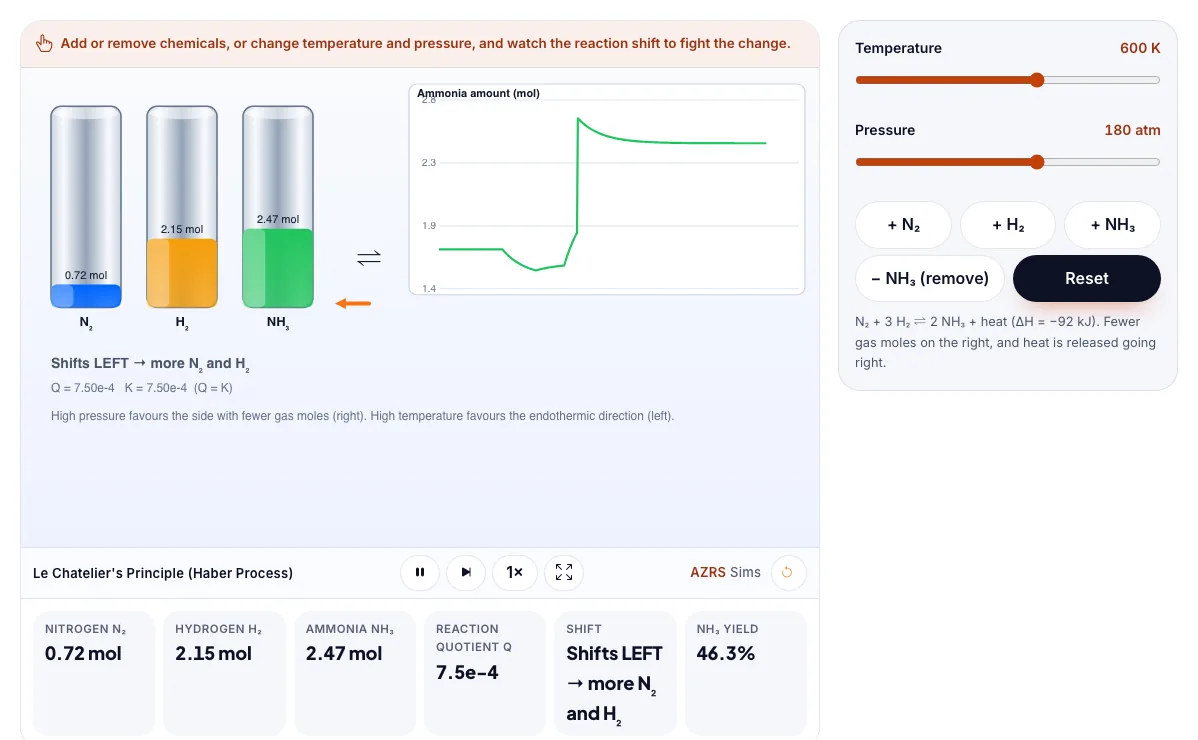
The Le Chatelier's Principle with sample data entered and the result showing.
What is the Le Chatelier's Principle?
Change concentration, temperature and pressure on N₂ + 3H₂ ⇌ 2NH₃ and watch the equilibrium shift. It runs in your browser, so a change to a setting or a drag on an object shows up at once.
The Haber process makes the ammonia that feeds half of the world through fertiliser. Pressure and temperature choices are exactly this trade-off.
3 steps to your result
Open the tool and follow along. Nothing to install.
What you get
A system at equilibrium shifts to reduce any change made to it.
Adding a reactant shifts the reaction towards products.
Raising pressure favours the side with fewer gas moles.
Add extra N₂ and watch ammonia rise.
Raise the pressure to 200 atm.
Raise the temperature and see ammonia fall.
Used for
Pick one to see how it fits.
Reactions & Kinetics learners
Students learning reaction rates, equilibrium and equations, and teachers who want a visual way to explain what happens to particles.
Try it freeTeachers
For teachers: project the Le Chatelier's Principle (Haber Process) on the board, let students predict the result, then run it together and test this: Raise the pressure to 200 atm. For students: change one thing at a time and write down what changes.
Try it freeHow it compares
A plain look at this tool next to the usual alternative.
| This simulation | Textbook diagram | |
|---|---|---|
| Interactive | Drag, tap and change settings | Fixed picture |
| Install | Nothing to install | Not needed |
| Cost | Free to use | Depends on the book |
Questions people ask
What does Le Chatelier's principle say?
If you disturb a system at equilibrium, it shifts in the direction that partly cancels the disturbance.
Why is the Haber process run at high pressure?
Four moles of gas become two, so high pressure pushes the equilibrium to make more ammonia.
Is the Le Chatelier's Principle (Haber Process) free to use?
Yes. The Le Chatelier's Principle (Haber Process) is free, needs no signup or download and runs in your web browser. It is part of the Reactions & Kinetics group of AZRS simulations.
Does the Le Chatelier's Principle (Haber Process) work on a phone or tablet?
Yes. The Le Chatelier's Principle (Haber Process) takes touch input as well as mouse input, so you can use its 2 adjustable settings with a finger. A larger screen makes the controls and graphs easier to read.
How do I use the Le Chatelier's Principle?
1. In the Le Chatelier's Principle (Haber Process), use the controls to change Temperature, Pressure. The simulation reacts instantly. 2. In the Le Chatelier's Principle (Haber Process), press "+ N₂", "+ H₂", "+ NH₃", "− NH₃ (remove)" to start, reset or change what is happening. 3. Start with this experiment: Add extra N₂ and watch ammonia rise. Drag any glowing handle, object or slider with your mouse or finger and the Le Chatelier's Principle (Haber Process) responds in real time. 4. Change one setting at a time and watch which readout moves, then compare it with this idea: A system at equilibrium shifts to reduce any change made to it.
More free tools
Related to the Le Chatelier's Principle.
Try the Le Chatelier's Principle now
Change concentration, temperature and pressure on N₂ + 3H₂ ⇌ 2NH₃ and watch the. Free to use.
Try it free