
Explore the Heat Exchanger Simulator: Parallel-Flow vs
Run a hot and a cold fluid stream through a simple exchanger in parallel-flow or counter-flow, set the inlet temperatures, flow rates.
- Free to use
- No signup
- Nothing to install
- Runs in your browser
Illustration. Open the tool for the real thing.
See it in action
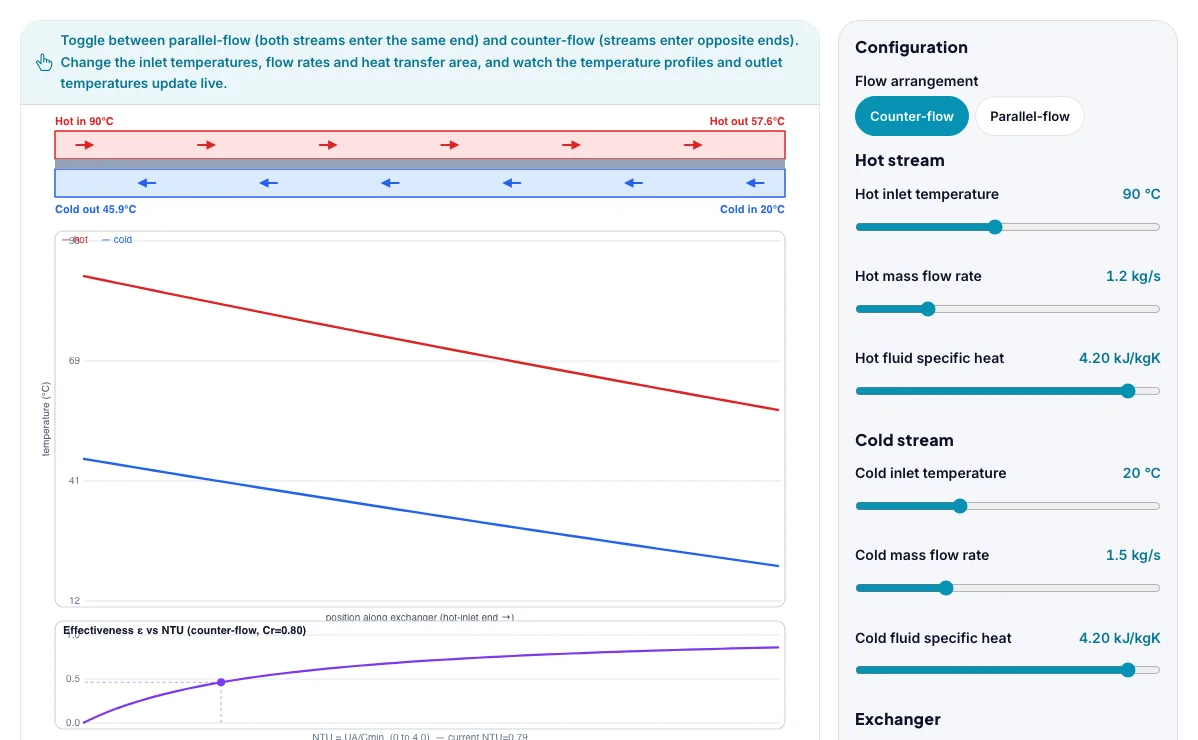
The Heat Exchanger Simulator: Parallel-Flow vs with sample data entered and the result showing.
What is the Heat Exchanger Simulator: Parallel-Flow vs?
Run a hot and a cold fluid stream through a simple exchanger in parallel-flow or counter-flow, set the inlet temperatures, flow rates and heat transfer area, and compare the outlet temperatures, LMTD and effectiveness live. It runs in your browser, so a change to a setting or a drag on an object shows up at once.
Car radiators and engine oil coolers, power plant condensers and boiler feedwater heaters, HVAC coils, industrial process heat recovery, and heat pumps and refrigeration condensers/evaporators are all designed using this same energy-balance and LMTD/effectiveness-NTU analysis.
3 steps to your result
Open the tool and follow along. Nothing to install.
What you get
A heat exchanger transfers heat between two fluid streams without mixing them, governed by the energy balance Q = m_hot·cp_hot·(Th,in − Th,out) = m_cold·cp_cold·(Tc,out − Tc,in).
The log mean temperature difference (LMTD) is the correct average driving temperature difference to use with Q = U·A·LMTD, because the temperature difference between the two streams is not constant along the exchanger's length.
The effectiveness-NTU method solves the outlet temperatures without iterating: NTU = UA/C_min compares the exchanger's size to the smaller stream's heat capacity rate, and a standard formula converts NTU into an effectiveness ε, from which Q = ε·C_min·(Th,in − Tc,in).
Keep every input the same and just toggle between parallel-flow and counter-flow, and watch Q, LMTD and the outlet temperatures all change.
Make the cold flow rate much larger than the hot flow rate so C_min is the hot stream, then swap it around, and see how the effectiveness definition still makes sense either way, checking the 'Limiting stream' readout as you go.
Increase the area A a lot in counter-flow until the outlet temperatures start to approach each other closely, then try the same area in parallel-flow and compare how close they get.
Used for
Pick one to see how it fits.
Engineering learners
Engineering and technology students, makers, robotics clubs and teachers of design and technology.
Try it freeTeachers
For teachers: project the Heat Exchanger Simulator: Parallel-Flow vs Counter-Flow (LMTD) on the board, let students predict the result, then run it together and test this: Make the cold flow rate much larger than the hot flow rate so C_min is the hot stream, then swap it around, and see how the effectiveness definition still makes sense either way, checking the 'Limiting stream' readout as you go. For students: change one thing at a time and write down what changes.
Try it freeHow it compares
A plain look at this tool next to the usual alternative.
| This simulation | Textbook diagram | |
|---|---|---|
| Interactive | Drag, tap and change settings | Fixed picture |
| Install | Nothing to install | Not needed |
| Cost | Free to use | Depends on the book |
Questions people ask
Why does counter-flow outperform parallel-flow for the same size of exchanger?
In parallel-flow, the temperature difference between the streams is largest at the inlet end and shrinks fast toward the exit, so most of the exchanger area is doing very little work. In counter-flow, the temperature difference stays more even along the whole length, so the same area transfers more heat, giving a higher LMTD and a higher effectiveness.
What does the heat transfer coefficient U represent?
U is the overall heat transfer coefficient, combining the convection on both fluid sides and the conduction through the wall between them, in W/(m²·K). A higher U (better fluids, thinner or more conductive walls, more turbulence) means more heat gets through for the same area and temperature difference.
Why use the effectiveness-NTU method instead of solving LMTD directly?
The direct Q = U·A·LMTD equation needs the outlet temperatures to compute LMTD, but the outlet temperatures depend on Q, so a direct solve requires guessing and iterating. The effectiveness-NTU method sidesteps this by first computing NTU and effectiveness from known quantities, giving Q and both outlet temperatures algebraically in one pass, then LMTD can be computed afterward for display.
What does the effectiveness-vs-NTU chart show and why does it matter?
It plots effectiveness ε against NTU (exchanger size relative to C_min) for the current configuration and capacity ratio, with your current operating point marked. Because the curve rises fast then flattens, it shows that making an exchanger bigger past a certain point gives smaller and smaller improvements in heat transferred — the key idea behind right-sizing an exchanger instead of oversizing it.
How do I tell which stream is C_min?
The 'Limiting stream' readout names it directly: whichever stream has the smaller heat-capacity rate (mass flow rate × specific heat) is C_min, and it is the stream that sets the maximum possible heat transfer, since it can only cool or heat by so much before it runs out of temperature difference to give.
More free tools
Related to the Heat Exchanger Simulator: Parallel-Flow vs.
Try the Heat Exchanger Simulator: Parallel-Flow vs now
Run a hot and a cold fluid stream through a simple exchanger in parallel-flow or. Free to use.
Try it free