
Explore the Torque & Rotational Inertia Lab
Push a wheel at different distances from its axle and see torque, moment of inertia, angular acceleration and angular momentum.
- Free to use
- No signup
- Nothing to install
- Runs in your browser
Illustration. Open the tool for the real thing.
See it in action
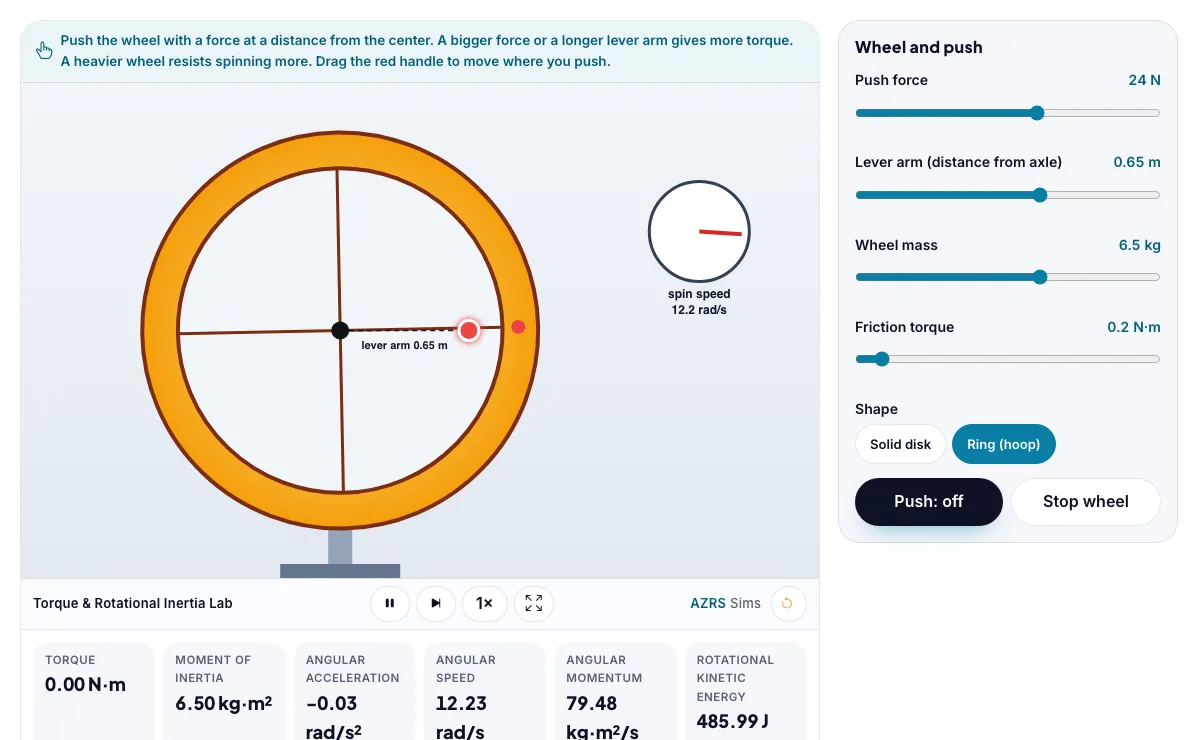
The Torque & Rotational Inertia Lab with sample data entered and the result showing.
What is the Torque & Rotational Inertia Lab?
Push a wheel at different distances from its axle and see torque, moment of inertia, angular acceleration and angular momentum. It runs in your browser, so a change to a setting or a drag on an object shows up at once.
Wrenches, gears, engines, flywheels, helicopters and figure skaters spinning faster by pulling in their arms all use torque and rotational inertia.
3 steps to your result
Open the tool and follow along. Nothing to install.
What you get
Torque = force × lever arm, so pushing farther from the axle is more effective.
Angular acceleration = torque ÷ moment of inertia.
A ring is harder to spin than a solid disk of the same mass because its mass is farther from the center.
Double the lever arm and watch the torque double.
Switch from a disk to a ring and compare the angular acceleration.
Turn on friction and find the smallest force that starts the wheel turning.
Used for
Pick one to see how it fits.
Physics learners
Physics students in middle school, high school and first-year university, teachers who want a quick demonstration for the projector, and anyone revising for exams.
Try it freeTeachers
For teachers: project the Torque & Rotational Inertia Lab on the board, let students predict the result, then run it together and test this: Switch from a disk to a ring and compare the angular acceleration. For students: change one thing at a time and write down what changes.
Try it freeHow it compares
A plain look at this tool next to the usual alternative.
| This simulation | Textbook diagram | |
|---|---|---|
| Interactive | Drag, tap and change settings | Fixed picture |
| Install | Nothing to install | Not needed |
| Cost | Free to use | Depends on the book |
Questions people ask
What is moment of inertia?
It measures how hard it is to change how fast something spins. It depends on the mass and on how far that mass is from the axis.
Why is a door handle far from the hinge?
A longer lever arm gives more torque for the same force, so the door opens more easily.
Is the Torque & Rotational Inertia Lab free to use?
Yes. The Torque & Rotational Inertia Lab is free, needs no signup or download and runs in your web browser. It is part of the Physics group of AZRS simulations.
Does the Torque & Rotational Inertia Lab work on a phone or tablet?
Yes. The Torque & Rotational Inertia Lab takes touch input as well as mouse input, so you can use its 5 adjustable settings with a finger. A larger screen makes the controls and graphs easier to read.
How do I use the Torque & Rotational Inertia Lab?
1. In the Torque & Rotational Inertia Lab, use the controls to change Push force, Lever arm (distance from axle), Wheel mass, Friction torque, Shape. The simulation reacts instantly. 2. In the Torque & Rotational Inertia Lab, pick an option such as Solid disk, Ring (hoop) to switch modes or load an example. 3. In the Torque & Rotational Inertia Lab, press "Push: on", "Stop wheel" to start, reset or change what is happening. 4. Start with this experiment: Double the lever arm and watch the torque double. Drag any glowing handle, object or slider with your mouse or finger and the Torque & Rotational Inertia Lab responds in real time. 5. Change one setting at a time and watch which readout moves, then compare it with this idea: Torque = force × lever arm, so pushing farther from the axle is more effective.
More free tools
Related to the Torque & Rotational Inertia Lab.
Try the Torque & Rotational Inertia Lab now
Push a wheel at different distances from its axle and see torque, moment of inertia. Free to use.
Try it free