
Explore the Reflex Arc & Nervous System Simulator
Trigger a stimulus and watch it race through the reflex arc, then compare a fast one-synapse knee-jerk reflex with a slower multi-synapse withdrawal.
- Free to use
- No signup
- Nothing to install
- Runs in your browser
Illustration. Open the tool for the real thing.
See it in action
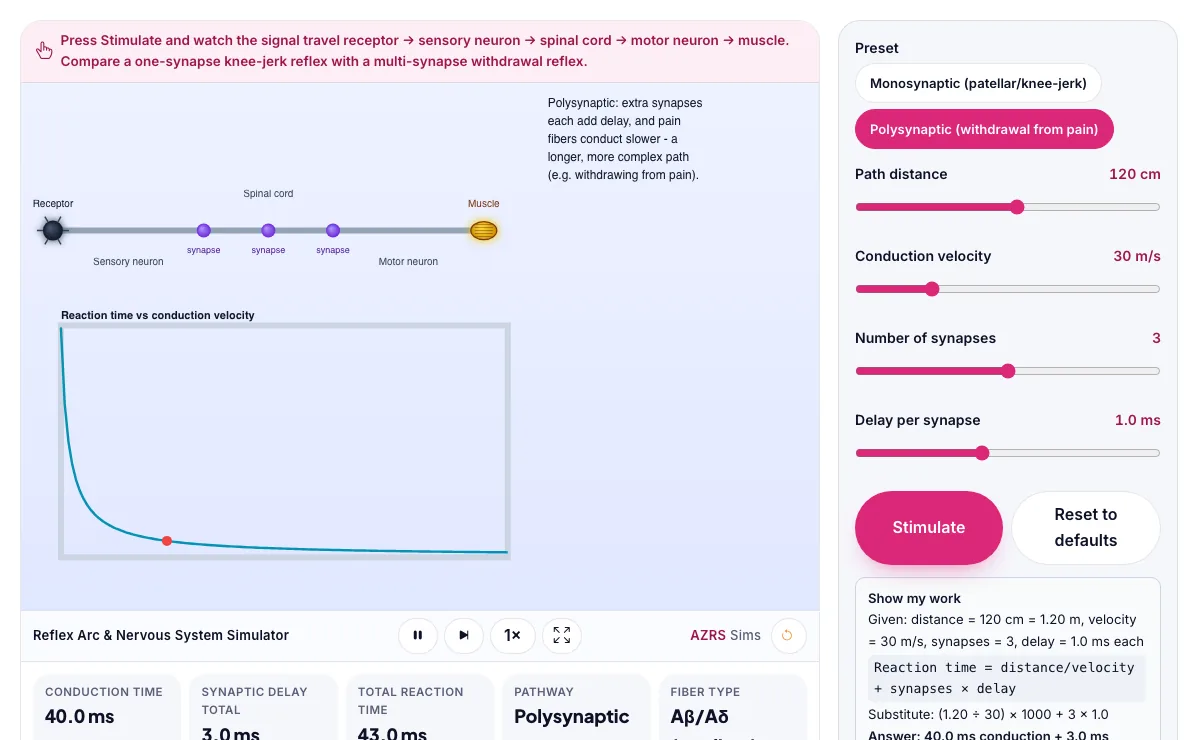
The Reflex Arc & Nervous System Simulator with sample data entered and the result showing.
What is the Reflex Arc & Nervous System Simulator?
Trigger a stimulus and watch it race through the reflex arc, then compare a fast one-synapse knee-jerk reflex with a slower multi-synapse withdrawal reflex. It runs in your browser, so a change to a setting or a drag on an object shows up at once.
Doctors test reflexes like the patellar reflex for exactly this reason - an abnormally slow or absent reflex can point to nerve or spinal cord problems.
3 steps to your result
Open the tool and follow along. Nothing to install.
What you get
A reflex arc runs receptor → sensory neuron → spinal cord → motor neuron → muscle, usually without waiting for the brain.
Reaction time = conduction time (distance ÷ velocity) plus synaptic delay time (delay × number of synapses).
A monosynaptic reflex like the patellar (knee-jerk) reflex has only one synapse and is the fastest possible reflex.
Load the monosynaptic preset and read the reaction time.
Load the polysynaptic preset and compare - predict which will be faster before checking.
Raise the number of synapses one at a time and watch reaction time climb in steps.
Used for
Pick one to see how it fits.
Biology learners
Biology students and teachers who want to explore living systems, populations and genetics interactively and safely.
Try it freeTeachers
For teachers: project the Reflex Arc & Nervous System Simulator on the board, let students predict the result, then run it together and test this: Load the polysynaptic preset and compare - predict which will be faster before checking. For students: change one thing at a time and write down what changes.
Try it freeHow it compares
A plain look at this tool next to the usual alternative.
| This simulation | Textbook diagram | |
|---|---|---|
| Interactive | Drag, tap and change settings | Fixed picture |
| Install | Nothing to install | Not needed |
| Cost | Free to use | Depends on the book |
Questions people ask
Why is the knee-jerk reflex so fast?
It uses only one synapse and fast, thick sensory and motor fibers, so almost no time is lost at synapses.
Why does pulling your hand from a hot stove involve more synapses than the knee-jerk reflex?
A withdrawal reflex coordinates several muscles and often crosses to the opposite leg for balance, which needs extra interneurons and synapses.
Is the Reflex Arc & Nervous System Simulator free to use?
Yes. The Reflex Arc & Nervous System Simulator is free, needs no signup or download and runs in your web browser. It is part of the Biology group of AZRS simulations.
Does the Reflex Arc & Nervous System Simulator work on a phone or tablet?
Yes. The Reflex Arc & Nervous System Simulator takes touch input as well as mouse input, so you can use its 5 adjustable settings with a finger. A larger screen makes the controls and graphs easier to read.
How do I use the Reflex Arc & Nervous System Simulator?
1. In the Reflex Arc & Nervous System Simulator, use the controls to change Preset, Path distance, Conduction velocity, Number of synapses, Delay per synapse. The simulation reacts instantly. 2. In the Reflex Arc & Nervous System Simulator, pick an option such as Monosynaptic (patellar/knee-jerk), Polysynaptic (withdrawal from pain) to switch modes or load an example. 3. In the Reflex Arc & Nervous System Simulator, press "Stimulate", "Check reaction time", "Check total reaction time" to start, reset or change what is happening. 4. Start with this experiment: Load the monosynaptic preset and read the reaction time. Drag any glowing handle, object or slider with your mouse or finger and the Reflex Arc & Nervous System Simulator responds in real time. 5. Change one setting at a time and watch which readout moves, then compare it with this idea: A reflex arc runs receptor → sensory neuron → spinal cord → motor neuron → muscle, usually without waiting for the brain.
More free tools
Related to the Reflex Arc & Nervous System Simulator.
Try the Reflex Arc & Nervous System Simulator now
Trigger a stimulus and watch it race through the reflex arc, then compare a fast. Free to use.
Try it free