
Explore the 3D Molecule Viewer
Rotate, zoom and switch between ball-and-stick and space-filling models of common molecules. Free, no signup, runs in your browser.
- Free to use
- No signup
- Nothing to install
- Runs in your browser
See it in action
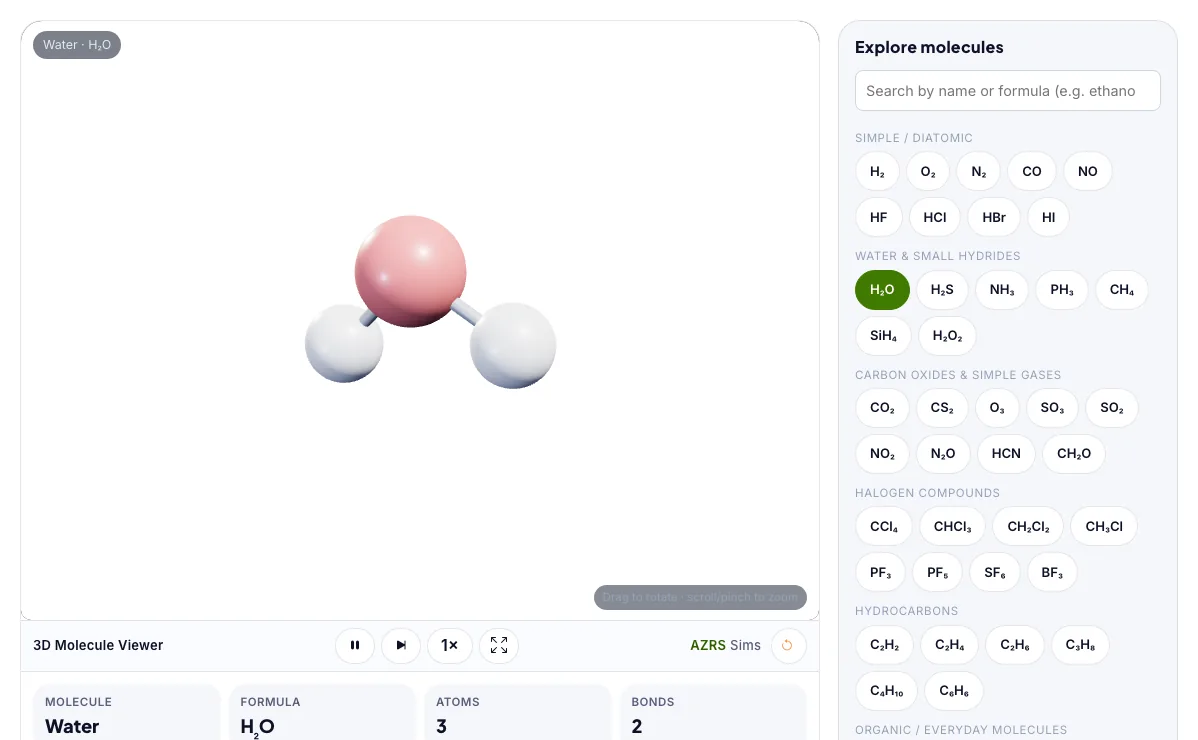
The 3D Molecule Viewer with sample data entered and the result showing.
What is the 3D Molecule Viewer?
Rotate, zoom and switch between ball-and-stick and space-filling models of common molecules. It runs in your browser, so a change to a setting or a drag on an object shows up at once.
3D structures help chemists, biologists and students visualise proteins, drugs and materials that cannot be seen directly.
3 steps to your result
Open the tool and follow along. Nothing to install.
What you get
Ball-and-stick models show bonds and angles clearly.
Space-filling models show how much room atoms take up.
Colours follow the CPK convention: white hydrogen, black carbon, blue nitrogen, red oxygen.
Rotate water.
Switch to space-filling.
Look at benzene.
Used for
Pick one to see how it fits.
Molecules learners
Chemistry and biology students learning bonding and molecular shape, and teachers who need an interactive 3D model instead of a textbook drawing.
Try it freeTeachers
For teachers: project the 3D Molecule Viewer on the board, let students predict the result, then run it together and test this: Switch to space-filling. For students: change one thing at a time and write down what changes.
Try it freeHow it compares
A plain look at this tool next to the usual alternative.
| This simulation | Textbook diagram | |
|---|---|---|
| Interactive | Drag, tap and change settings | Fixed picture |
| Install | Nothing to install | Not needed |
| Cost | Free to use | Depends on the book |
Questions people ask
What do the atom colours mean?
They follow the CPK colour scheme: hydrogen is white, carbon dark grey, nitrogen blue, oxygen red, chlorine green and sulfur yellow.
What is the difference between ball-and-stick and space-filling models?
Ball-and-stick shows bonds and geometry. Space-filling shows the relative size and volume of each atom.
Is the 3D Molecule Viewer free to use?
Yes. The 3D Molecule Viewer is free, needs no signup or download and runs in your web browser. It is part of the Molecules group of AZRS simulations.
Does the 3D Molecule Viewer work on a phone or tablet?
Yes. The 3D Molecule Viewer takes touch input as well as mouse input, so you can use its 3 adjustable settings with a finger. A larger screen makes the controls and graphs easier to read.
How do I use the 3D Molecule Viewer?
1. In the 3D Molecule Viewer, use the controls to change Style, Show atom labels, Element colours. The simulation reacts instantly. 2. In the 3D Molecule Viewer, pick an option such as Ball and stick, Space filling to switch modes or load an example. 3. In the 3D Molecule Viewer, press "Stop rotating" to start, reset or change what is happening. 4. Start with this experiment: Rotate water. Drag any glowing handle, object or slider with your mouse or finger and the 3D Molecule Viewer responds in real time. 5. Change one setting at a time and watch which readout moves, then compare it with this idea: Ball-and-stick models show bonds and angles clearly.
More free tools
Related to the 3D Molecule Viewer.
Try the 3D Molecule Viewer now
Rotate, zoom and switch between ball-and-stick and space-filling models of common. Free to use.
Try it free