
Explore the DNA Replication & Protein Synthesis Simulator
Step through DNA replication, transcription and translation of a short gene using real base-pairing and a genetic code table.
- Free to use
- No signup
- Nothing to install
- Runs in your browser
Illustration. Open the tool for the real thing.
See it in action
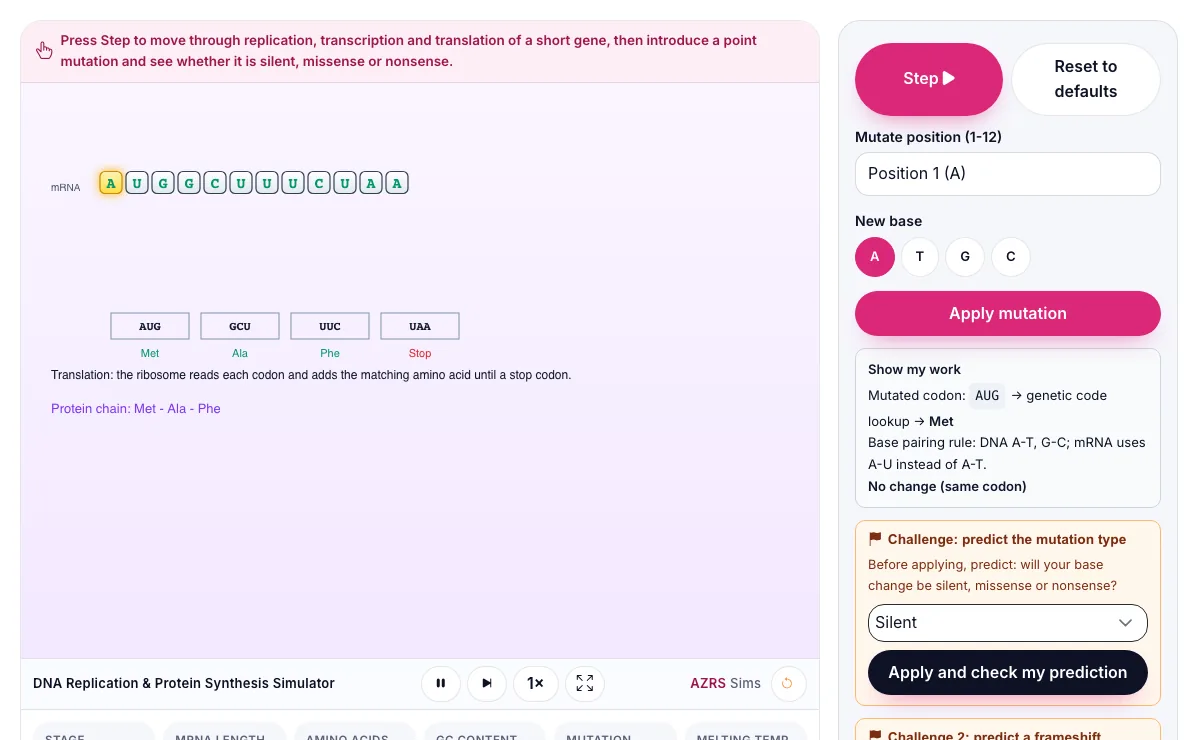
The DNA Replication & Protein Synthesis Simulator with sample data entered and the result showing.
What is the DNA Replication & Protein Synthesis Simulator?
Step through DNA replication, transcription and translation of a short gene using real base-pairing and a genetic code table, then introduce a mutation and classify its effect. It runs in your browser, so a change to a setting or a drag on an object shows up at once.
Genetic counselors and cancer researchers classify real mutations this same way - silent, missense or nonsense - to judge how serious a DNA change is likely to be.
3 steps to your result
Open the tool and follow along. Nothing to install.
What you get
DNA replication is semiconservative: each new DNA molecule keeps one original strand and one newly built strand.
Transcription copies a DNA template strand into mRNA, pairing A with U instead of A with T.
Translation reads mRNA three bases (one codon) at a time and matches each codon to an amino acid using the genetic code, until a stop codon is reached.
Step through replication, transcription and translation in order.
Mutate the third base of a codon and see how often it is silent.
Mutate a base to create an early stop codon and watch the protein get cut short.
Used for
Pick one to see how it fits.
Biology learners
Biology students and teachers who want to explore living systems, populations and genetics interactively and safely.
Try it freeTeachers
For teachers: project the DNA Replication & Protein Synthesis Simulator on the board, let students predict the result, then run it together and test this: Mutate the third base of a codon and see how often it is silent. For students: change one thing at a time and write down what changes.
Try it freeHow it compares
A plain look at this tool next to the usual alternative.
| This simulation | Textbook diagram | |
|---|---|---|
| Interactive | Drag, tap and change settings | Fixed picture |
| Install | Nothing to install | Not needed |
| Cost | Free to use | Depends on the book |
Questions people ask
Why is DNA replication called semiconservative?
Each of the two resulting DNA molecules contains one strand from the original molecule and one newly synthesized strand.
Why don't all mutations change the protein?
The genetic code is redundant - several different codons can code for the same amino acid, so some base changes are silent.
Is the DNA Replication & Protein Synthesis Simulator free to use?
Yes. The DNA Replication & Protein Synthesis Simulator is free, needs no signup or download and runs in your web browser. It is part of the Biology group of AZRS simulations.
Does the DNA Replication & Protein Synthesis Simulator work on a phone or tablet?
Yes. The DNA Replication & Protein Synthesis Simulator takes touch input as well as mouse input, so you can use its 3 adjustable settings with a finger. A larger screen makes the controls and graphs easier to read.
How do I use the DNA Replication & Protein Synthesis Simulator?
1. In the DNA Replication & Protein Synthesis Simulator, use the controls to change Mutate position (1-12), New base, Predicted protein length. The simulation reacts instantly. 2. In the DNA Replication & Protein Synthesis Simulator, pick an option such as A, T, G, C to switch modes or load an example. 3. In the DNA Replication & Protein Synthesis Simulator, press "Step ▶", "Apply mutation", "Apply and check my prediction", "Insert base and check" to start, reset or change what is happening. 4. Start with this experiment: Step through replication, transcription and translation in order. Drag any glowing handle, object or slider with your mouse or finger and the DNA Replication & Protein Synthesis Simulator responds in real time. 5. Change one setting at a time and watch which readout moves, then compare it with this idea: DNA replication is semiconservative: each new DNA molecule keeps one original strand and one newly built strand.
More free tools
Related to the DNA Replication & Protein Synthesis Simulator.
Try the DNA Replication & Protein Synthesis Simulator now
Step through DNA replication, transcription and translation of a short gene using real. Free to use.
Try it free