
Explore the Structural Column Buckling Lab
Load a slender column and watch it sway toward Euler buckling as the applied load closes in on the critical load. Free, no signup, runs in your browser.
- Free to use
- No signup
- Nothing to install
- Runs in your browser
Illustration. Open the tool for the real thing.
See it in action
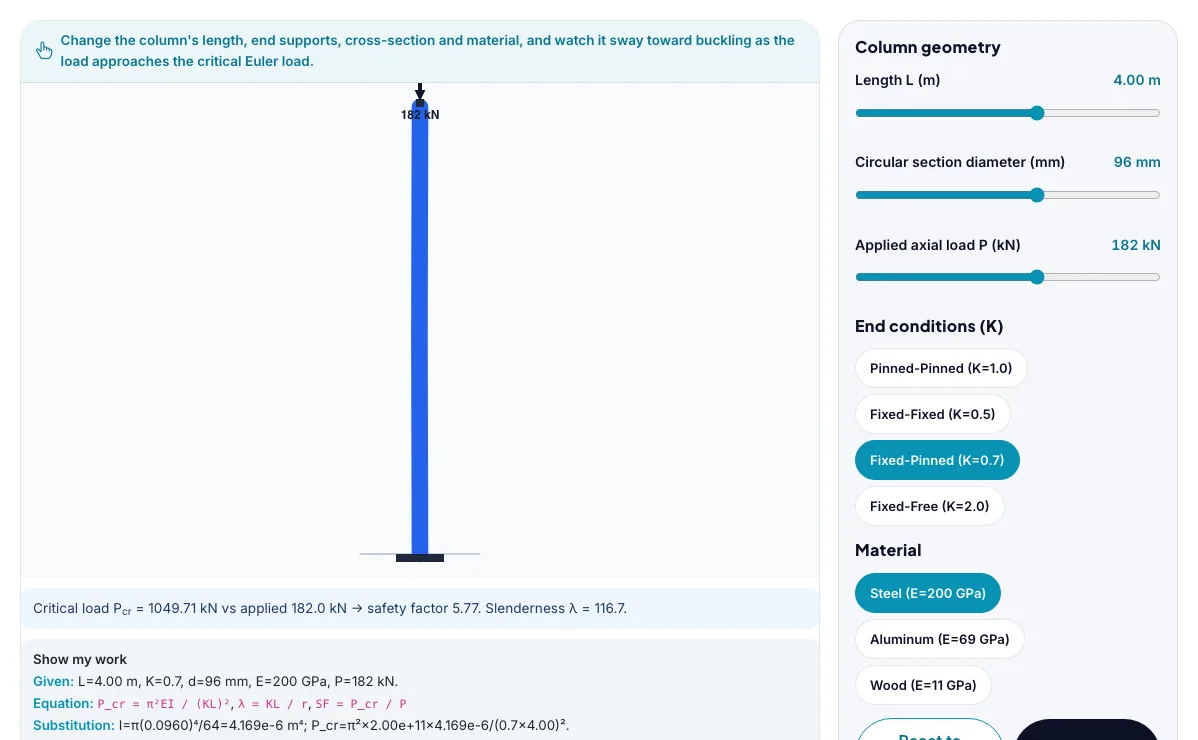
The Structural Column Buckling Lab with sample data entered and the result showing.
What is the Structural Column Buckling Lab?
Load a slender column and watch it sway toward Euler buckling as the applied load closes in on the critical load. It runs in your browser, so a change to a setting or a drag on an object shows up at once.
Engineers check Euler buckling on every slender compression member - building columns, bridge piers, aircraft struts and even bicycle frame tubes - since a member can fail by sudden sideways buckling long before the material itself would crush.
3 steps to your result
Open the tool and follow along. Nothing to install.
What you get
Euler's formula P_cr = pi^2 EI/(KL)^2 predicts the axial load at which a slender column suddenly bows sideways, far below its material's crushing strength.
The effective length factor K accounts for how the ends are held: fixed ends resist rotation and roughly quadruple the critical load compared to a free end, or double it compared to pinned ends.
The slenderness ratio lambda = KL/r measures how slender a column is; Euler's formula only applies reliably to 'long' columns above a material-dependent slenderness threshold.
Reduce the length until the safety factor climbs above 2 for a 50 kN load.
Switch from pinned-pinned to fixed-fixed and watch the critical load roughly quadruple.
Try the safety-factor-2.0 challenge.
Used for
Pick one to see how it fits.
Engineering learners
Engineering and technology students, makers, robotics clubs and teachers of design and technology.
Try it freeTeachers
For teachers: project the Structural Column Buckling Lab (Euler) on the board, let students predict the result, then run it together and test this: Switch from pinned-pinned to fixed-fixed and watch the critical load roughly quadruple. For students: change one thing at a time and write down what changes.
Try it freeHow it compares
A plain look at this tool next to the usual alternative.
| This simulation | Textbook diagram | |
|---|---|---|
| Interactive | Drag, tap and change settings | Fixed picture |
| Install | Nothing to install | Not needed |
| Cost | Free to use | Depends on the book |
Questions people ask
Why does a fixed-fixed column carry more load before buckling than a pinned-pinned column of the same length?
Fixed ends resist rotation, which forces the buckled shape into a shorter effective wavelength than the full column length; Euler's formula uses this effective length KL in place of L, and a smaller effective length (K=0.5 for fixed-fixed versus K=1.0 for pinned-pinned) gives a larger critical load.
Why does doubling the column length reduce its buckling capacity by a factor of four instead of two?
Euler's critical load is inversely proportional to length squared, P_cr = pi^2EI/(KL)^2, so doubling L multiplies the denominator by four and divides the critical load by four, not two.
Is the Structural Column Buckling Lab (Euler) free to use?
Yes. The Structural Column Buckling Lab (Euler) is free, needs no signup or download and runs in your web browser. It is part of the Engineering group of AZRS simulations.
Does the Structural Column Buckling Lab (Euler) work on a phone or tablet?
Yes. The Structural Column Buckling Lab (Euler) takes touch input as well as mouse input, so you can use its 3 adjustable settings with a finger. A larger screen makes the controls and graphs easier to read.
How do I use the Structural Column Buckling Lab?
1. In the Structural Column Buckling Lab (Euler), use the controls to change Length L (m), Circular section diameter (mm), Applied axial load P (kN). The simulation reacts instantly. 2. In the Structural Column Buckling Lab (Euler), pick an option such as Pinned-Pinned (K=1.0), Fixed-Fixed (K=0.5), Fixed-Pinned (K=0.7), Fixed-Free (K=2.0) to switch modes or load an example. 3. Start with this experiment: Reduce the length until the safety factor climbs above 2 for a 50 kN load. Drag any glowing handle, object or slider with your mouse or finger and the Structural Column Buckling Lab (Euler) responds in real time. 4. Change one setting at a time and watch which readout moves, then compare it with this idea: Euler's formula P_cr = pi^2 EI/(KL)^2 predicts the axial load at which a slender column suddenly bows sideways, far below its material's crushing strength.
More free tools
Related to the Structural Column Buckling Lab.
Try the Structural Column Buckling Lab now
Load a slender column and watch it sway toward Euler buckling as the applied load closes. Free to use.
Try it free