Towering 'sponge' dome in Brazil is the secret source of nearby hot springs
Where is it? Caldas Novas, Goiás, Brazil [ -17.788739460, -48.70589106 ] What's in the photo? A giant, sponge-like dome towering above its surroundings Which satellite took the photo? Landsat 9 Th…
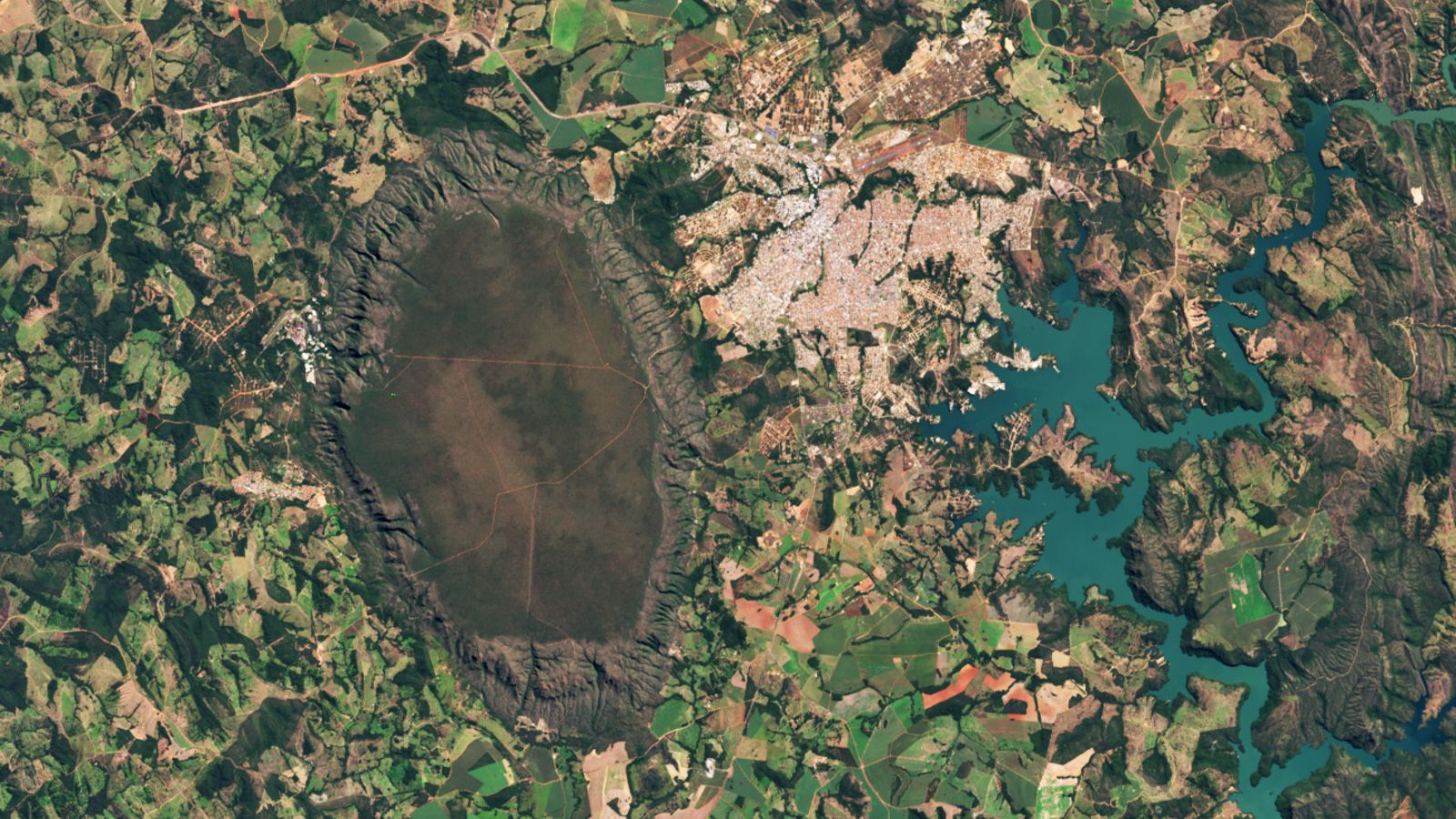
Where is it? Caldas Novas, Goiás, Brazil [ -17.788739460, -48.70589106 ]
What's in the photo? A giant, sponge-like dome towering above its surroundings
This striking satellite snap shows a giant, "sponge-like" dome towering over central Brazil. The dark monolith and the rare biome that covers it are key to the region's famed hot springs.
The imposing oval structure, which is around 12 miles (20 kilometers) long and 7 miles (12 km) across, is known as the Caldas Novas dome, or Serra de Caldas, according to NASA's Earth Observatory . It is located in southeast Goiás state and towers up to 1,000 feet (300 meters) above the surrounding landscape, although an optical illusion known as relief inversion may cause some viewers to see the raised land as a bowl-like depression.
The monolithic feature, which one 2004 study predicted could be at least 600 million years old, gets its name from the town of Caldas Novas, which is visible in the satellite image, sandwiched between the dark-green dome and Lake Corumbá, an artificial reservoir created by a nearby hydroelectric dam. The town is home to around 100,000 people but receives hundreds of thousands of visitors a year, many of whom travel there to bathe in its famous hot springs.
The dome is blanketed by savanna known as the Cerrado , which covers around a quarter of Brazil and is the second-most-abundant biome in South America, behind rainforests like the Amazon .
This biome is a tropical savanna. It is much more ecologically diverse than most savannas and is often described as a mix of woodland, grassland and wetland.
The Cerrado readily soaks up rainwater, making the dome act like a giant sponge. The collected liquid percolates through the monolith's inner structure, refilling submerged groundwater reservoirs that help feed the nearby hot springs with a regular supply of warm water, even throughout the region's dry season, according to the Earth Observatory.
Read Full Story at Live Science →