Scientists confirm vacuum birefringence affects light from magnetar.
Scientists have potentially confirmed vacuum birefringence, showing that "empty" space is influenced by magnetic fields, as observed in light from a magnetar. This discovery enhances our understandin…
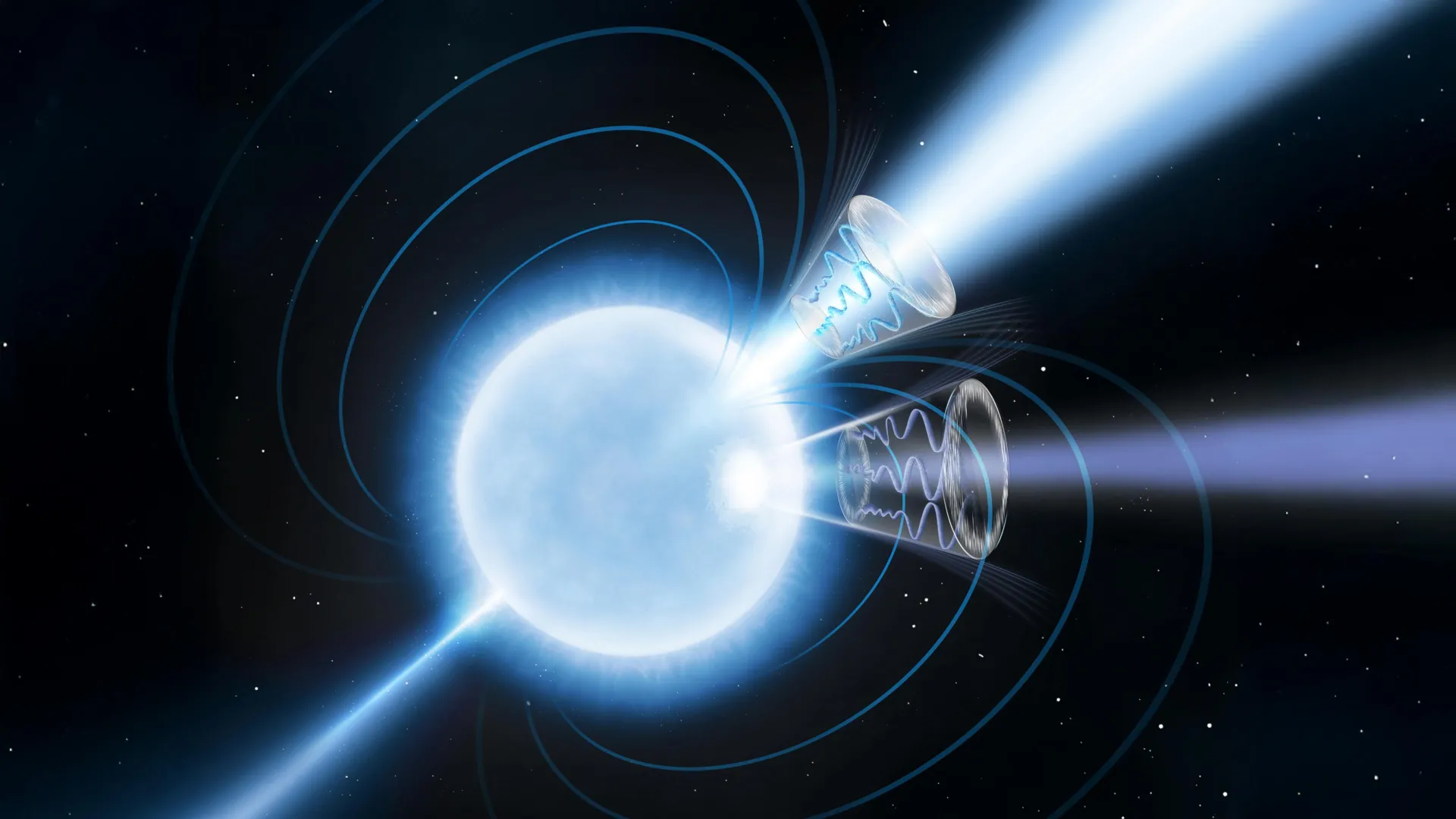
Scientists may have confirmed the existence of a quantum phenomenon known as vacuum birefringence, which suggests that "empty" space is not truly empty. This finding stems from observations of a magnetar, a type of neutron star with an extraordinarily strong magnetic field, revealing how this field can influence the behavior of light. The research, which builds on theories proposed by physicist Werner Heisenberg nearly 90 years ago, was published in a recent study and represents a significant step in understanding the complexities of quantum physics.
Vacuum birefringence occurs when light passing through a vacuum is affected by an external magnetic field, causing it to behave differently than expected. Heisenberg's theories about the quantum vacuum suggested that even in a vacuum, particles and antiparticles can briefly pop in and out of existence, leading to changes in the properties of light. This discovery is particularly timely as scientists are increasingly looking for ways to bridge quantum mechanics and general relativity, two foundational pillars of modern physics that have yet to be reconciled.
In their research, scientists observed the light emitted from a magnetar and noted variations in its polarization, which they attributed to the influence of the magnetar's magnetic field on the vacuum. This finding could provide the first direct evidence of vacuum birefringence, a phenomenon that has been predicted but not conclusively demonstrated. The implications of this research are profound, as it could lead to a deeper understanding of the universe's underlying structure and the forces at play within it.
Moving forward, researchers aim to replicate these findings and explore the implications of vacuum birefringence further. This could open new avenues for research in quantum physics, astrophysics, and even technology, such as quantum computing and communication. By exploring the properties of the quantum vacuum, scientists hope to uncover new insights that could reshape our understanding of the cosmos and the fundamental laws that govern it.
Read Full Story at ScienceDaily →