An Ichthyosaur’s terrible, horrible, no good, very bad day 160 million years ago
An Ichthyosaur’s terrible, horrible, no good, very bad day 160 million years ago A rare fossil find shows a tooth embedded an ichthyosaur’s vertebra, where it was likely left when a giant pliosaurid…
An Ichthyosaur’s terrible, horrible, no good, very bad day 160 million years ago
A rare fossil find shows a tooth embedded an ichthyosaur’s vertebra, where it was likely left when a giant pliosaurid chomped down on this dolphin-resembling reptile
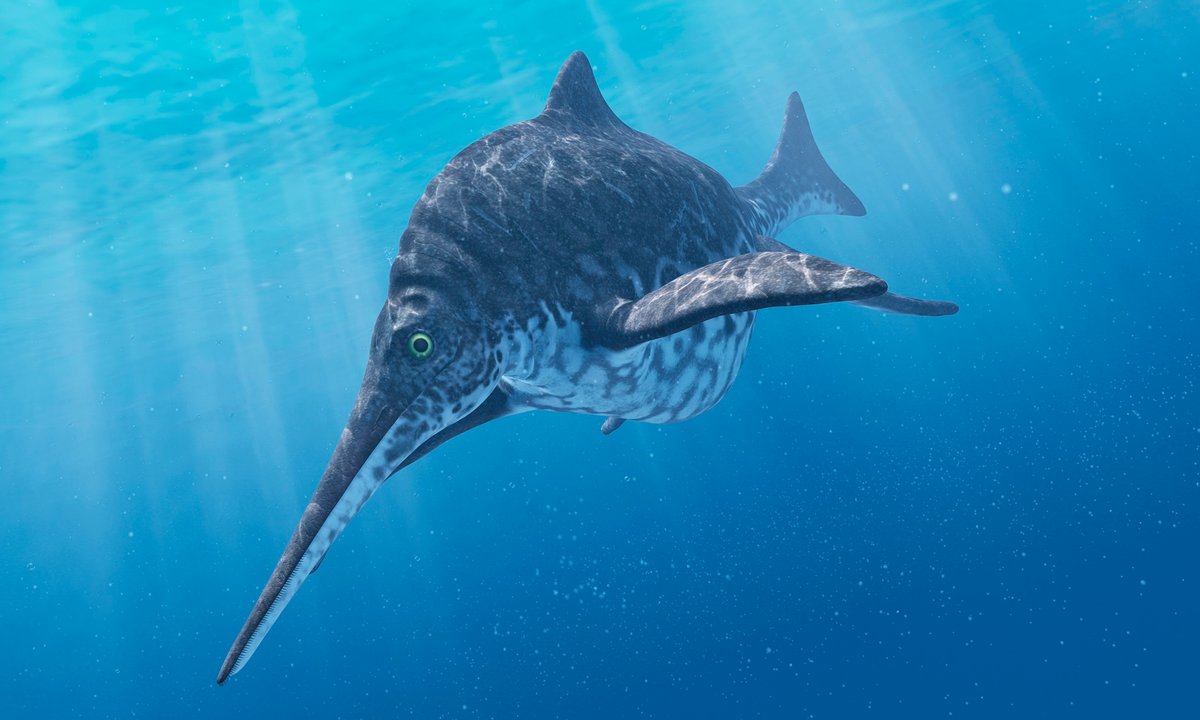
Off the coast of what is now Peterborough, England, an ichthyosaur—a prehistoric marine reptile that resembled an oversize dolphin—was presumably going about its business, looking for fish and ammonites to eat, when it had a very unlucky day indeed. Another ancient marine reptile known as a pliosaurid—which was three times the ichthyosaur’s size and had a head as big as an adult human body—took a giant bite out of the smaller creature’s spine that likely led to its demise.
It has long been thought that pliosaurids and their cousins, the long-necked plesiosaurs, were apex predators that fed on smaller (but still enormous) creatures such as ichthyosaurs, marine crocodiles and giant bonefish. But an ichthyosaur vertebra punctured by a broken-off pliosaurid tooth that was found moldering in a museum drawer has provided rare physical proof.
It forever fossilizes a very violent moment in the prehistoric circle of life, showing how these ancient sea monsters lived. “This simple, unassuming lump of rock that we found in an abandoned museum drawer provides a snapshot of a moment in time where one ancient sea monster is attacking another,” says Caleb Gordon , a postdoctoral researcher at the Florida Museum of Natural History in Gainesville and lead author of a recent Bulletin of the Peabody Museum of Natural History study describing the find.
If you're enjoying this article, consider supporting our award-winning journalism by subscribing . By purchasing a subscription you are helping to ensure the future of impactful stories about the discoveries and ideas shaping our world today.
Since the tooth of the pliosaurid was embedded in bone, researchers used computed tomography (CT) scans and a technique that stacks high-magnification images on top of one another to analyze the serrated edges and shape of the tooth to confirm that it came from a pliosaurid. The researchers say that the way the fossil was preserved means that the tooth was more likely to have been ripped off in a moment of predation because there aren’t visible signs of acidification on the vertebra to hint that it went through a predator’s stomach and was scavenged by another predator afterward.
The team also pored through unpublished handwritten correspondence between two prolific Victorian fossil collectors, Nicholson Leeds and Othniel Charles Marsh, as well as a centuries-old Yale Peabody Museum ledger to uncover the English provenance of the specimen, which is thought to date to the Upper Jurassic epoch, spanning between 163 million and 145 million years ago.
Read Full Story at Scientific American →